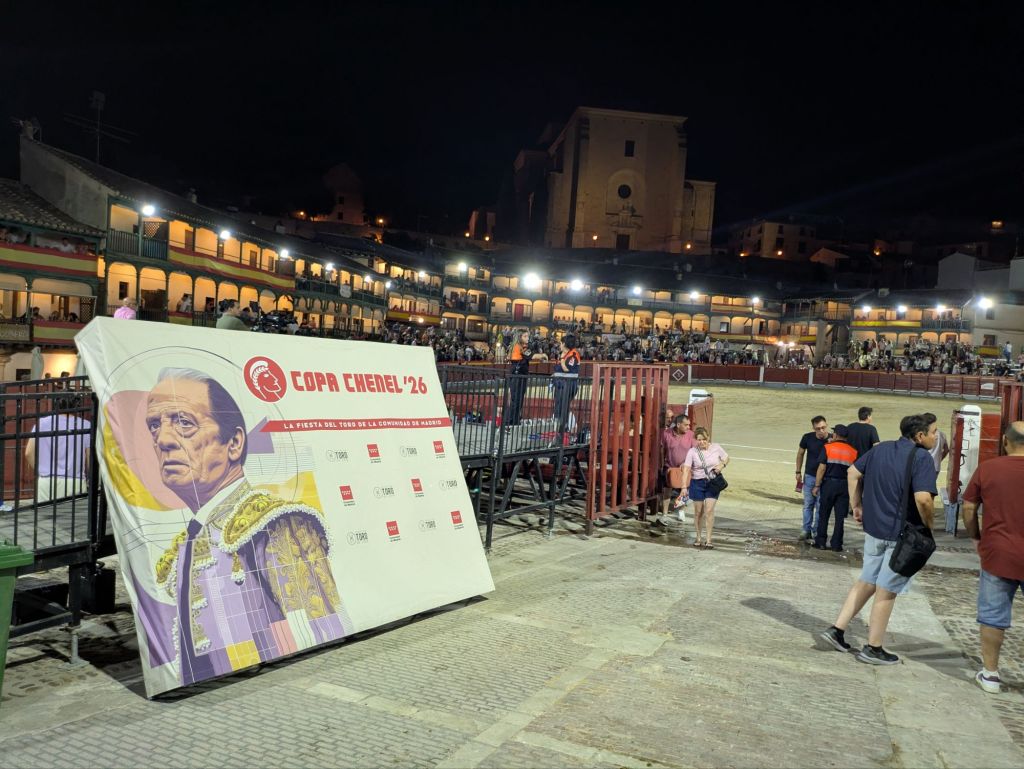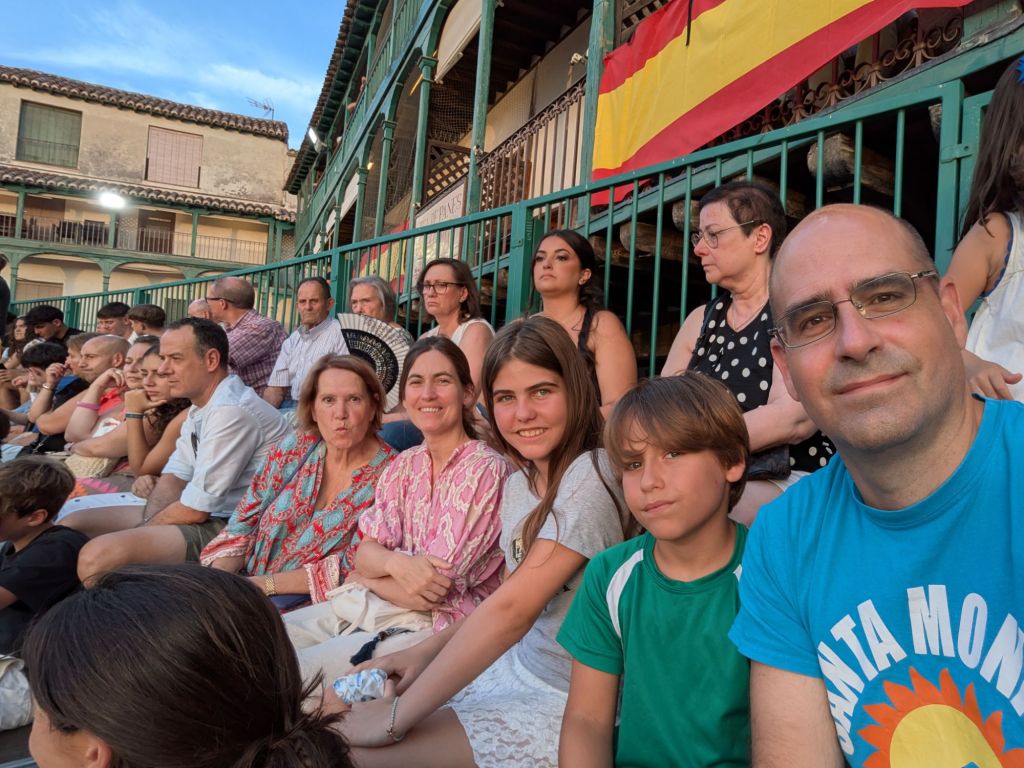
Chinchón es un pueblo del sureste de la Comunidad de Madrid con unos 5.800 habitantes, cuyo centro histórico está declarado Bien de Interés Cultural y es principalmente conocido por su Plaza Mayor, con sus famosos soportales y balcones del siglo XV. En la plaza se celebran todo tipo de actos, como teatro o corridas de toros.
Plaza Mayor de Chinchón
El pasado 11 de julio se celebró en Chinchón la primera semifinal de la Copa Chenel 2026.
La Copa Chenel lleva el nombre del torero Antonio Chenel Albaladejo, Antoñete (1932 – 2011). Antoñete fue un torero clásico distinguido por su elegancia y pureza con el capote y la muleta. Se retiró en 2001 con casi setenta años y murió a los 79. Recibió a título póstumo la Gran Cruz de la Orden del Dos de Mayo. La copa que lleva su nombre tiene como objetivo promover el toreo en la Comunidad de Madrid y dar oportunidades a toreros de la región.
Copa Chenel
Aprovechamos la ocasión para ir a los toros por primera vez con los niños (quienes ya habían estado en un concurso de recortes) y con mi madre, además de con Luca, que ya había ido conmigo hace muchos años.
Toros en familia
Los toreros en aquella corrida fueron Javier Cortés, Héctor Gutiérrez y Alejandro Chicharro, que lidiaron toros de José Cruz y Peñajara. Hubo un lleno total.
La actuación según recoge la web oficial de la Copa fue:
Javier Cortés, ovación y oreja.
Héctor Gutiérrez, silencio y silencio tras aviso.
Alejandro Chicharro, ovación tras aviso y vuelta al ruedo.
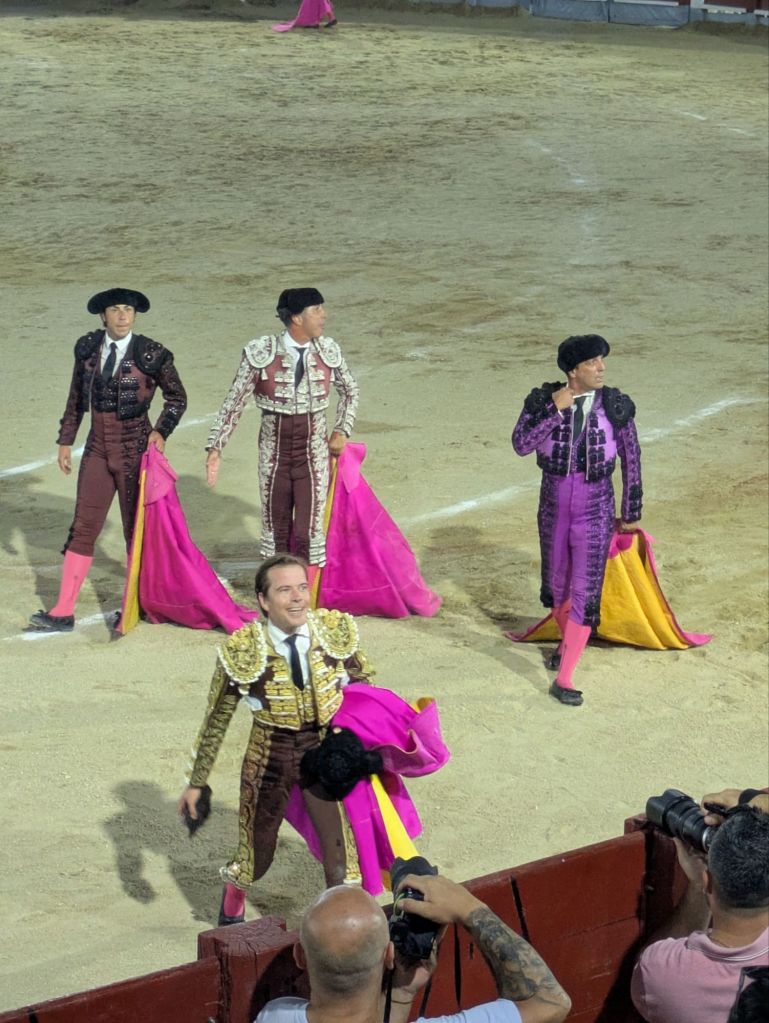
Sólo Javier Cortés pudo cortar una oreja al cuarto toro. La corrida en general fue discreta. Otro hecho a reseñar fue que el quinto toro tuvo que ser devuelto por un problema con el pitón derecho.
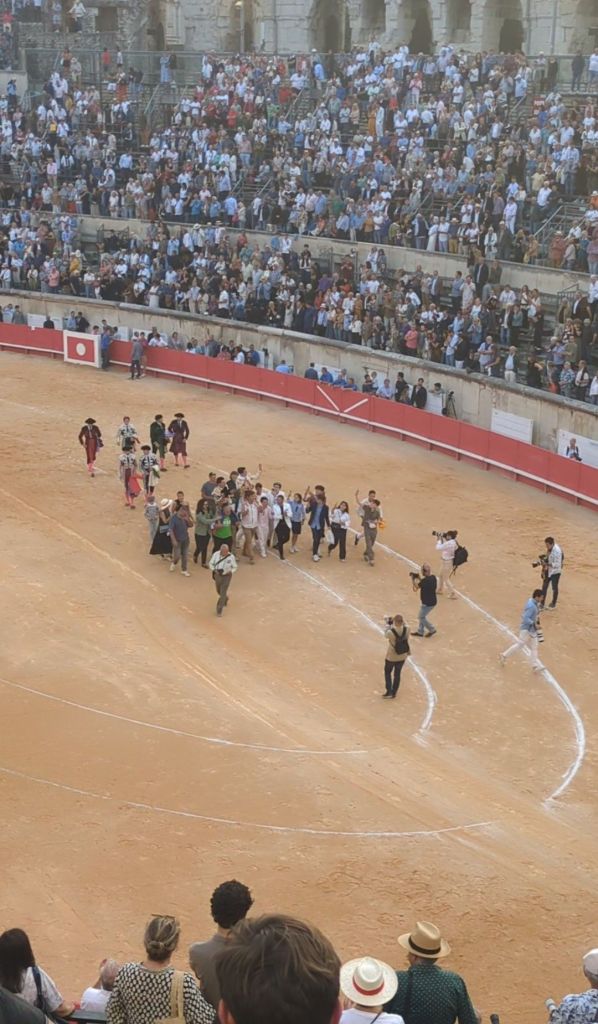
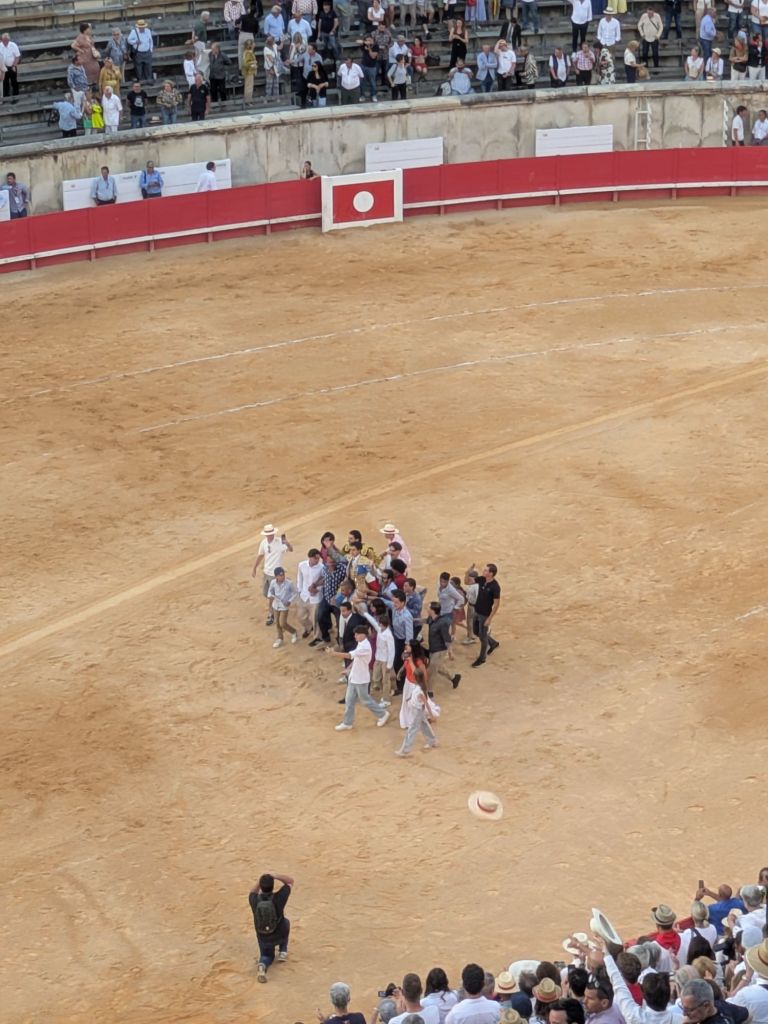
Javier Cortés celebrando la oreja obtenida con el cuarto toro
A toda la familia le gustó bastante la experiencia y sirvió para comentar y explicar muchos aspectos de la tauromaquia.
Tras la corrida de ese fin de semana los tres toreros participaron en la semifinal a seis donde cada uno de ellos lidió otro toro. Con base en las puntuaciones obtenidas en las semifinales, tres toreros se clasificaron para la final en la plaza de Las Ventas. Éstos fueron Alejandro Marcos, Héctor Gutiérrez y Manuel Diosleguarde (solo Hector toreó en Chinchón, los otros dos torearon en la otra seminal, en Valdetorres de Jarama). El ganador de la copa (en la que participaron 18 toreros) fue Héctor Gutiérrez.
We first learned about this year’s total solar eclipse from our son David who had discussed it in class last year (grade 4, 10 years old). Since then we made the point of going somewhere in Spain to watch it.
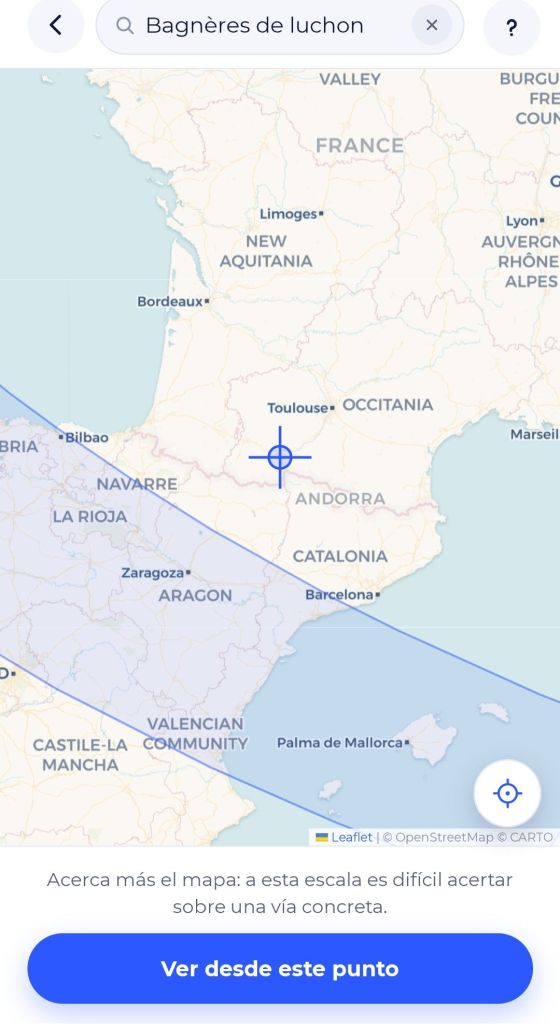
For medical reasons, we had to spend three weeks in Bagnères de Luchon at the end of July to mid August this summer, so we had to pick a spot to watch the eclipse that allowed us to drive to and from within a day. Thanks to the website Mirador del eclipse, which I came across in X/Twitter, we decided to go somewhere in Aragón. If we watched it from Zaragoza or somewhere South from it we would be able to have about 80-90 seconds of total eclipse, 100%, meaning we could watch it with the naked eye (even though we had bought glasses for the eclipse over a month ago, from the optician in our village).
“Mirador del eclipse”, selecting the location
I then made a quick query to Grok, X/Twitter artificial intelligence assistance, asking it to give me suggestions for elevated points from which you watch the eclipse sounds villages South of Zaragoza. We then selected Cadrete. In that village there is a castle on a hill which was our initial selected spot. But while driving there we saw that some cars were driving further up towards the Mirador de las Planas (a view point) so there we went.
Checking the view from Cadrete ahead of the eclipse.
We arrived at the spot at 19h30, just 3-4 minutes ahead of the start of the eclipse. We were equipped with glasses, water and chips to enjoy the next hour. And so we did.
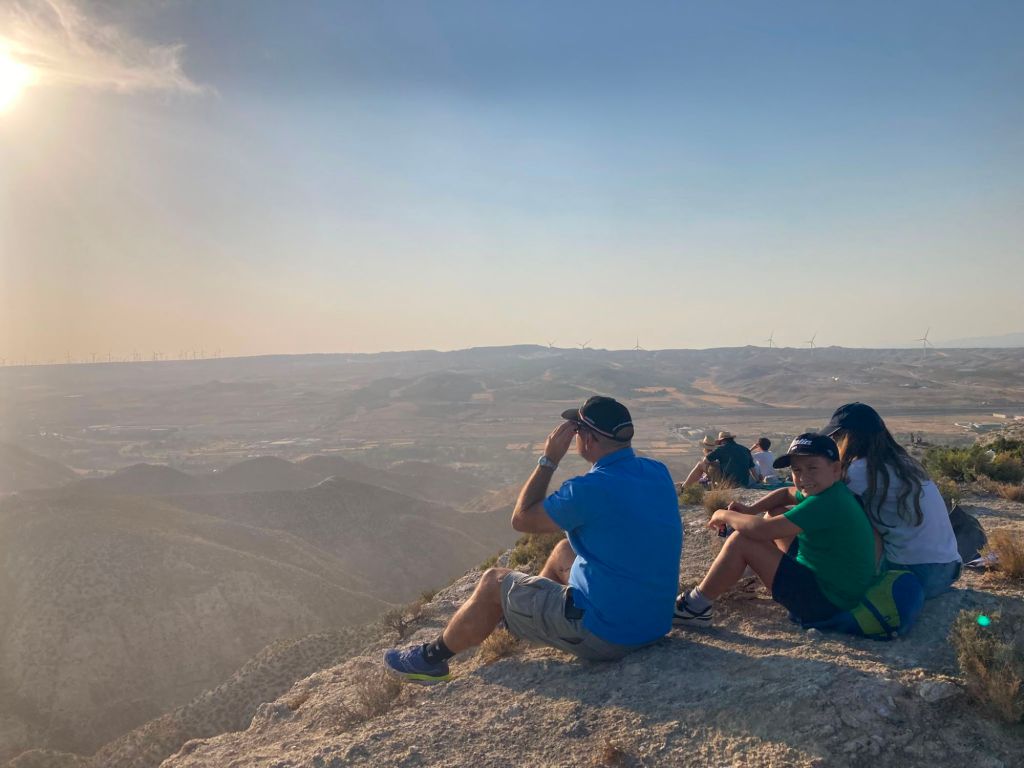
I share below some of the pictures we took with our smartphones, no professional photographer gear, hence nothing close to what you may have seen already in social media.
Mirador de Las Planas, Cadrete Watching the eclipse (before the total eclipse)Watching the total eclipse with the naked eyeTotal eclipseTotal eclipse from Mirador de Las Planas
As you may have lived or read, watching the total eclipse with the naked eye for those 80+ seconds was a breathtaking experience. Totally worth it
Finally, as you may have already read, next year, on August 2nd 2027, there will be another total solar eclipse going through Spain, this time across the South (Cádiz, Málaga) which will last longer (over 4 minutes of total eclipse).
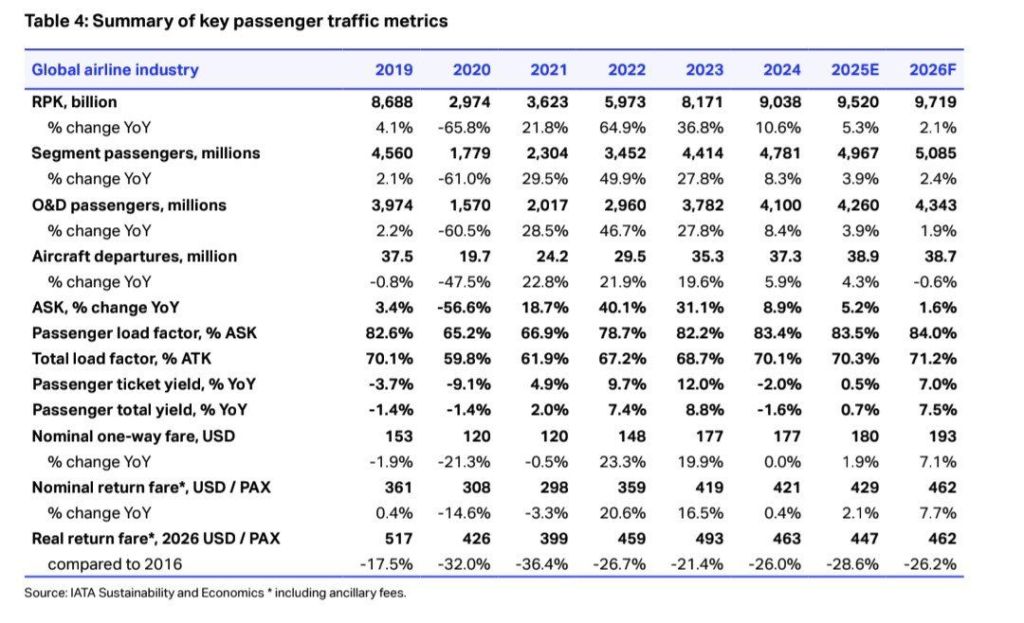
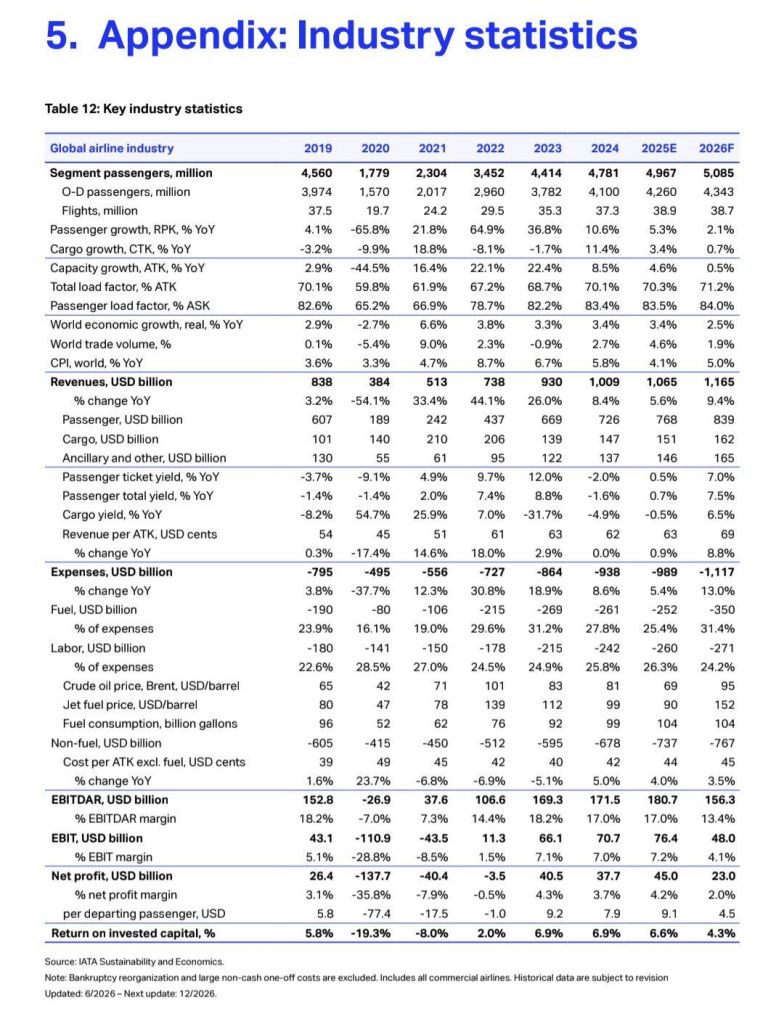
The year 2025 was the best ever in terms of consolidated economics results for the air transportation industry according to IATA (International Air Transport Association). Last June 2026 they presented their report “Global Outlook for Air Transport” which is released every six months.
Some key figures to retain:
38.9 million flights in 2025
9,520 billion RPK (revenue passenger kilometre)
4,966 million passenger-segments
1,065 bn$ revenues
45.0bn$ net profit
See the charts they published with the complete figures:
IATA summary of key passenger traffic metrics, June 2026IATA Industry statistics, June 2026IATA Global airline EBIT evolution, June 2026
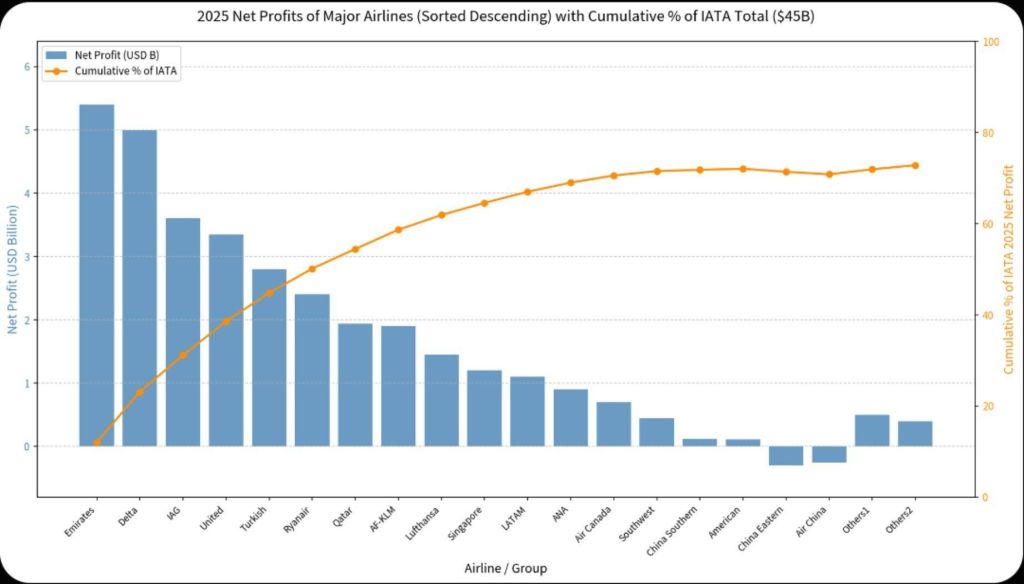
Recently I read about the results of some major airlines and wondered what proportion of the consolidated results shown by IATA come from the top 20 airlines.
IATA represents over 370 airlines which account for ~85% of the global traffic. For their reports, IATA extrapolates the figures to cover for the non members to produce figures of the overall industry.
The top 20 airlines make up for ~5% of the airlines however they achieve ~70% of the cumulative 2025 net profits, according to the chart below I asked Grok to compute.
The expression “crossing the Rubicon” means passing a point of no return. It relates to the crossing of the river Rubicon by Julius Caesar in January (~10th) 49 BC. During last summer holidays in Italy we reenacted that crossing.
The crossing of the Rubicon by Caesar is described by Suetonius in his book “The lives of the Caesars” (we have at home a recent translation by the historian Tom Holland).
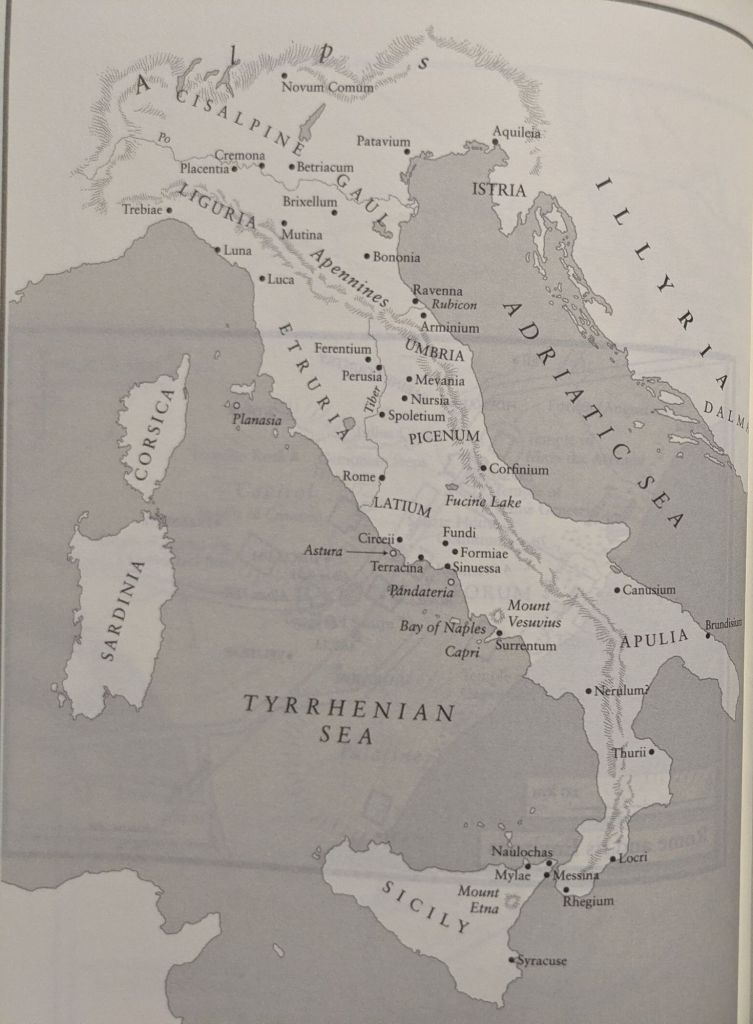
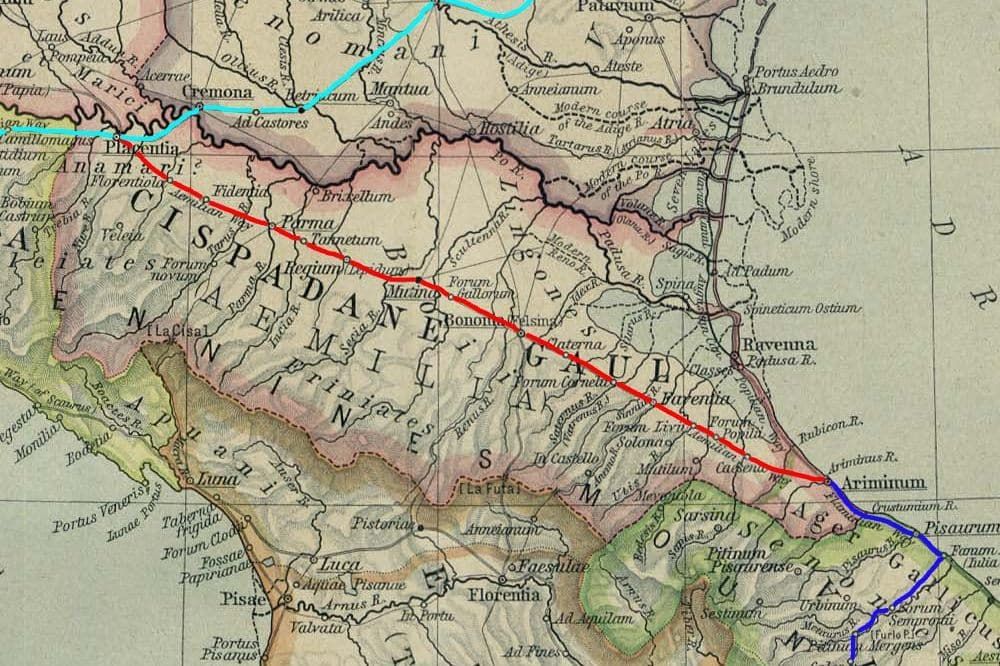
Map of Italy
In the map, the river Rubicon can be seen South of Ravenna, flowing to the Adriatic sea. The river later was called Fiumicino until the 20th century when the name changed back to Rubicon.
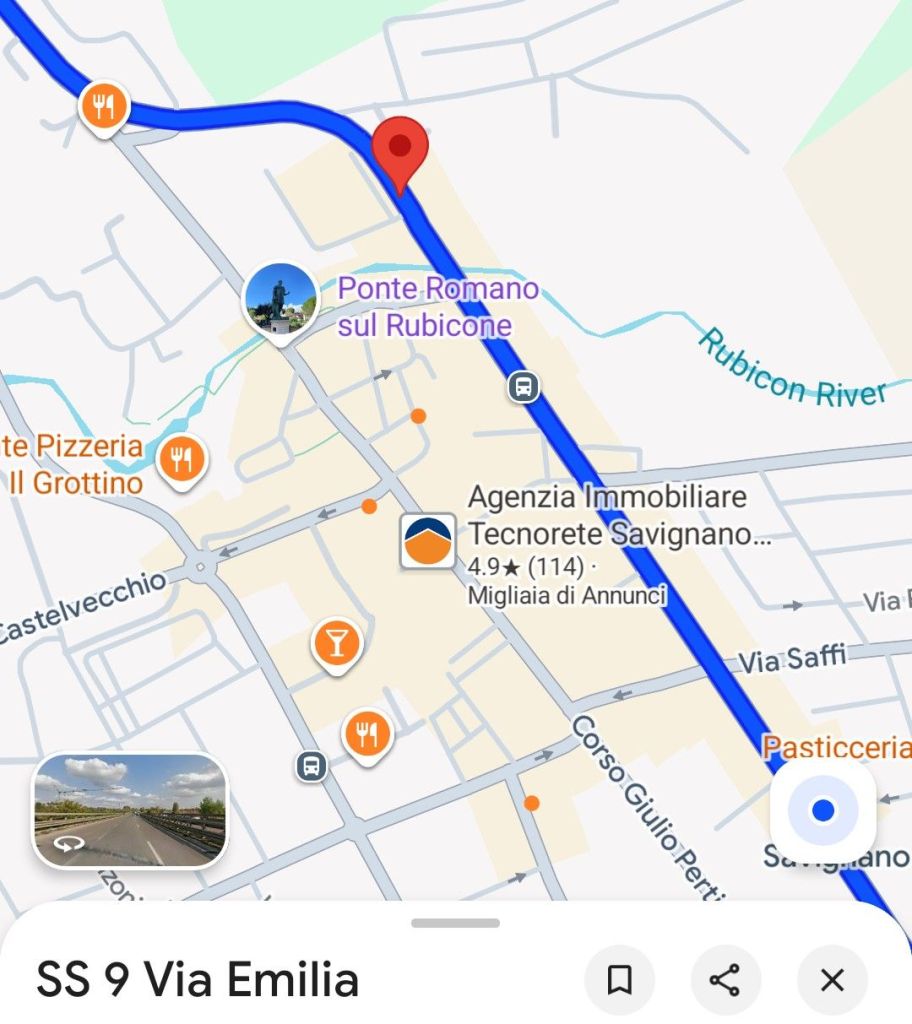
The course of the river is not the same as it was two thousand years ago and the exact location of the crossing is not surely known, though the more credible location is in the village which today is known as Savignano sul Rubicone. The former Roman road Via Emilia connected Bologna with Rimini, and the path is more or less preserved in the SS9 road, which crosses the Rubicon river in Savignano.
Via Emilia
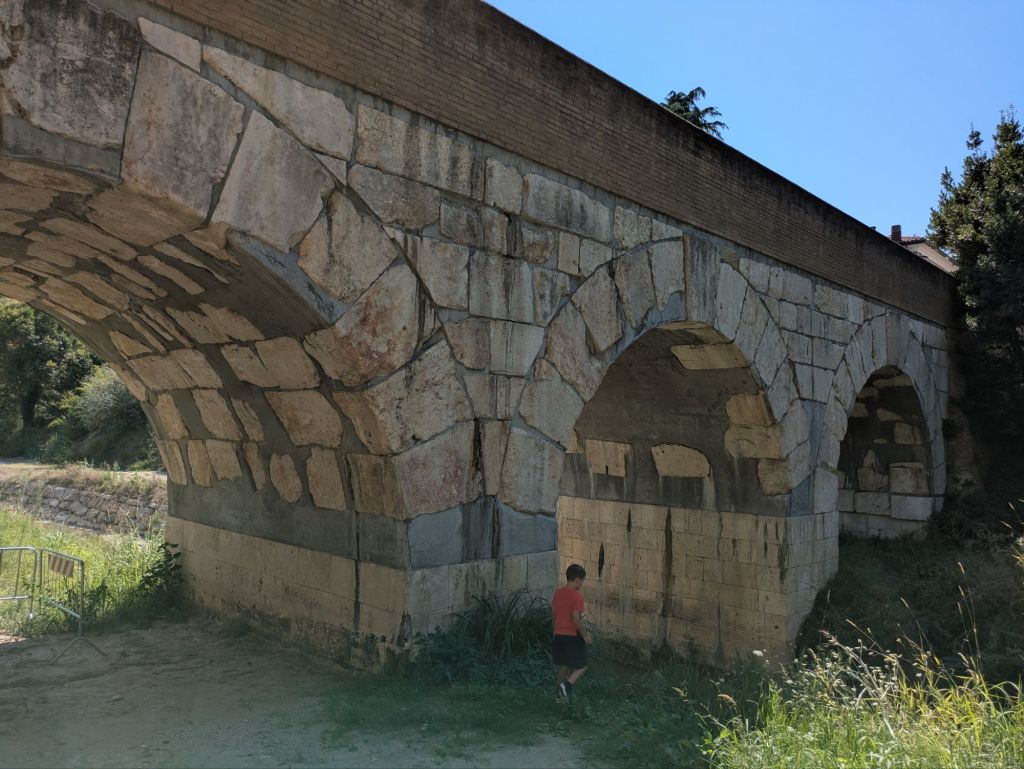
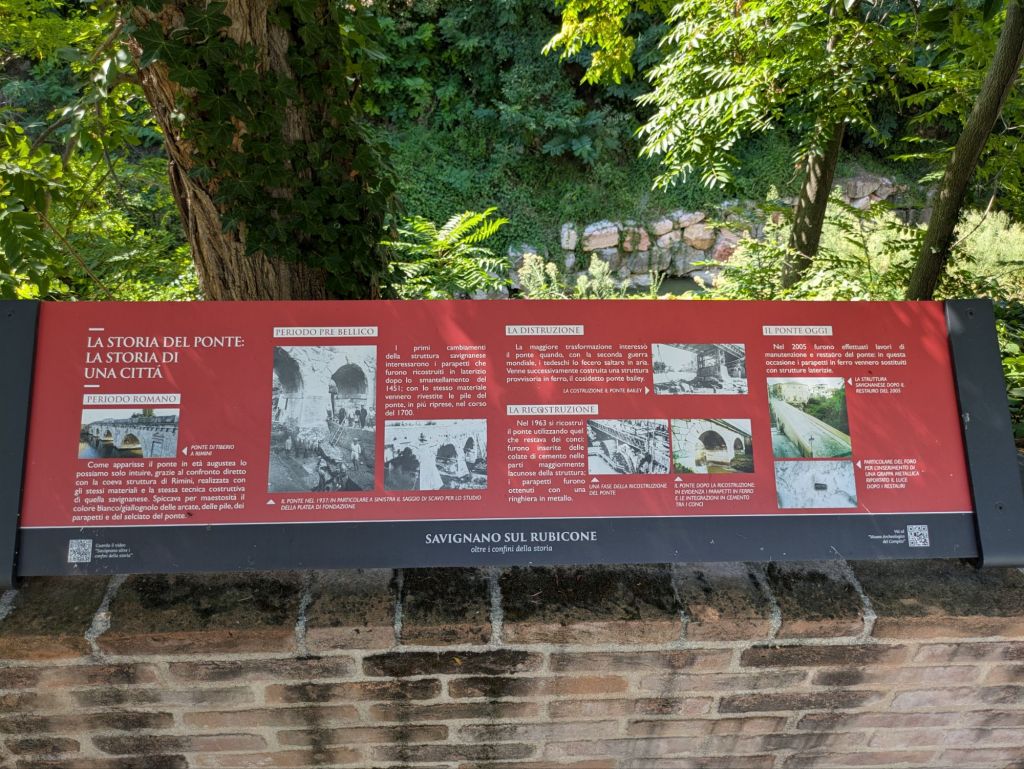
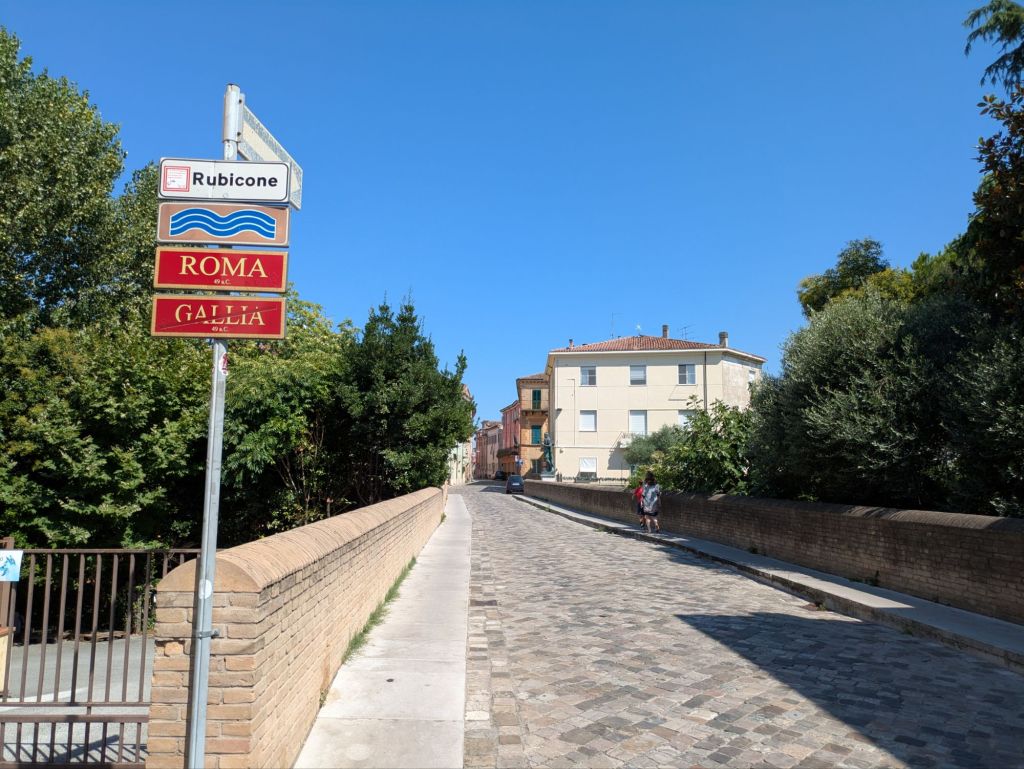
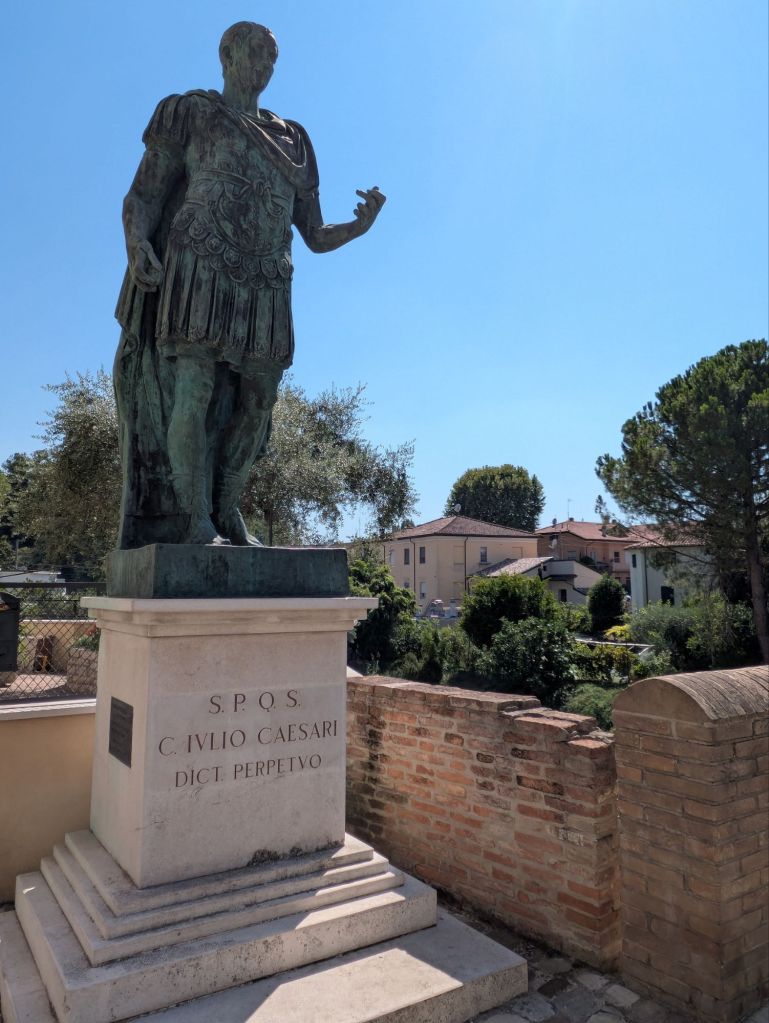
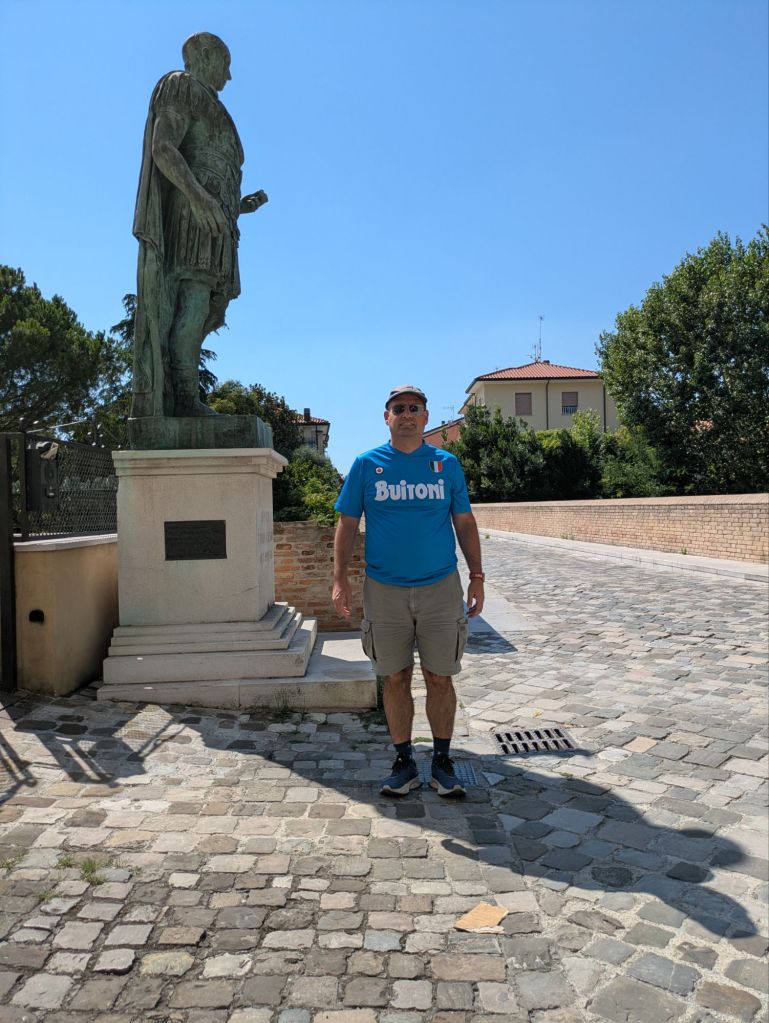
In the path of the former Via Emilia across the river there is a Roman bridge (which has gone through several renovations) where a statue of Julius Caesar is located.
Roman bridge over the RubiconThe bridge over the Rubicon marking the border between Roma and Gallia (Cisalpine Gaul)“Senatus Populusque Senensis (“The Senate and People of Siena”) / Gaius Julius Caesar / Perpetual Dictator”After crossing the Rubicon
I leave below some excerpts from Suetonius describing the events:
[…] he wrote letters to the senate, pleading with them not to deprive him of the special privilege granted him by the people; either that, or the senate should oblige other generals as well to divest themselves of their armies (he proposed this because he took for granted – or so it is thought – that he would find it easier to summon his veterans when the need arose than Pompey would to summon his raw recruits). Even as he was offering to disband eight of his legions and the command of Gaul north of the Alps, however, he demanded it as a condition from his enemies that he keep two legions and the province of Cisalpine Gaul, or else one legion and Illyria, until such time as he had become consul.
[30] When, however, the senate refused to engage with this proposal, and his enemies declared that they would never haggle over the security of the republic, he crossed into Nearer Gaul; there, after a circuit of the local courts, he made his base in Ravenna, with the intention of pressing his claim by armed force should the senate launch a crackdown on the tribunes of the plebs who were championing his cause. Such, at any rate, was the pretext he gave for civil war; but others think he had different motives. Gnaeus Pompey frequently used to say of him that because, as a private citizen, his income would be insufficient to complete the projects he had embarked upon, and to satisfy the expectations which the prospect of his return had aroused among the people, his goal was upheaval and chaos. Others say that he dreaded being compelled to give an account of all the auspices he had ignored, all the laws he had broken and all the tribunician vetoes he had flouted during his consulship – for Marcus Cato had repeatedly declared, and on oath too, that he would impeach him the moment he disbanded his army, and it was popularly anticipated that, should he return as a private citizen, then he would be obliged to answer the charges against him just as Milo had done, amid a ring of armed men. Evidence for this is provided by Asinius Pollio, who records that, as he gazed at the corpses of his enemies where they lay strewn across the battlefield of Pharsalus, he uttered these words: ‘They were the ones who wanted this – for not all my great achievements would have prevented them from finding me, Gaius Caesar, guilty, had I not had my army to turn to for backing.’ Some think he was so seduced by the habit of command that, after weighing up his own strength against that of his enemies, he seized the opportunity to grasp after the absolute power that he had been craving since the earliest years. This, it seems, was the opinion of Cicero, who writes in the third book of On Duties that two lines from Euripides were forever on Caesar’s lips (the translation is Cicero’s own):
For if the law must be broken, then let it be broken with the aim of winning a throne. Otherwise, show the law respect.
[31] So it was, the moment news reached him that the tribunes’ veto had been overridden and the tribunes themselves had fled the city, he ordered his cohorts to advance, but under cover, so as not to rouse suspicion; meanwhile, keeping his own intentions disguised, he attended a public festival, inspected the plans for a gladiator school which he was planning to have built, and hosted a well-attended dinner party, as he invariably did. Then, after the sun had set, and mules taken from a nearby mill had been harnessed to his carriage, he set out in the utmost secrecy, with only a modest retinue as company; for a while – because his torches had gone out, and he had lost his way – he blundered about, until, as the sky began to lighten, he located a guide, who led him on foot to where he needed to be; catching up with his cohorts on the banks of the Rubicon, the river which marked the frontier of his province, he paused for a while, revolving in his mind the sheer enormity of what he was contemplating, before turning to those nearest to him and saying: ‘Even now we could turn back. But once we have crossed that tiny bridge, everything will have to be decided by war.’
[32] Then, as he was hesitating, a wondrous thing happened: nearby him, a figure of remarkable size and beauty abruptly appeared, sitting and playing on a pipe; and when some of his soldiers – trumpeters and shepherds who had run to listen to the music, the apparition snatched the advance with a mighty blast, and crossed over to the far bank. Then Caesar spoke. ‘Let us go where we are summoned both by divinely authored signs and by the wrongs our foes have done us. The die is cast.’³⁹
[33] And so his army crossed the Rubicon; and he welcomed the tribunes who, following their expulsion from Rome, had come to join him, summoned the soldiers to an assembly, and then, weeping and tearing the garments from his breast, called on them to pledge him their loyalty. Some have thought that he went so far as to promise each and every one of them equestrian status – but this is incorrect. What actually happened is that, while he was giving his rallying cry to the troops, he would point again and again to a finger on his left hand, insisting that he would gladly tear the ring from it if only it would provide to those who were backing him in defence of his honour commensurate reward; but because those on the margins of the assembly – who could see him better than they could hear him – based their understanding of what he was saying on his gestures rather than on his words, the story spread that he had promised them all the right to an equestrian ring, plus 400,000 sesterces each.
[34] Here, in the order they happened, are the most significant things he went on to do. He seized Picenum, Umbria and Etruria; he defeated and then set free Lucius Domitius, the man who, on the outbreak of civil war, had been named his successor and had garrisoned Corfinium against him; he advanced along the Adriatic coast to Brundisium, which had been serving the consuls and Pompey as their bolthole, and from where they were planning to cross to Greece. Then, after the failure of all his various stratagems to block their escape, he made his way back to Rome and summoned the senate to discuss affairs of state, before heading for Spain, where he moved against three of Pompey’s legates (Marcus Petreius, Lucius Afranius and Marcus Varro), who between them commanded a formidable army. ‘First,’ as he had put it to his friends before setting out, ‘we will target the army without a general – and then, on our return, the general without an army.’ Sure enough, although he was delayed by having to lay siege to Massilia when the city closed its gates against him, and by a serious shortage of grain supplies, it did not take him long to bring everywhere under his control.
[35] From Spain he returned to Rome, then crossed to Macedonia, where he blockaded Pompey for almost four months behind massive siege works, before eventually defeating him in battle at Pharsalus and pursuing his fugitive rival to Alexandria…
[Note 39: In Latin, iacta alea est. According to Plutarch, in his life of Pompey, the phrase was ‘Let the die be cast’ (anerrhiphtho kybos): a quotation in Greek from the comic playwright Menander. Some editions of Suetonius, following this, accordingly amend Caesar’s famous saying to iacta alea esto.]
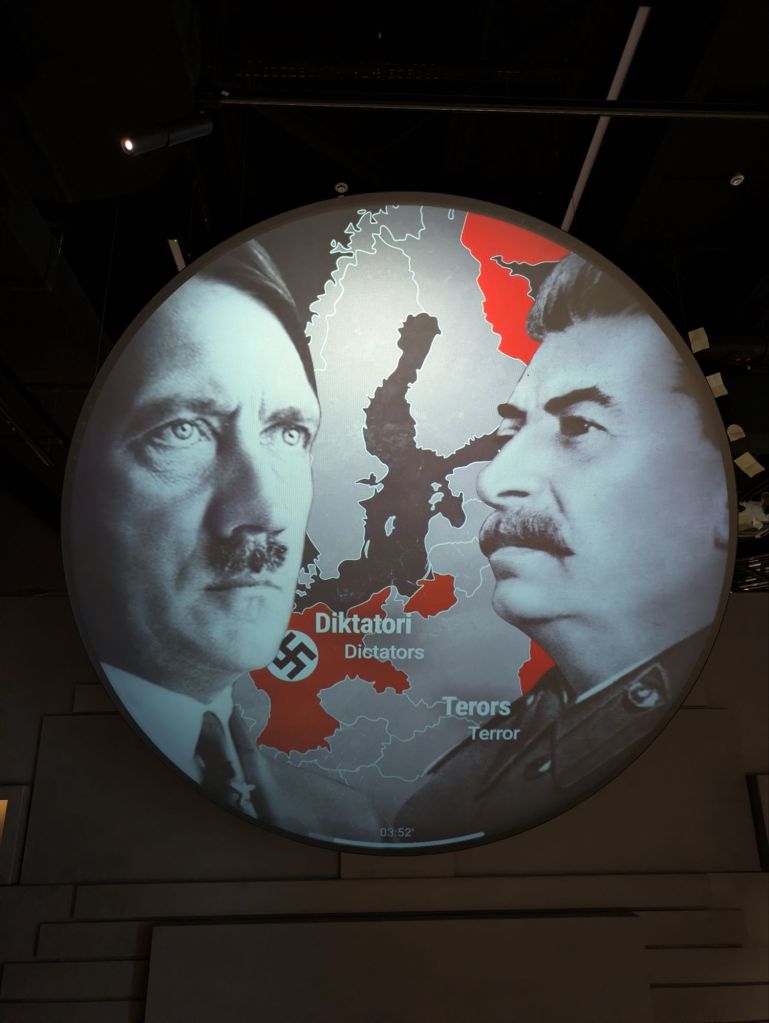
Last month I visited Riga and took the opportunity to visit The Museum of the Occupation of Latvia. The museum tells the story of the Latvian nation and Latvian state that it founded, as the German and Russian empires collapsed at the end of the First World War. A key message of the museum is to raise awareness of the conspiracybetween Communist Soviet Union and Nazi Germany:
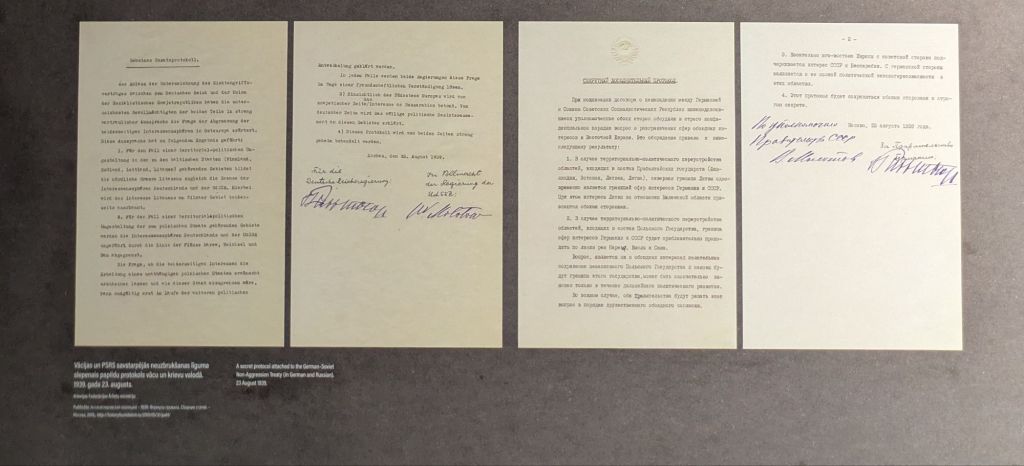
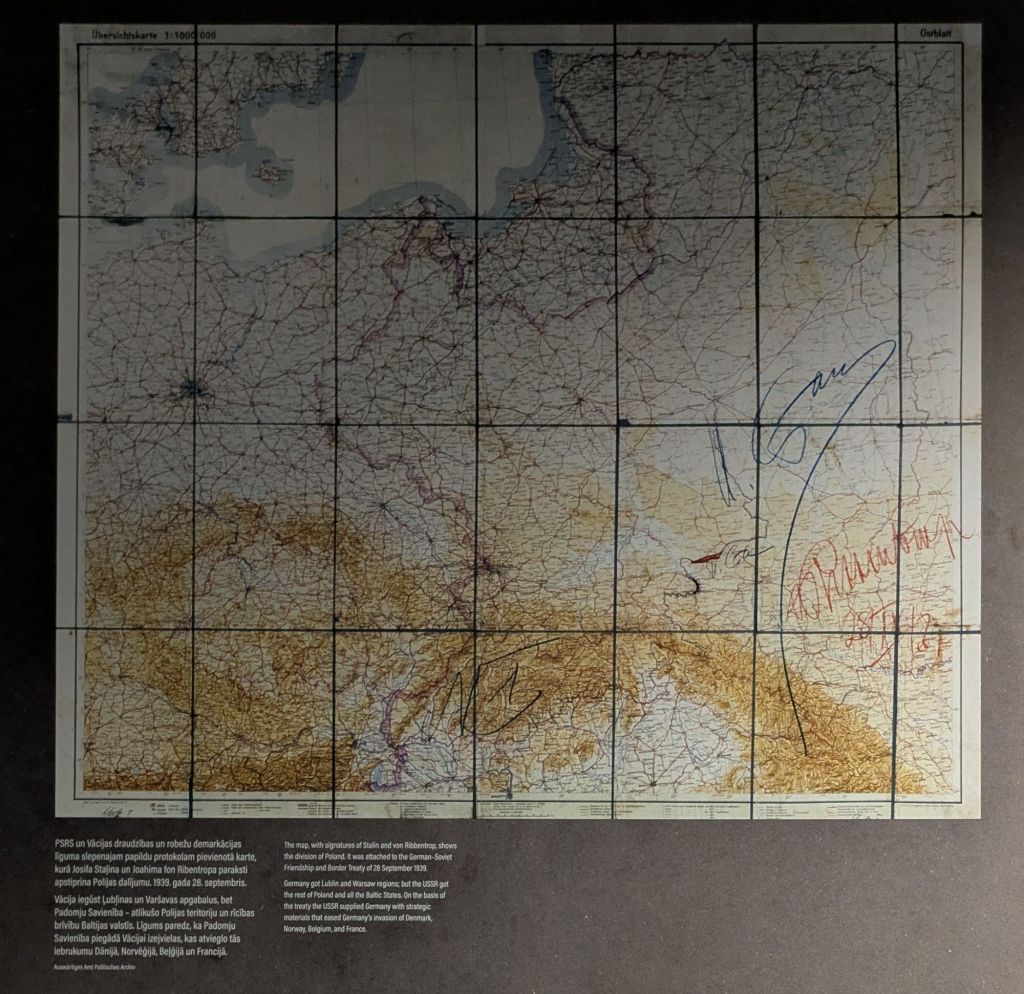
On 23 August 1939, the Soviet Union and Nazi Germany conclude a mutual non-aggression treaty. It is signed by the People’s Commissioner for Foreign Affairs of the Soviet Union Vyacheslav Molotov and German Minister for Foreign Affairs Joachim von Ribbentrop. Its secret protocols divide the eastern part of Europe into German and Soviet spheres of influence and pave the way for the Second World War.
The Soviet Union and Germany collaboration lasts for almost two years. In September of 1939, they occupy and divide Poland. The Soviet Union demands the Baltic States and Finland to sign “mutual assistance” treaties that establish Red Army bases on their territories. Finland refuses to comply; on 30 November, it is attacked by the Soviet Union. The Baltic States sign the imposed treaties.
Thus from October 1939 to September 1998 foreign troops – alternately Soviet Union, German, Russian forces – are stationed in Latvia. For 50 years, the Soviet Union denies the existence of the secret protocols. Modern day Russia continues to justify them as a necessity dictated by the historical situation.
Protocol attached to the non-aggression pact between Nazi Germany and the Soviet Union.Map with the division of Poland
The museum is arranged chronologically and even though it’s not very big, there’s plenty of material to read and watch. I could spend only about two hours in it, as I had a flight to catch.
Organization of the museum:
Creation of an independent Latvia (1918–1940)
Conspiracy. The Hitler-Stalin Pact (1939)
First Soviet Occupation (1940–1941)
Soviet Mass Deportations of 1941 and 1949
Nazi German Occupation, Holocaust (1941–1944/1945)
Resistance against the Soviet Totalitarian Rule (1944/1945–1991)
Gulag – Descent Into Hell. Incarceration and Forced Resettlement (1940–1988)
A Renewed State. Rebuilding Latvia
In Western Europe we have many museums and war memorials to remind ourselves of the totalitarianism from the Nazis, not so many from the totalitarianism from Communism which still enjoys sympathy in some circles, that’s why it’s interesting to visit this kind of museum in countries that suffered from it. I will include some pictures and transcriptions of different panels from the museum to illustrate it.
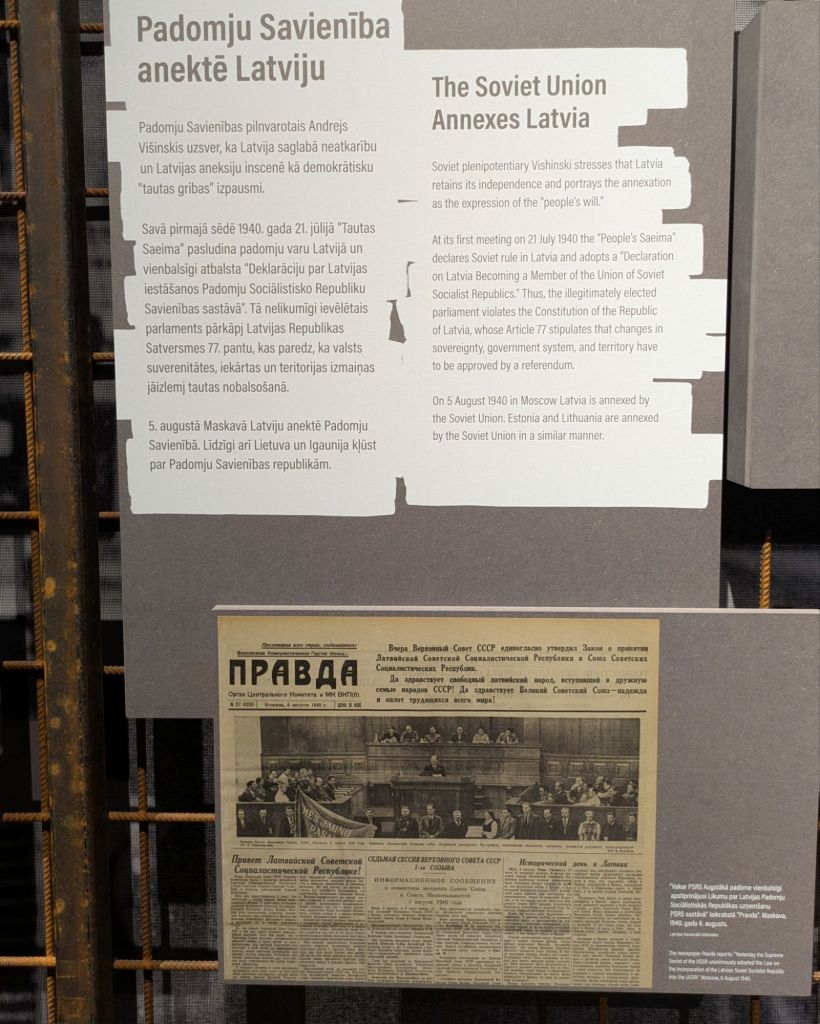
The Soviet Union annexes Latvia as the expression of the “people’s will”. Front page of the newspaper Pravda.
Soviet security operatives arrive from Moscow in June as Soviet rule is instituted in Latvia. They are charged with the liquidation of real and imagined opposition, intimidation of society, and enforcement of compliance.
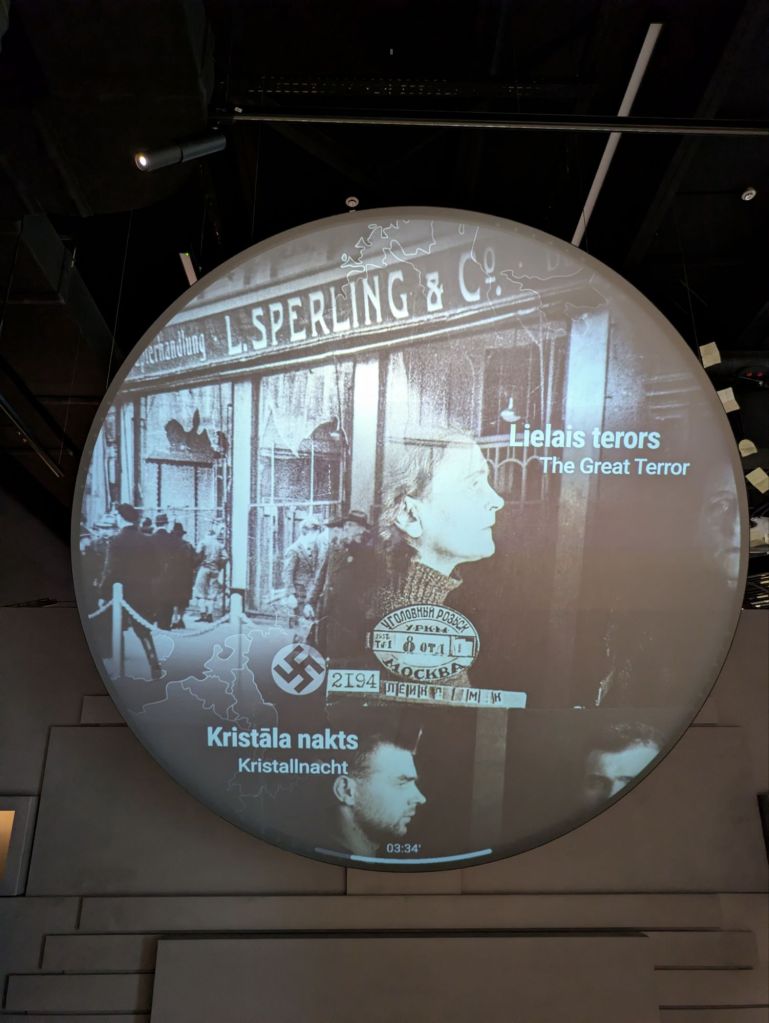
The Soviet security service is known in Latviaafter its first acronymCheka, in most of the world, after the last – KGB. In 1940, it is the People’s Commissariat of the Interior – NKVD, whose State Security Administration establishes offices in the largest towns of Latvia with headquarters in Riga. The NKVD was the perpetrator of Stalin’s Great Terror with extreme brutality.
Latvian citizens, who have been able to trust a fair trial for the past 20 years are suddenly losing real legal protection, basic human rights and many disappear without a trace.
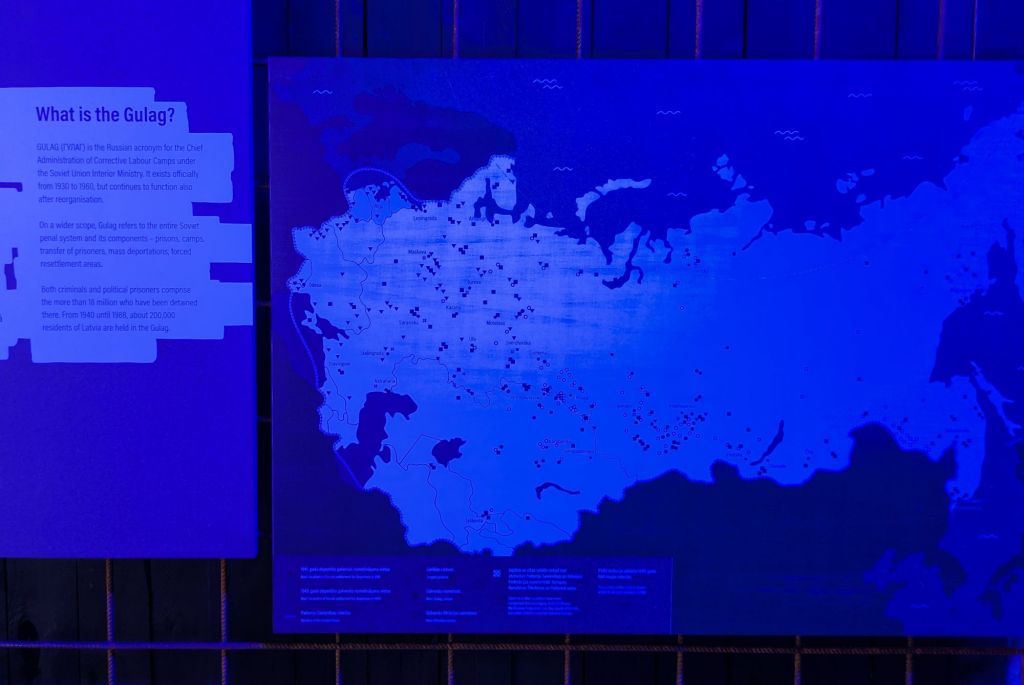
The museum included the map below with the Gulag camps:
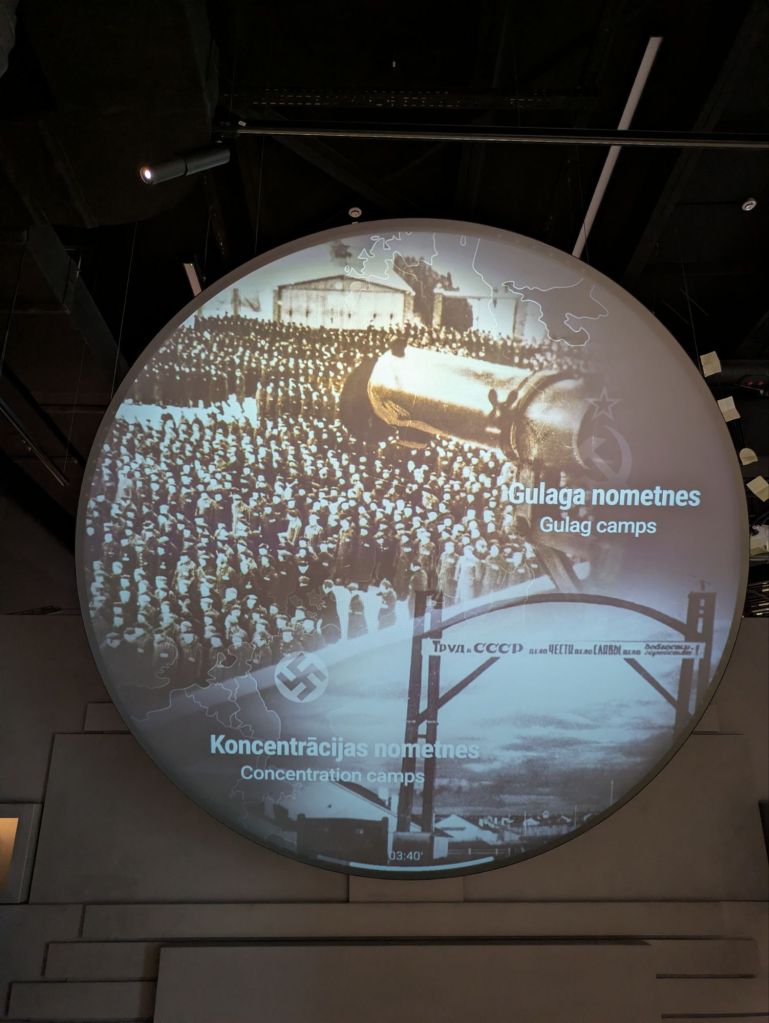
What is the Gulag? GULAG (ГУЛАГ) is the Russian acronym for the Chief Administration of Corrective Labour Camps under the Soviet Union Interior Ministry. It exists officially from 1930 to 1960, but continues to function also after reorganisation.
On a wider scope, Gulag refers to the entire Soviet penal system and its components – prisons, camps, transfer of prisoners, mass deportations, forced resettlement areas.
Both criminals and political prisoners comprise the more than 18 million who have been detained there. From 1940 until 1988, about 200,000 residents of Latvia are held in the Gulag.
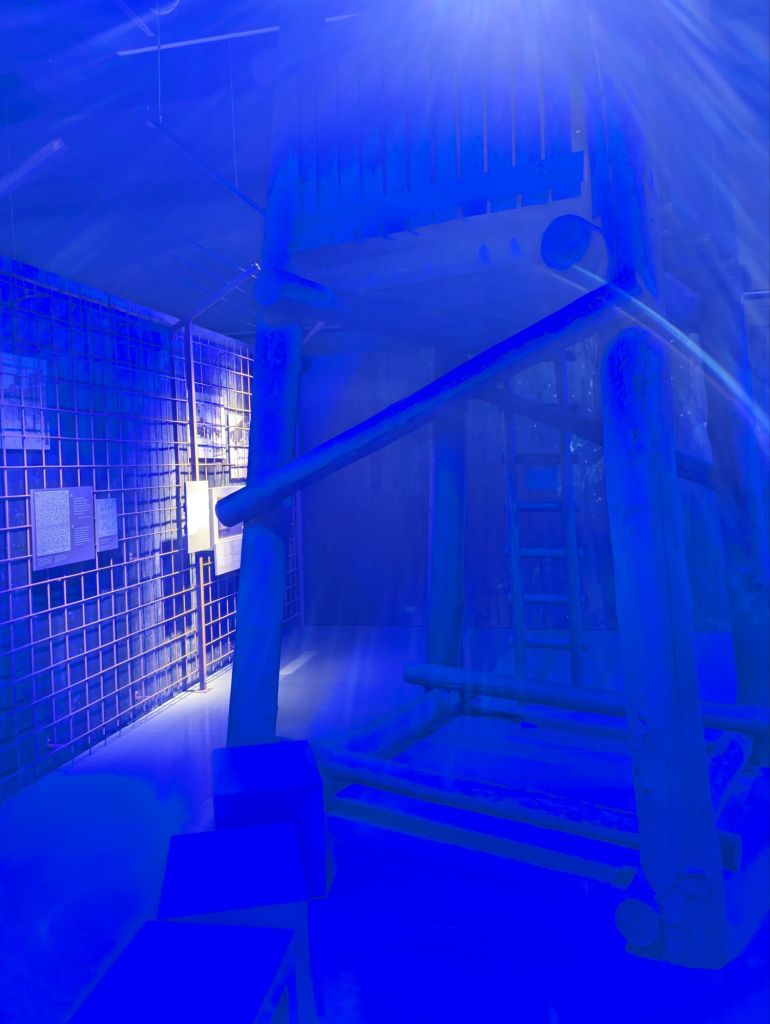
The light of the map above is not very good, because it was located in an area recreating a Gulag concentration camp, including a watchtower, sketches with the organization of the camps, stories from victims, clothes, etc.
Stalin’s death in 1953 marks a decrease of mass terror, but it does not change the totalitarian nature of the Communist Party. Psychological terror replaces physical terror. The goal remains: subjugate the Latvian people.
The Cheka and the army buttress the Communist Party. The Soviet Union’s government implements the Party’s orders. The Soviet citizen carries them out. In line with communist ideology, the economy, culture and social life are centrally planned in Moscow.
The Communist Party of Latvia and the government are Latvian in name only. They obey Moscow’s aims to colonise Latvia and blend the Latvian people into a Russian-speaking mass – homo sovieticus.
At least 30 countries didn’t recognize the occupation and annexation of Lavia. The Latvian legation in Washington DC continued to operate during the entire period of occupation. For a number of years there were also legations in London, Paris, Buenos Aires, Geneva and Rio de Janeiro, and a diplomatic mission in Madrid.
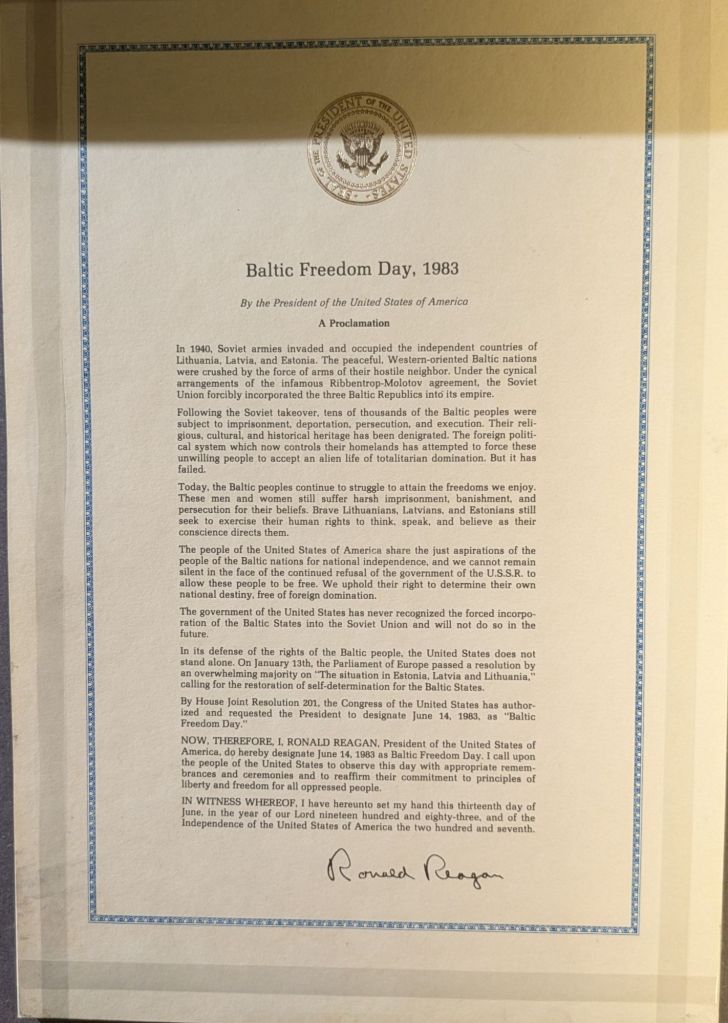
In 1983, Ronald Reagan proclaimed June 14th as the Baltic Freedom Day.
The Baltic Way
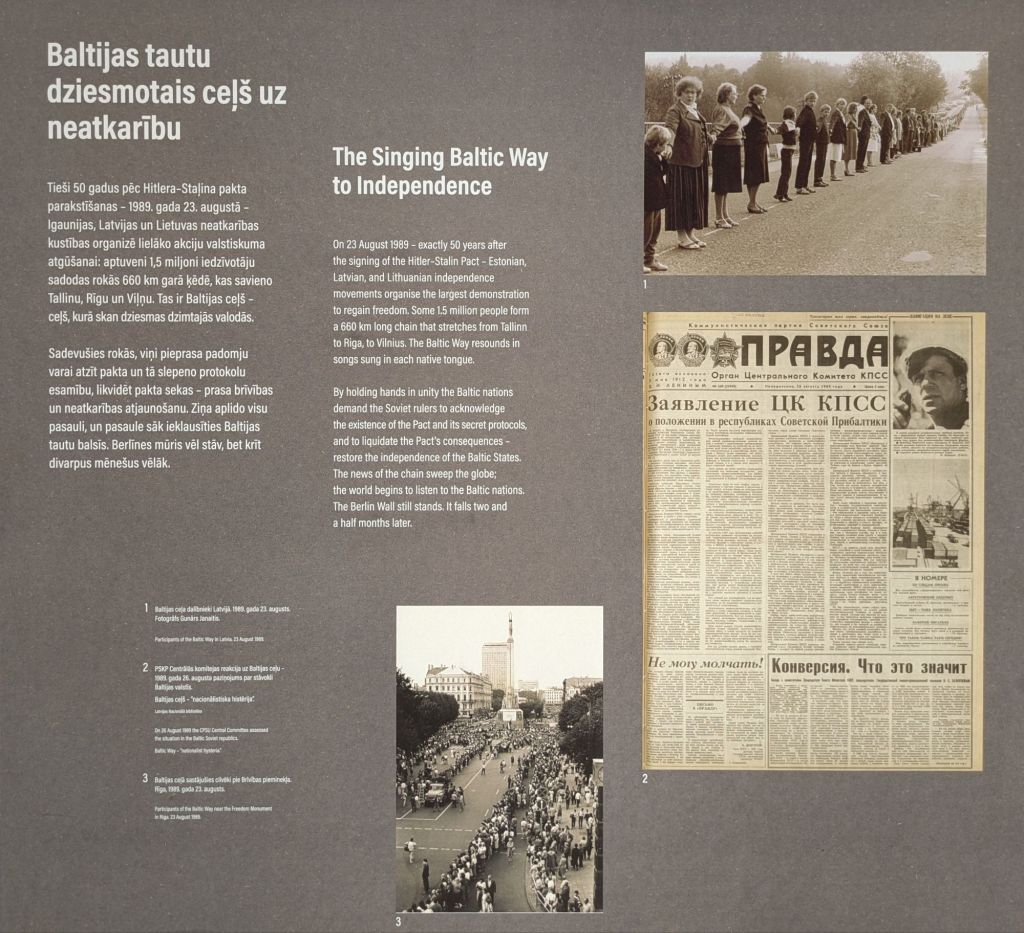
On 23 August 1989 – exactly 50 years after the signing of the Hitler-Stalin Pact – Estonian, Latvian, and Lithuanian independence movements organise the largest demonstration to regain freedom. Some 1.5 million people form a 660 km long chain that stretches from Tallinn to Riga, to Vilnius. The Baltic Way resounds in songs sung in each native tongue.
By holding hands in unity the Baltic nations demand the Soviet rulers to acknowledge the existence of the Pact and its secret protocols, and to liquidate the Pact’s consequences – restore the independence of the Baltic States.
The news of the chain sweep the globe; the world begins to listen to the Baltic nations. The Berlin Wall still stands. It falls two and a half months later.
In 1991 joins United Nations. In 1993 the Parliament reactivates the original Constitution. The Soviet (later Russian) Army doesn’t leave the country until 1994. Latvia joins NATO in 2004, as well as the European Union. During the 50 years of occupation ethnic Latvians went from 75% of the population in 1935 down to 52% in 1989.
The museum celebrates Three Heroes of Conscience: the poet Vizma Belsevica, Lidija Doronina-Lasmane (convicted three times for anti Soviet activities) and Gunars Astra (an activist convicted for reading 1984 and Archipelago Gulag).
On September 19th 2019, after the 80th anniversary of the Molotov-Ribbentrop pact, thd European Parliament passed a resolution on the Importance of European remembrance for the future of Europe, which among other points included the following:
– whereas although the crimes of the Nazi regime were evaluated and punished by means of the Nuremberg trials, there is still an urgent need to raise awareness, carry out moral assessments and conduct legal inquiries into the crimes of Stalinism and other dictatorships;
– whereas in some Member States, communist and Nazi ideologies are prohibited by law;
– whereas remembering the victims of totalitarian regimes and recognising and raising awareness of the shared European legacy of crimes committed by communist, Nazi and other dictatorships is of vital importance for the unity of Europe and its people and for building European resilience to modern external threats;
– Condemns all manifestations and propagation of totalitarian ideologies, such as Nazism and Stalinism, in the EU
Black Ribbon Day: The 23rd of August, since 2009, is officially known in the European Union, as the European Day of Remembrance for Victims of Stalinism and Nazism and also referred to as the Europe-wide Day of Remembrance for the victims of all totalitarian and authoritarian regimes
I leave some more pictures from the museum below.
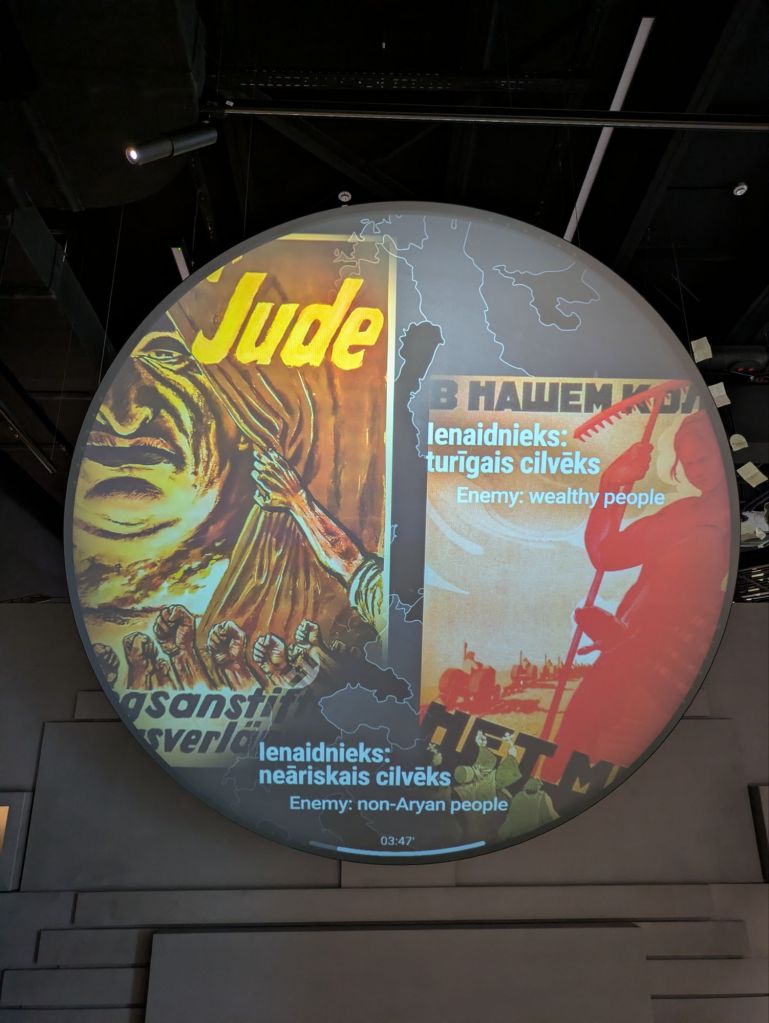
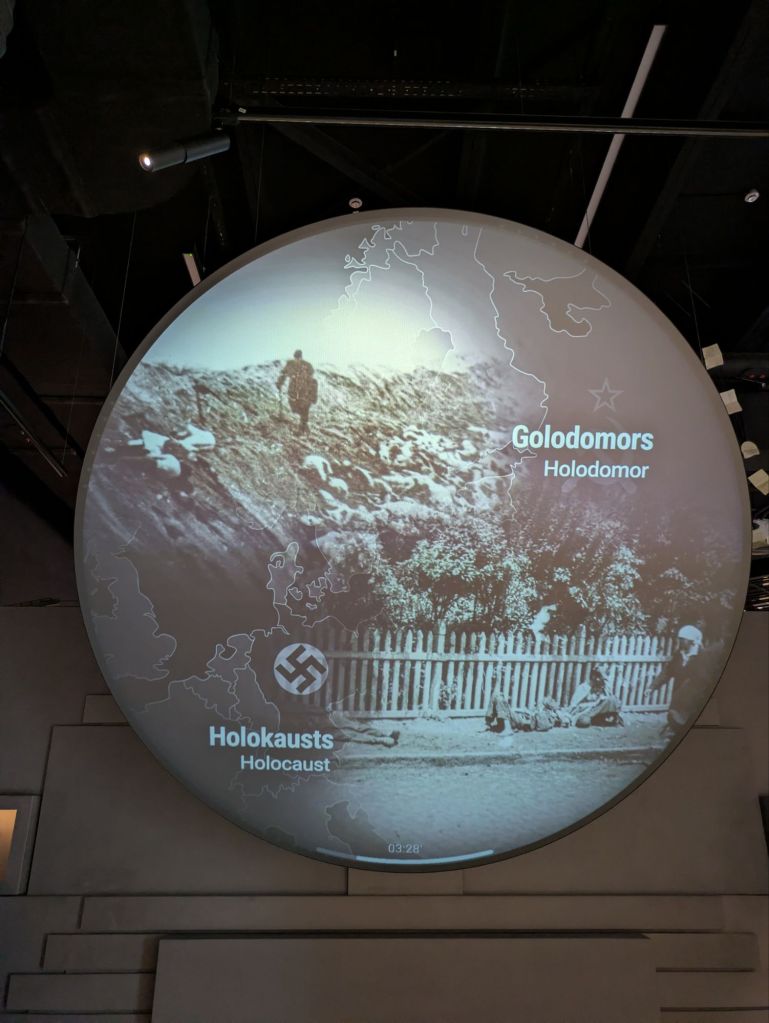
Hitler and Stalin. Dictators. Terror.Enemies of the people: non-Aryan people, wealthy people.Gulag camps, concentration camps.The Great Terror. Kristallnacht.Holocaust. Holodomor.
Hacia principios de mayo de 2025 la temporada que estaba haciendo Morante de La Puebla era ya de época, así que mi amigo Luismi y yo decidimos comprar entradas para ir a verle torear en Nîmes, el viernes 6 de junio, por la tarde. Para ver aquella corrida salimos a mediodía desde la oficina en Toulouse.
Se lidiaron toros de Garcigrande y junto a Morante, torearon Alejandro Talavante (a quien llevábamos tiempo queriendo ver) y un joven Marco Pérez que tomaría la alternativa.
El ambiente en Nîmes en la feria es espectacular, con la música en las calles, las peñas, la cantidad de gente que viene de Francia y España… La puesta en escena en el anfiteatro romano, la banda de música, el himno francés, también es de ensueño.
La corrida fue un gran espectáculo. Si bien Morante no tuvo suerte con los toros y el descabello en su segundo, lo que evitó que tuviese premios, Talavante y Pérez tuvieron una buena tarde. Talavante cortó una oreja a cada toro y Pérez obtuvo dos orejas en su último toro, con lo que los dos salieron a hombros por la puerta grande, la Puerta de los Cónsules.
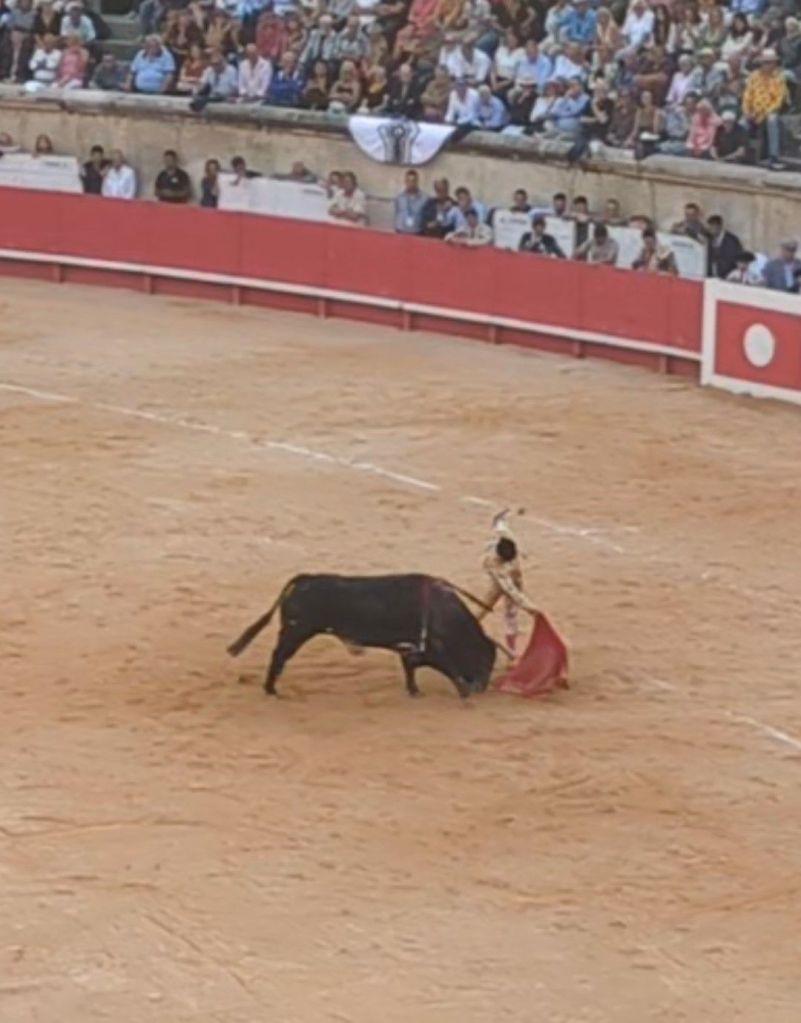
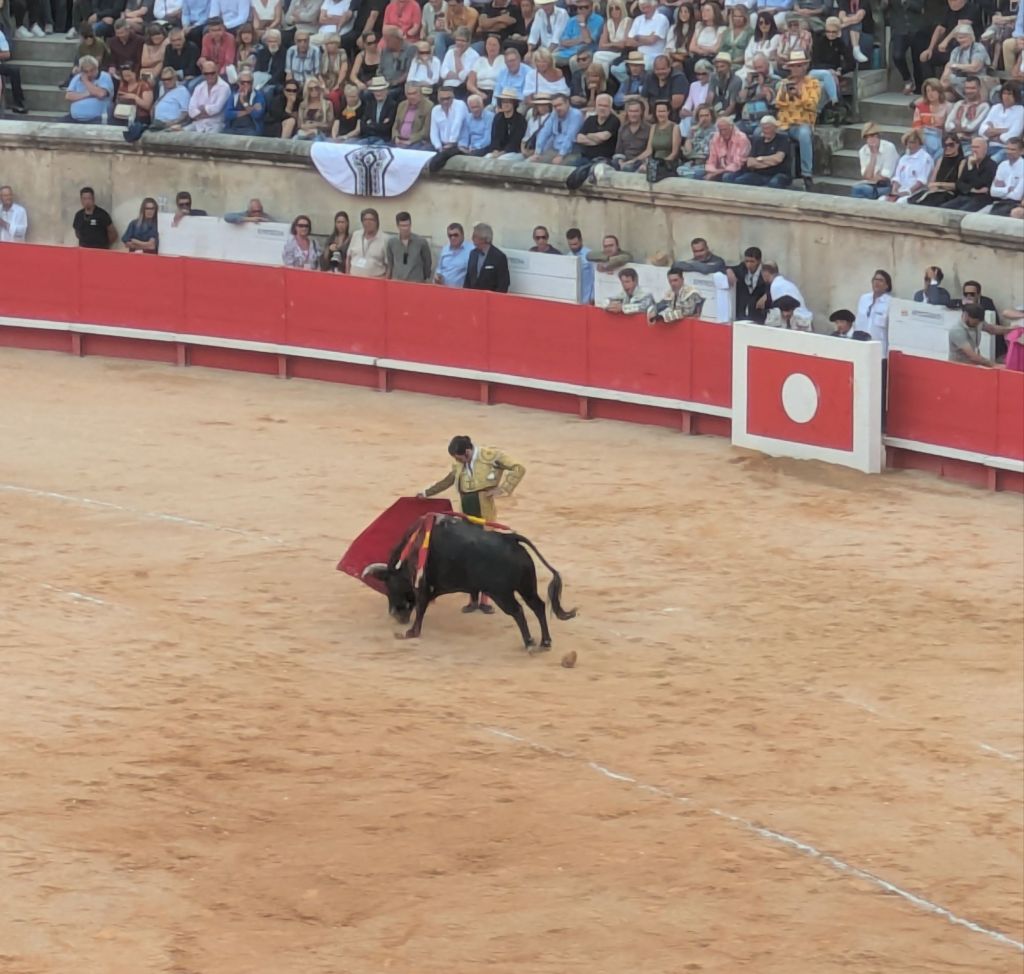
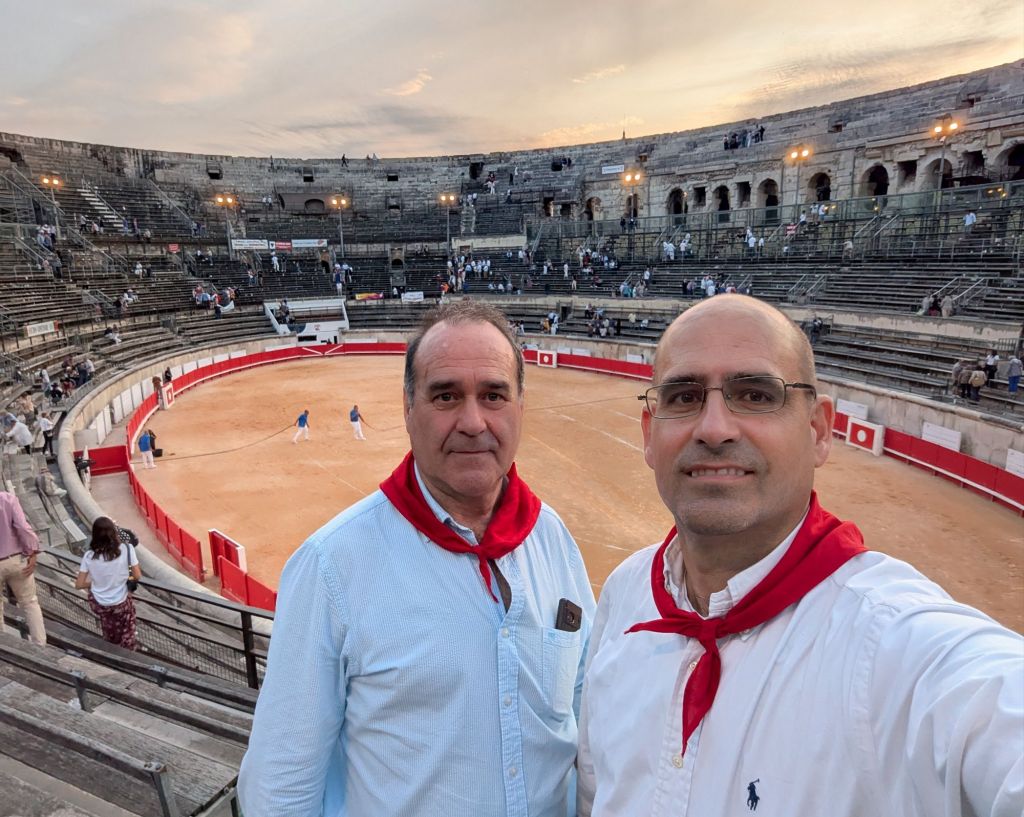
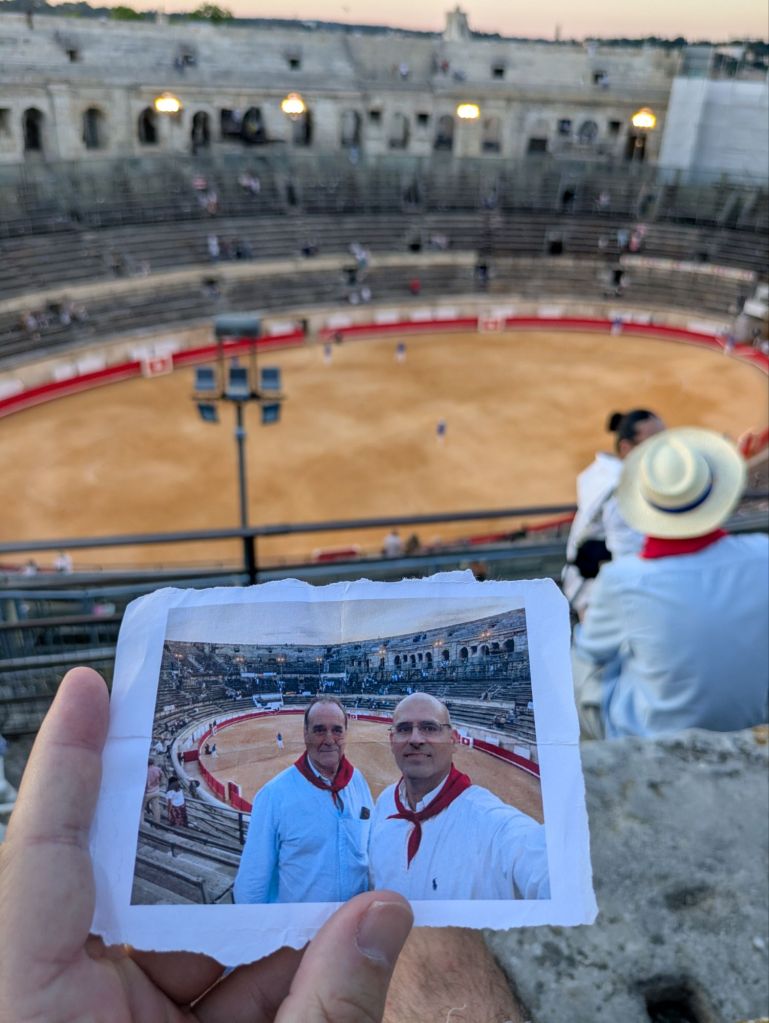
Marco PérezMorante de La PueblaTalavante y Pérez a hombrosLuismi y yo en la feria de 2025
La temporada de Morante siguió siendo épica hasta el punto de que anunció su retirada en octubre en Las Ventas en la Corrida de la Hispanidad.
2026
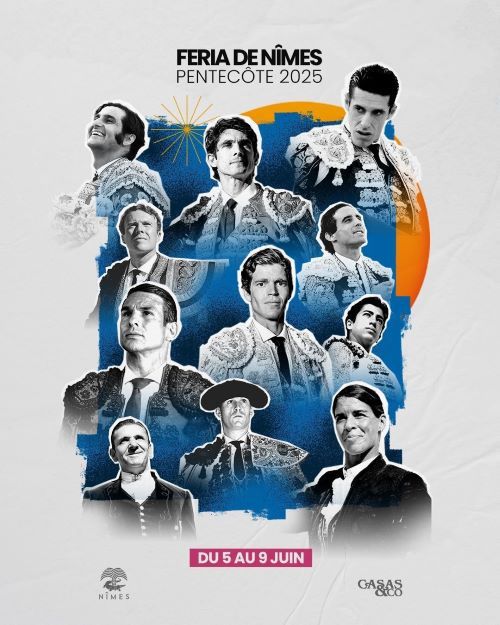
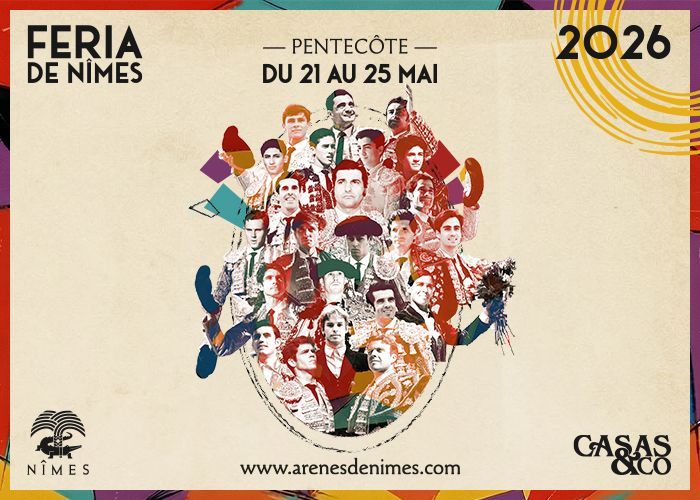
El 18 de febrero quedé a comer con Luismi y entre otras cosas hablamos de toros, de la vuelta Morante que ya se había anunciado para Sevilla, de las próximas vacaciones, etc. Unos días más tarde, el 26 de febrero, me envió un mensaje con los carteles de la Feria de Nîmes de 2026 que se acababan de publicar:
Se confirma la vuelta de Morante en Nîmes, con Talavante y Marco Pérez.
Un clásico para no perdérselo.
Buenas vacaciones de ski!
Nos vemos a la vuelta.
LM
De vuelta de las vacaciones de ski, paramos una noche con la familia en Nîmes. Cenamos en el restaurante italiano Pinocchio y la mañana siguiente desayunamos en el café Le Goeland, en el boulevard de La Libération, en el mismo sitio donde habíamos desayunado tras la corrida de 2025. Después de desayunar volvimos al hotel, recogimos y continuamos el viaje de vuelta a casa.
Pocas horas después recibí una llamada de Azucena, una compañera de trabajo, para anunciarme que Luismi había fallecido ese mismo 8 de marzo, en una pausa de su excursión de ski a La Mongie.
Así es que, cuando el sábado pasado 23 de mayo volví a Nîmes a la Feria de Pentecôte a ver aquella corrida, que habíamos planeado ver juntos, fue la primera que me tocó ver solo, sin Luismi.
Morante sufrió una cogida en abril y a pesar de haber vuelto a torear, anunció un par de días antes que no estaría en Nîmes. Fue sustituido por Juan Ortega. Los toros esta vez fueron de El Freixo.
El ambiente en Nîmes era espectacular, como siempre, pero en vez de estar con el dicharachero Luismi y su don de gentes, con su facilidad para entablar conversación con todo el mundo, esta vez iba solo y con una mezcla de recuerdos.
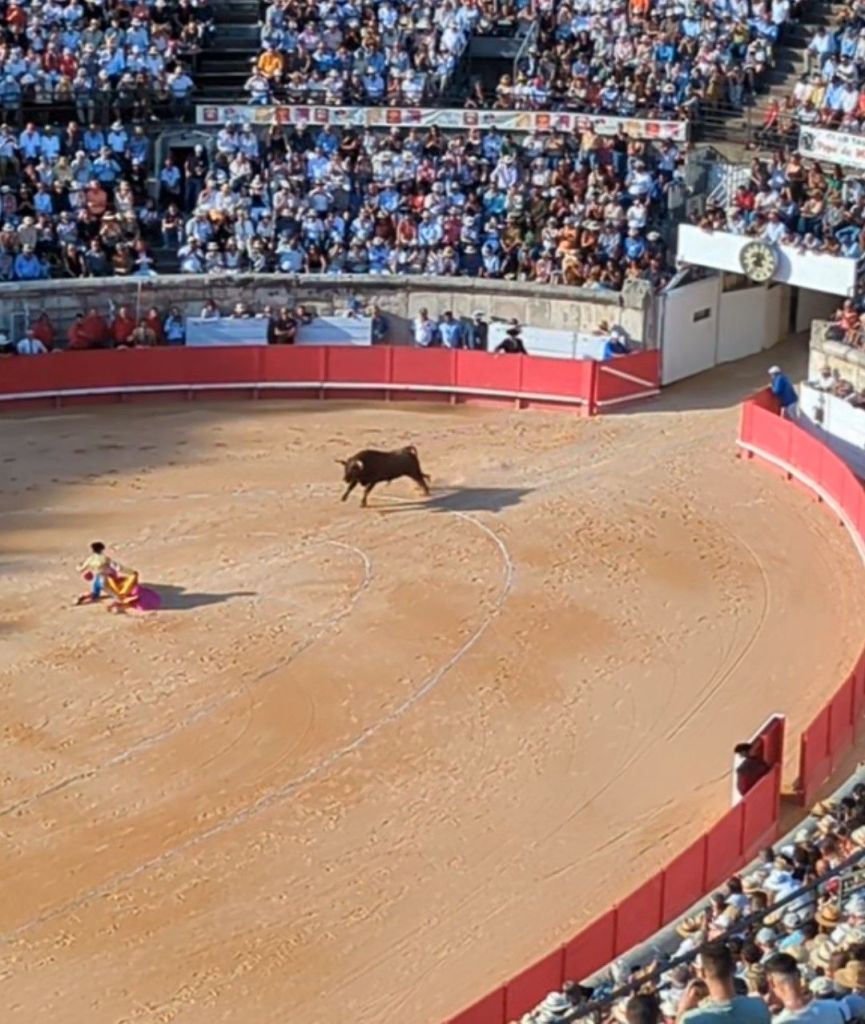
La corrida en sí empezó con Talavante cortando dos merecidas orejas a su primer toro, y luego otra más en el cuarto. Juan Ortega no pudo sacar mucho del segundo toro, pero con el quinto obtuvo una oreja. Marco Pérez volvió a dar muestra de su arrojo, recibiendo a los dos toros a porta gayola y dando varias tandas de rodillas. Al tercer toro le cortó las dos orejas y el rabo, pero con el sexto tuvo menos suerte y además falló con la estocada, dando tres pinchazos.
Marco Pérez
De nuevo Talavante y Pérez salieron por la Puerta de Los Cónsules, como en 2025, pero con una factura todavía mejor.
Talavante y Pérez a hombros
Sirva este breve post como recuerdo a Luismi, nuestra afición compartida y las corridas que disfrutamos juntos. DEP.
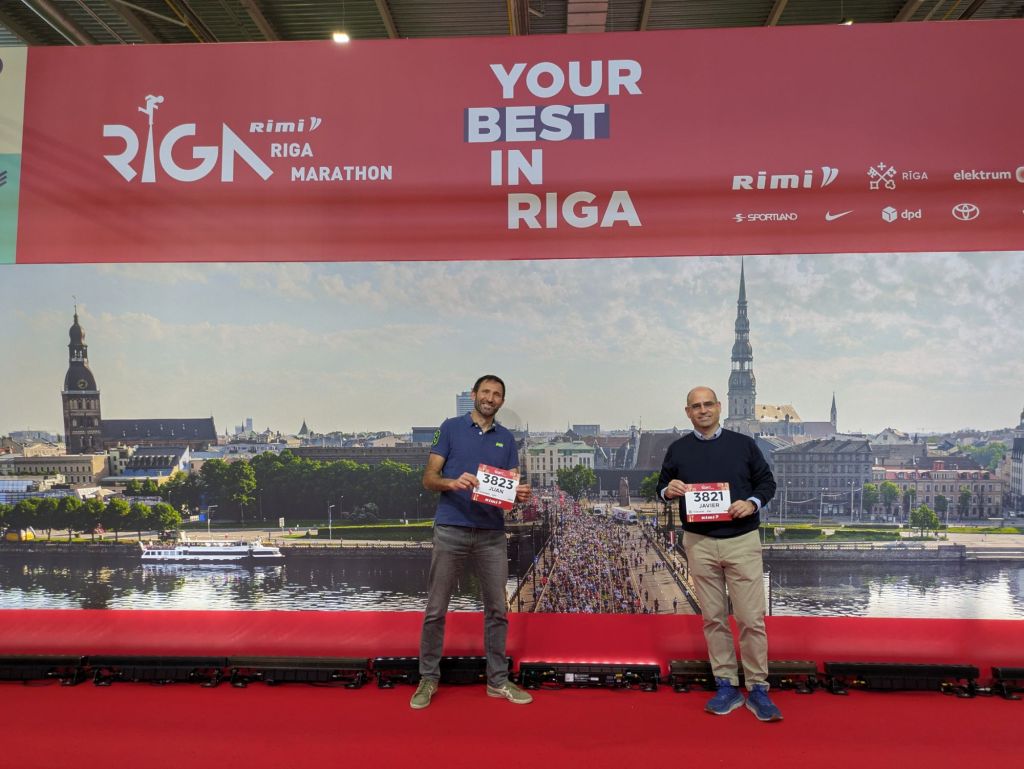
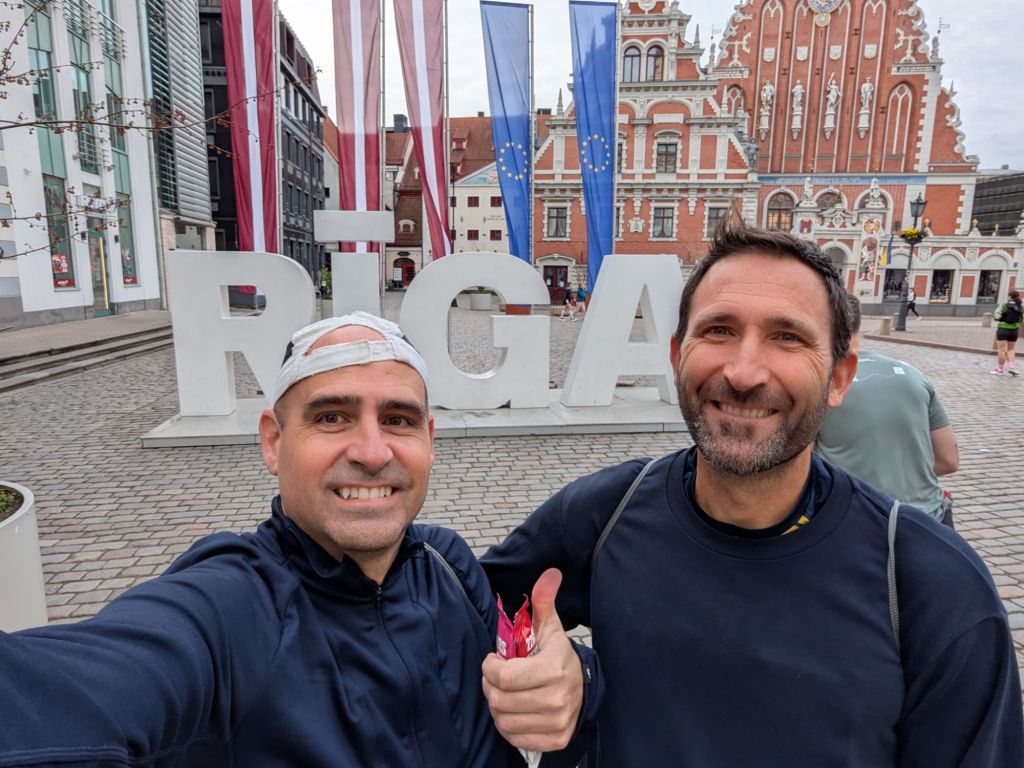
Last Sunday, May 17th, together with my friend Juan, we traveled to Riga to take part in its marathon, a big event in the city with over 45,000 runners taking part in different races across various distances and over 3,000 runners registered in the marathon.
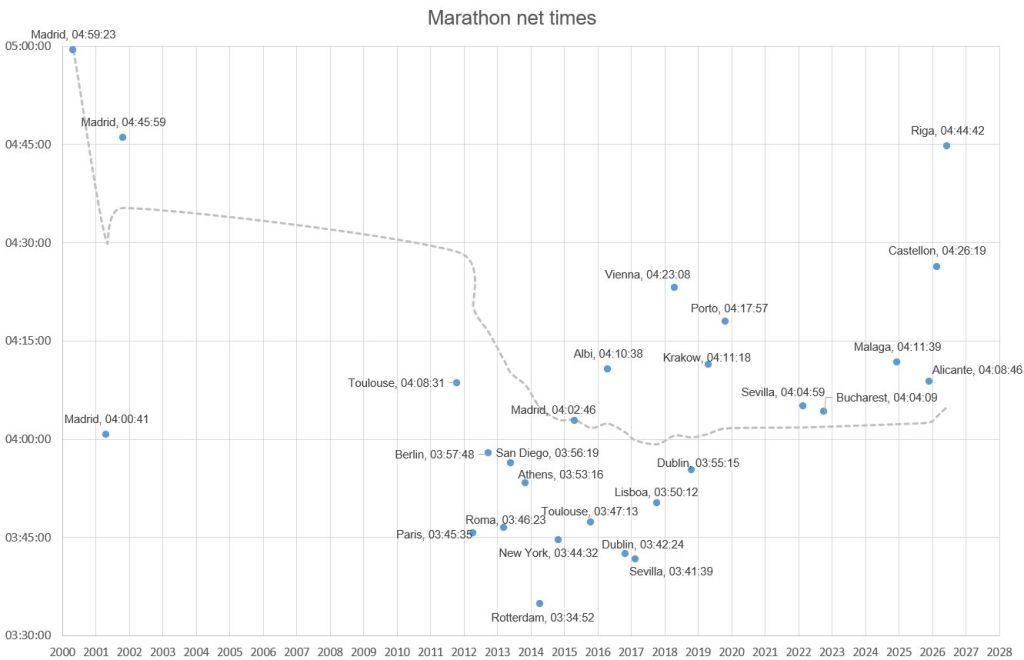
We picked Riga following our series of marathons abroad (to combine tourism with long distance running) that has taken some of us to run together in Paris, Berlin, Roma, Athens, Rotterdam, New York, Sevilla (x3), Madrid, Millau (x2), Dublin (x2), Lisboa, Vienna, Krakow, Porto, Bucharest, Málaga, Alicante, Castellón and now Riga.
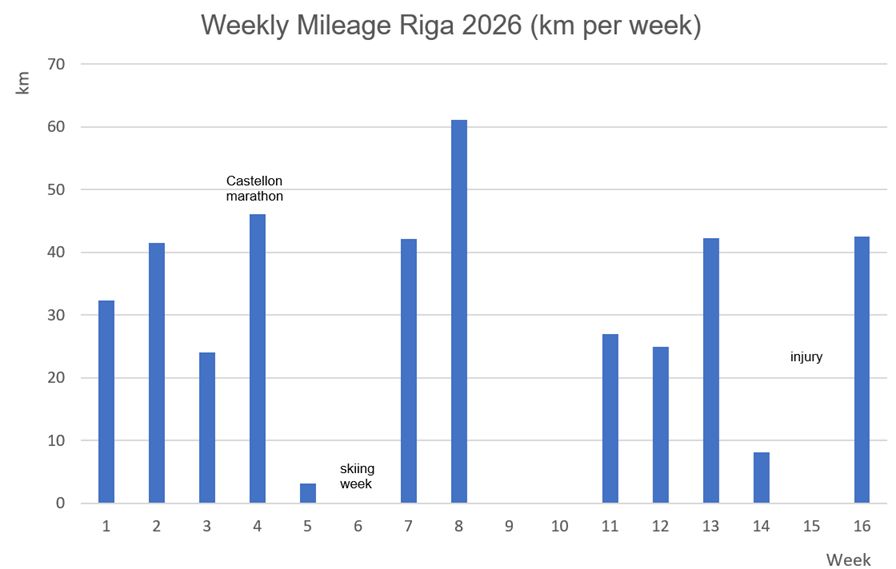
To prepare for this marathon I tried to follow the same 16-week training plan I had used in the past. However, since I had previously run the marathon in Castellón, by that date we were already in the 12 weeks prior to the one in Riga. I arrived at Riga with just over 350km in the legs in those 16 weeks, much less than I would have liked. I chose to skip the series training, as being overweight (96kg the day after the race), the series would hurt the Achilles tendon. I only did four long runs in those 16 weeks: the 42km marathon in Castellón (February 22nd), a 25km run and two 22km runs. To make it even worse, in April I started to feel pain in lateral tendon in the knee, so I decided to rest during the last 3 weeks of the plan to recover the knee as much as possible even if I was going to be unprepared for the race.
With that disastrous training behind and the injury, I doubted I would be able to complete the race and I only aimed at finishing the race, for which I would start with a pace for a 4h15′ marathon, to be followed until I could.
Weekly mileage (Castellón marathon at week 4)
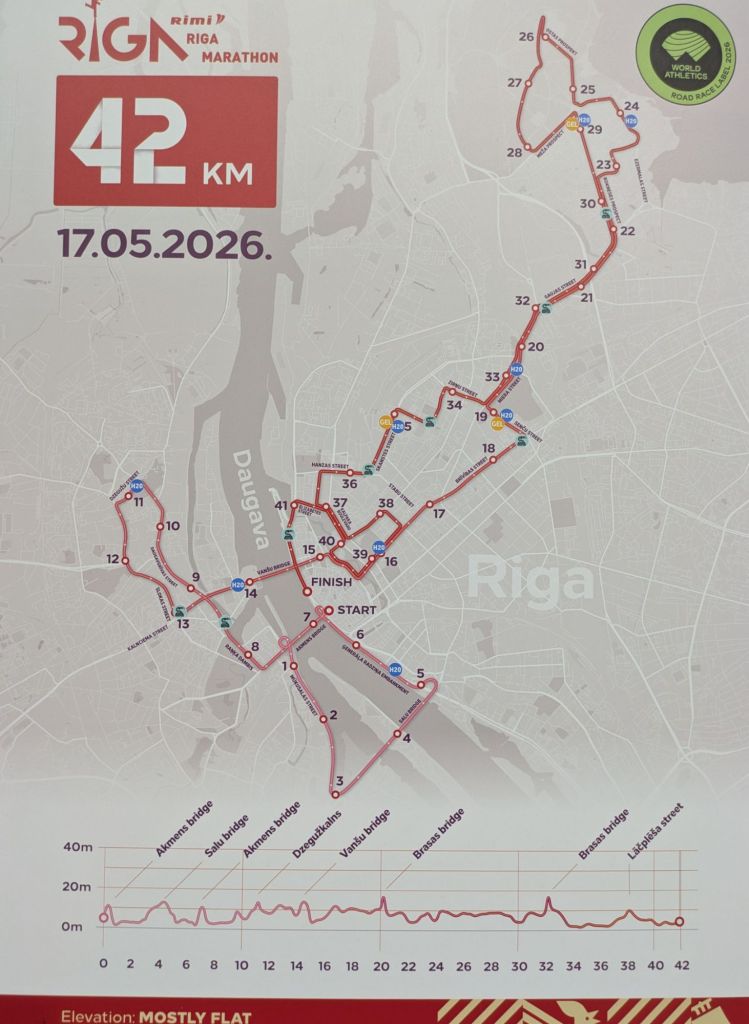
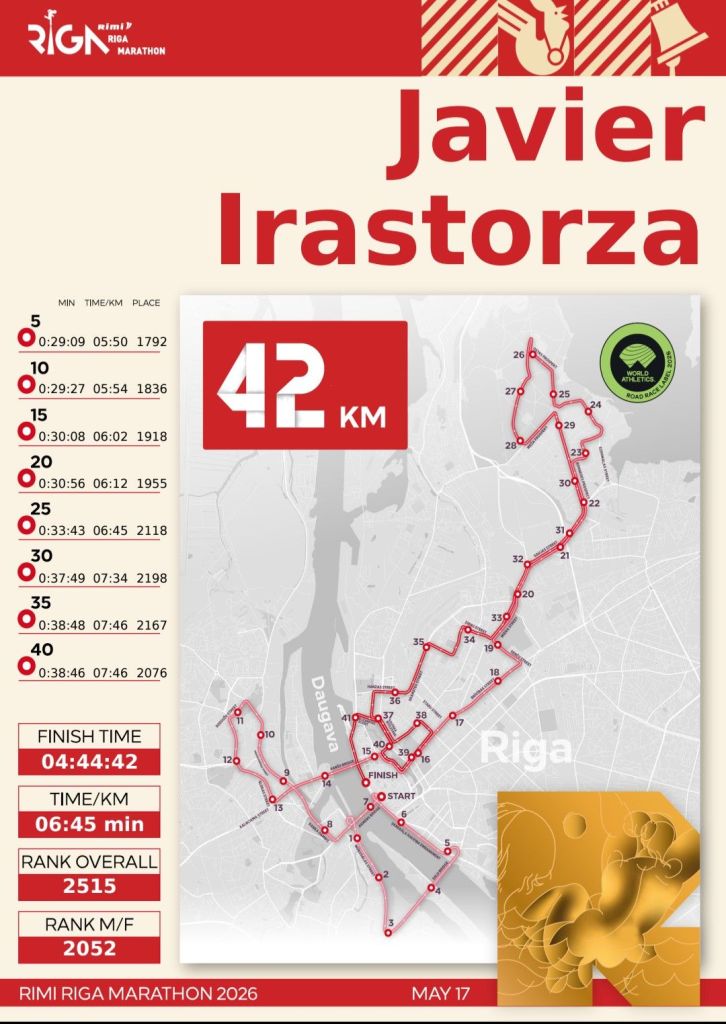
The profile in Riga is rather flat, with just a couple of climbs around bridges in the second half of the race. The organization prepared a circuit composed of several long avenues in the city centre and all the way to the Mezaparks in the North of the city. The organization was superb, with supply posts every 4-5 kilometers (though with liquids served in plastic cups, which is the least convenient option), some music bands, an impressive and overwhelming display at the Freedom monument including orchestra, choruses and dancers in traditional clothes…
Race circuit
The temperature was a bit fresh in the morning (~8°C), the sky was slightly cloudy and it would be a bit warmer towards the end of the race, though the temperature did not exceed 12°C. My strategy was to start at a pace just below 6min per km, with the group of 4h15′ (which also started a bit faster), and then, whenever I started to feel the lack of preparation, or pain in the knee, manage the situation the best I could.
Before the race
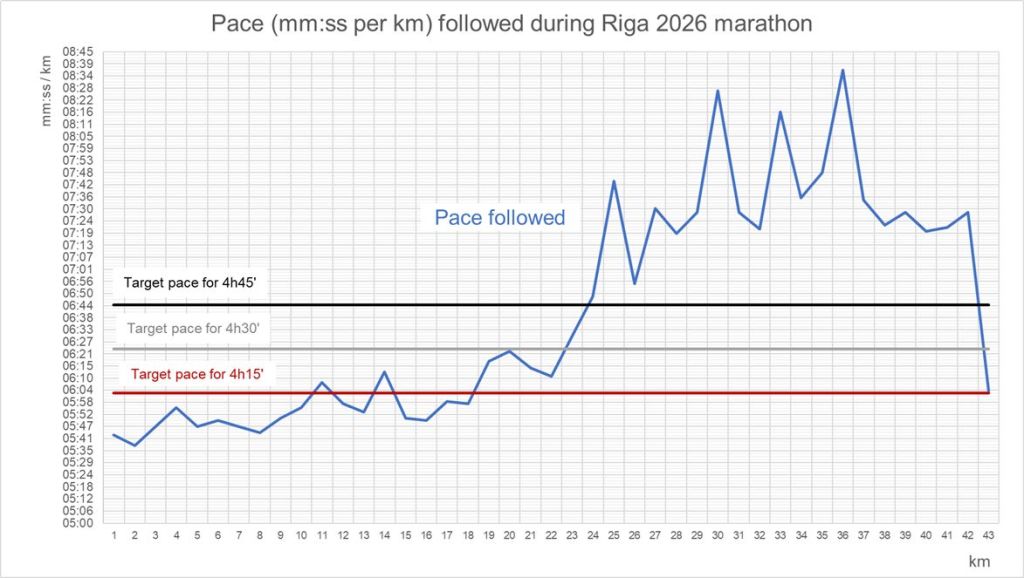
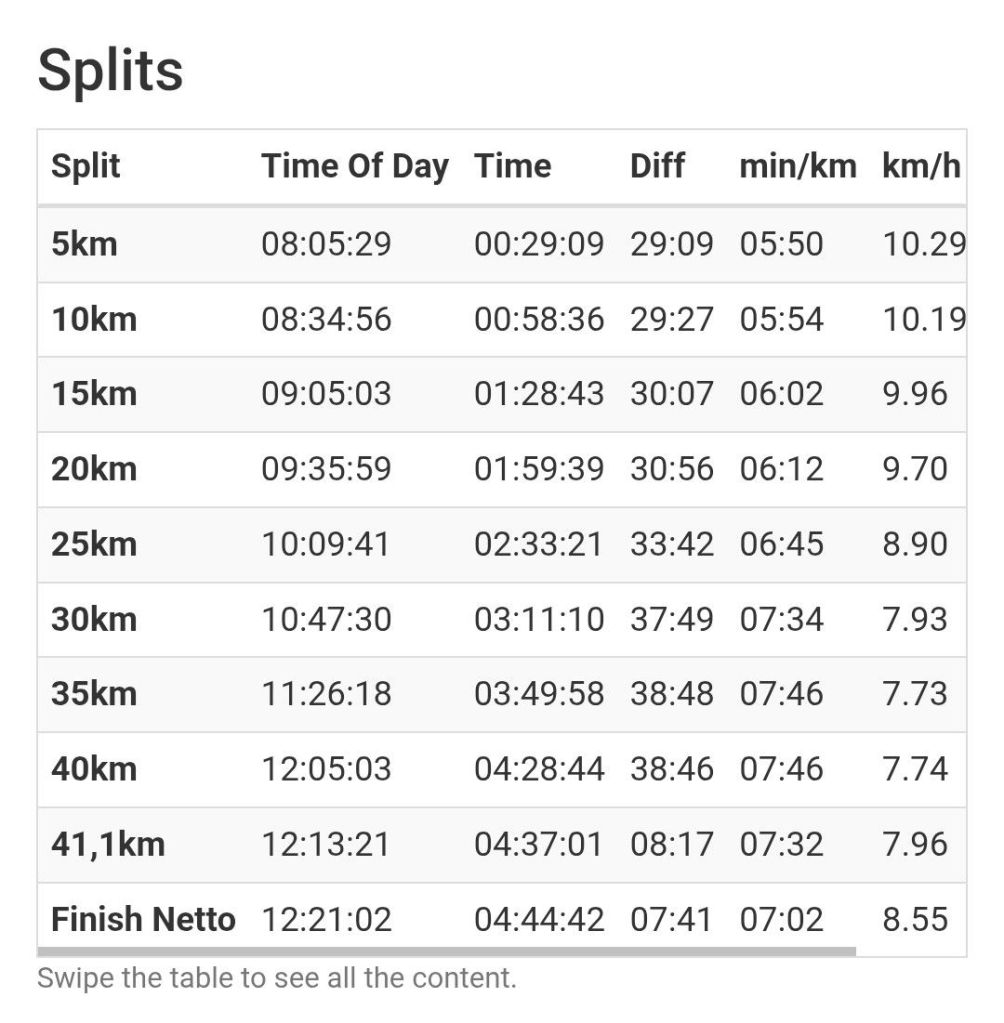
The race started very early at 7:35am, luckily we had a hotel at 3 minutes walking distance from the start. I went with the 4h15′ group and Juan a bit forward. We wished luck to each other and ran separately. I ran comfortably until km 22; with the 4h15 pack until km 18. I started to feel pain in the knee at around the km 12, and got assistance with anti-inflammatory cream or spray 4-5 times during the race starting from km 14. From the km 22, I hit the lack of training and had to walk for some short stretches of ~100m here and there.
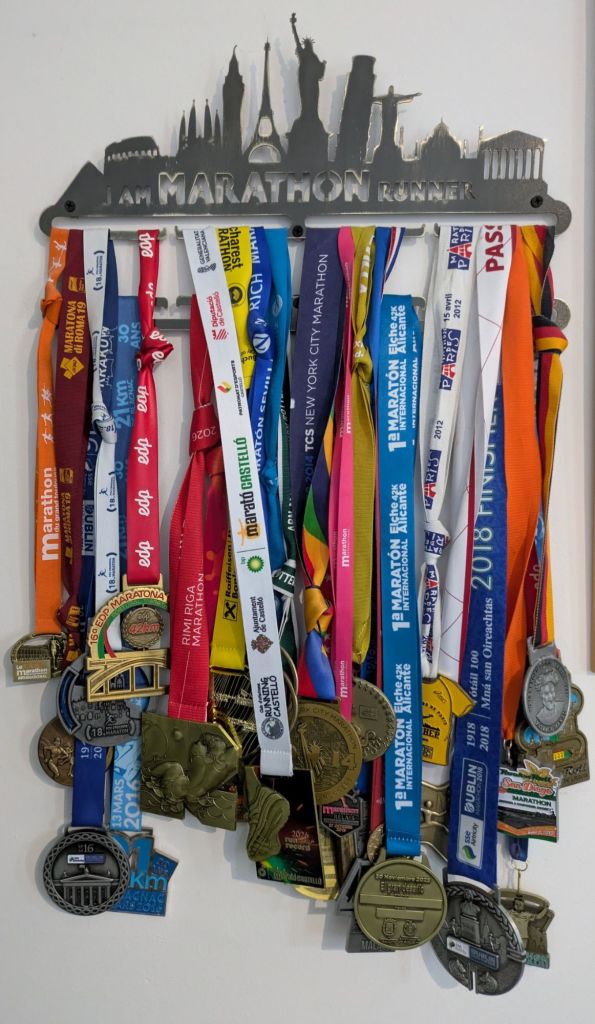
At around the km 35 I started to make numbers in my head and I got as plan C to finish below 4h45. In the end, I clocked a net time of 4h44’42”, a time 18-minute worse than the last marathon in Castellón, but happy to have completed my 27th marathon, easy to say today but not so on April 30th 2000 when I started in the distance in Madrid.
Pace followed
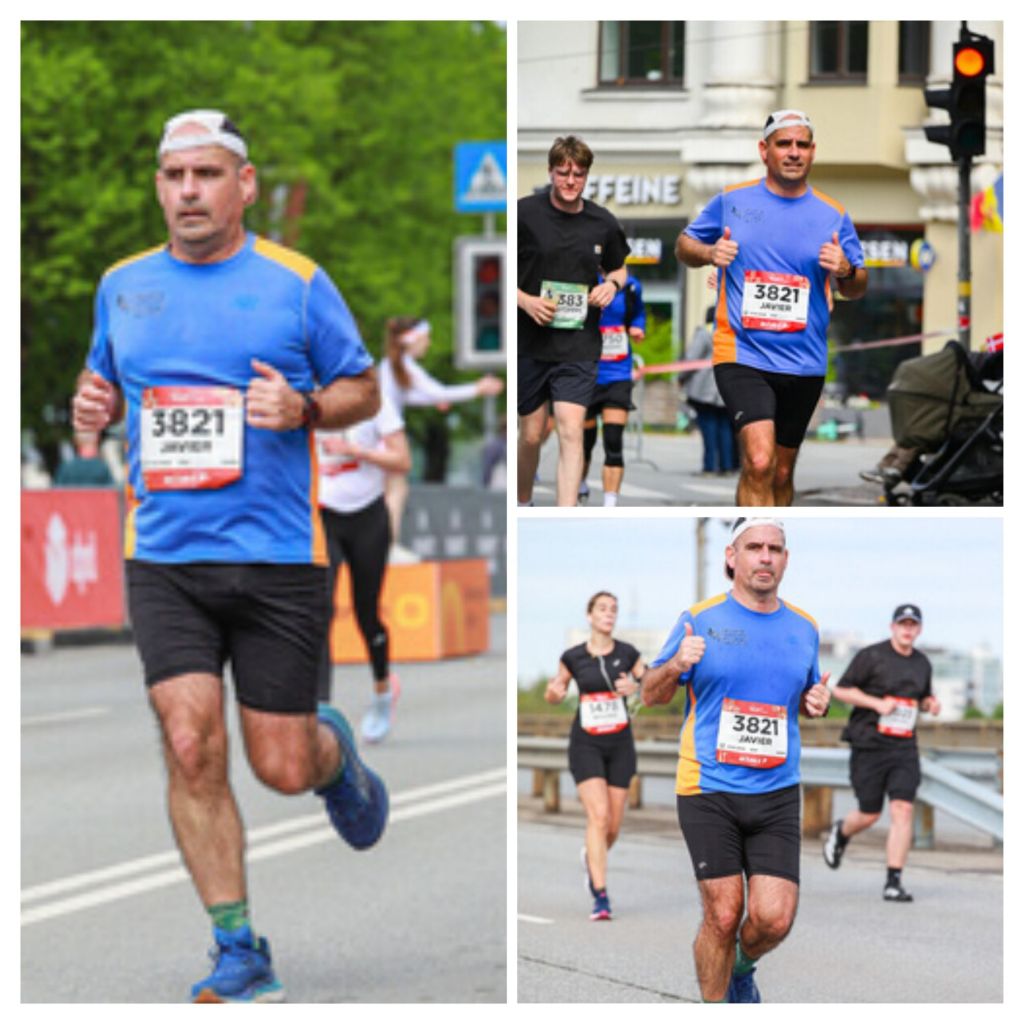
With those 4h44’42”, I was again above the 4-hour mark and finished in the 2515th place out of 2985 finishers (16% percentile). That time makes it my 3rd worst marathon, though with a positive feeling of having completed another marathon, having finished already 2 marathons in 2026, less than 3 months after the previous one. I am now looking forward to recovering from the injuries and better preparing the next one.
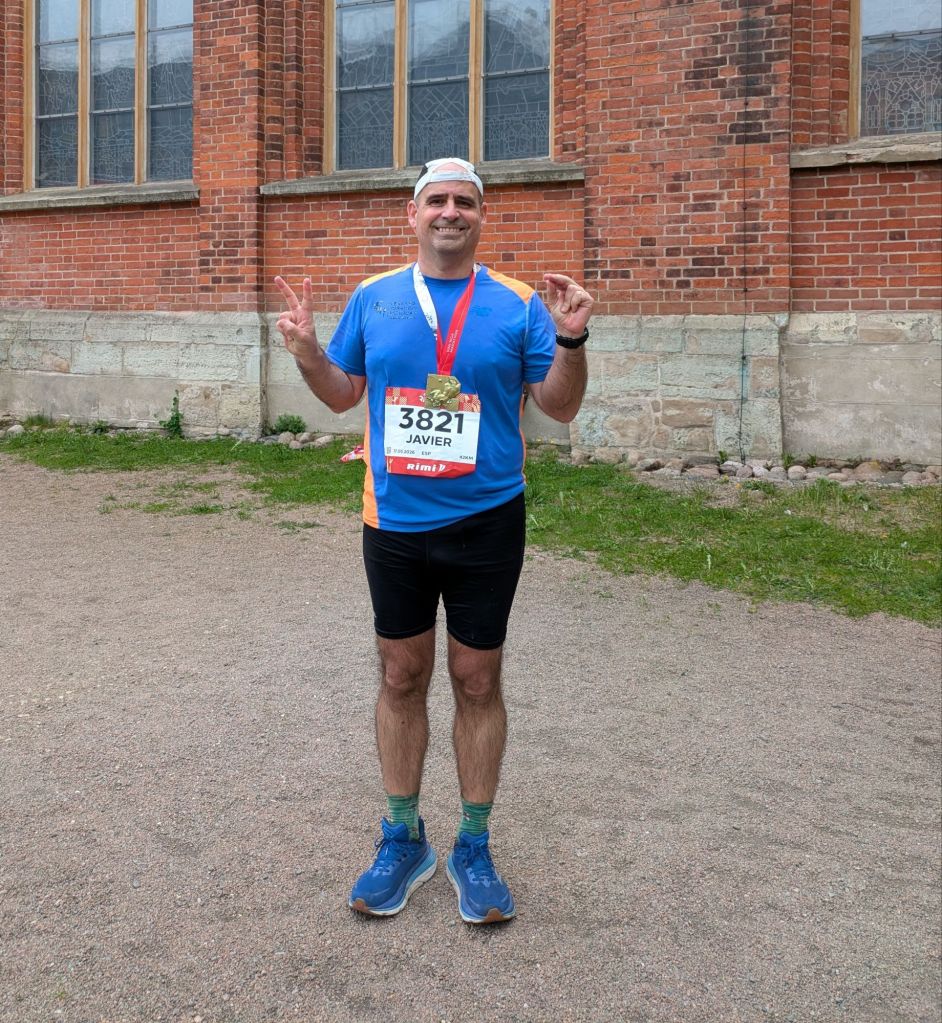
Race diplomaTime splits every 5kmPosing with the medal after the raceMarathon medals at home
This is a short post to share some locations to follow the steps of the Dutch painter Vincent van Gogh in Provence, in Arles and Saint Rémy de Provence.
Van Gogh was born in 1853, and at the age of 27 he decided to become an artist, to which he dedicated the next and last decade of his life. During that time he was financially supported by his brother Theo, with whom he moved.
In February 1888, he left Paris seeking the light and colors of Provence and settled in Arles, where he invited his friend Gauguin and where he hoped to establish the “Studio of the South“.
After a mental crisis in Arles, during which he cut off part of his ear, he interned himself to the Saint-Paul-de-Mausole asylum for treatment and rest. The asylum nowadays is open for visits and is located in Saint Rémy. The village and its surroundings provided several of the landscapes he painted.
Between Arles and Saint Rémy he spent just around two years but was the most productive period of his life with over 200 paintings (out of ~900 in his career).
The best museums to see his paintings are the Van Gogh museum in Amsterdam, the Kröller-Müller museum in Otterlo (Netherlands), the Musée d’Orsay in Paris, and the Metropolitan and MoMA in New York. And a good complement to those museums is to visit Arles and Saint Rémy in Provence, where in some places together with the landscapes there are panels with copies of the paintings to relate to one another. In Arles there is also a small museum, the Fondation Vincent van Gogh, about his life and style.
I will share some of those examples below.
Cafe La Nuit at the Place du Forum, Arles.“Terrace of a cafe at night (Place du Forum)” (Kröller-Müller)Pont de Langlois (South Arles)“Pont de Langlois” (Kröller-Müller)“Les Paveurs”“Cyprès avec deux femmes”Entrance to the Hôpital Saint-Paul de MausoleVan Gogh’s room in the asylum.“Cueilleuses d’olives”“Oliveraie”“Prairie dans les montagnes”“Hôpital Saint-Paul de Mausole”“Les Alpilles aux oliviers”“Les Alpilles aux oliviers” (MoMA)View from his room at the asylum.“Champ de bl锓Champ de blé avec cyprès”
Last October, we visited Dunkirk, the harbor, the beaches, the nearby village Zuydcoote and the museum Musée Dunkerque 1940 – Opération Dynamo. Dunkirk is a town in the North of France, by the North Sea which is 10 km from the border with Belgium, which had been historically affiliated to Flanders or France (for the last 360 years).
In the Dunkirk evacuation (Operation Dynamo), which took place between 26 May and 4 June 1940, at the beginning of the Second World War, over 338,000 allied soldiers were evacuated from the beaches and harbour of Dunkirk.
After Germany invaded Poland in September 1939, France and the British Empire declared war on Germany. The British Expeditionary Force (BEF) was sent to help defend France. After the Phoney War of October 1939 to April 1940, Germany invaded Belgium, the Netherlands, and France on 10 May 1940. In just a few weeks, the German troops advanced fast and cut off allied troops around Dunkirk. In just over a week the evacuation took place.
Even if the Dunkirk evacuation had been represented in movies before, it was in 2017 with Christopher Nolan‘s movie that made the iconic images of the beaches and piers with lines of soldiers waiting to be rescued, the bombing of those and the ships by the Luftwaffe airplanes or the courageous Little Ships of Dunkirk, the flotilla of fishing boats, merchant ships and yachts, widely known to the public.
The visit of the museum is a must if you want to make sense of the operation, as just by visiting the harbour or the beaches you cannot get much information other than the dimensions of the place.
Musée Dunkerque 1940 – Opération DynamoMalo-les-bains beach with the pier at the back
In the museum there is a detailed account of the beginning of the war and the advances of the German troops and how the evacuation went day by day.
Situation on the evening of 30th May 1940 (British forces in red, French forces in green, German forces in blue).
In this mock up at the museum there is the situation of the different allied ships at both sides of the Malo pier, with the names in the legend and a description of the different bombs they received in those days.
As it is mentioned above the Crested Eagle ship ran aground on the beach of Zuydcoote, a few kilometers North of Dunkirk. We went there by car but could not see anything of the remains, possibly because of the tide.
Looking at the numbers, most of the soldiers could be evacuated, though there are different views on whether it was a successful operation.
The big numbers shown in the panel at the museum: ~239,000 (71%) allied troops evacuated from the port and 98,000 (29%) from the beach; hence the lion’s share were evacuated from the port. Of the overall ~338,000 soldiers evacuated around ~28,000 (8%) were so thanks to the ~1,200 to 1,600 “little ships” involved, following orders from the Admiralty broadcast by the BBC (as seen on the movie). About 35 to 40,000 were taken as prisoners and there were around ~11,000 losses (87% evacuated, 10% prisoners, 3% losses).
In terms of nationalities: ~221,000 British soldiers (65%) were evacuated and between 100-122,000 (35%) French and Belgian soldiers (this comes as a point of conflict in the movie, where British soldiers had priority to get into the ships).
Figures of the Operation Dynamo
Looking at the material losses, the Allies lost around 240 ships of different sizes, including 6 destroyers and 3 torpedo boats, and around 250 aircraft fighters in the wider French campaign. Also 80% of the town of Dunkirk was destroyed.
Looking at the Little Ships part of the operation, even if in the overall picture their contribution in terms of soldiers evacuated was just 8%, it represented a boost in the morale and a success in the mobilization of civilians to support the evacuation.
The Robin DR400 is a single engine piston aircraft very popular in France, with well over 2,000 units produced since its first version first flew back in the 1970s. That is the aircraft model I fly in the aeroclub and in this post I just wanted to share a few details about its construction, materials and a couple of pictures.
Pierre Robin founded the company Centre-Est Aéronautique in 1957 in Darois (France) together with the engineer Jean Délémontez at the time working for Jodel, from whom he took the wing dihedral. It is from their initials that comes the “DR”. Over the years the company first changed its name for Avions Pierre Robin, then it was sold… today the aircraft production is made together by Robin Aircraft and Centre-Est Aéronautique Pierre Robin (CEAPR).
In their website they explain the history of the DR400, first produced in 1972, and have a series of very interesting articles (in French) describing how they select and prepare the wood for their aircraft, how they build the wooden structure of the wings, how they build the wooden fuselage, how the wing skin is made out of a fabric produced by Diatex stapled to the frame (the craftsmen working on the fabric), the metallic parts of the plane… you read it well, a big share of the airframe is built out of wood and fabric, and this is to enable its light weight, between 615 and 630kg of manufacturer weight empty.
Recently, one of our aeroclub’s DR400s has gone through heavy maintenance, replacing the fabric and several parts and equipment. At the end of the process we received the pictures below of the wooden airframe:
Wing wooden structureFuselage wooden structure
Below you can see how the wing looks in flight, with the wooden structure covered by the fabric and how the lower pressure in the upper wing pulls up the fabric of the wing.
Wing in flightWing in flightDimensions of the DR400 as described in the Airplane Flight Manual