Summary of (my) 2025

Time to look back and reflect on how the year which is about to end developed. Brief recap of my 2025. (*)

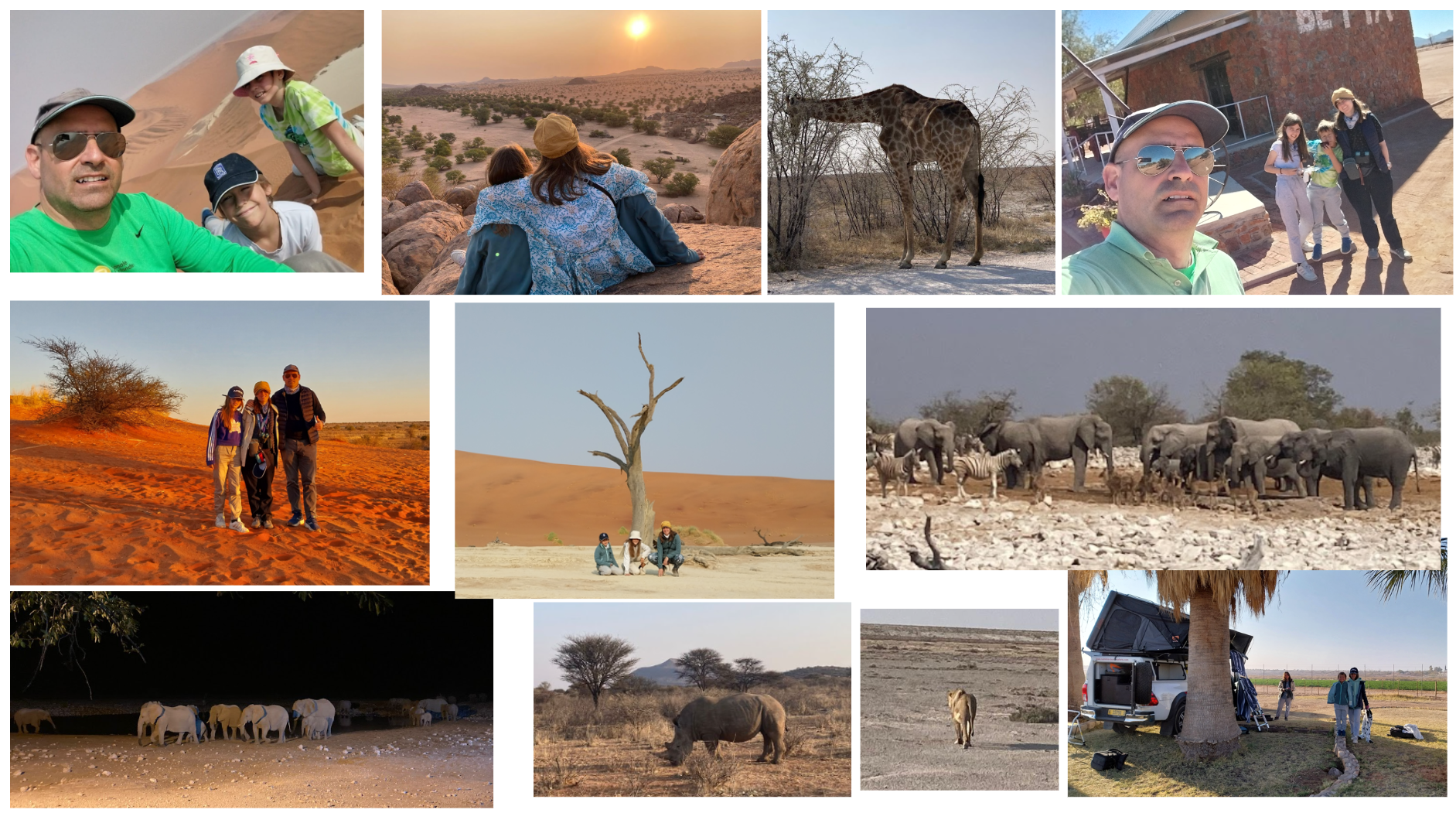
The main experience that we enjoyed together in this 2025 was the road trip we did to Italy during the summer holidays. We spent three weeks driving along the Cote d’Azur, Modena, Bologna, Roma, Orvieto, Assissi, Napoli, Pompei, Sorrento, Aquila, Attri, Loreto, Urbino, San Marino, Ravenna, Venezia, Padova, Verona, Milano… It was a trip full of museums, churches, cathedrals and basilicas (the 2025 jubilee in the Catholic Church and the Jubilee of Youth during our visit brought many young people with their chants and dances, it also enabled us to learn many things), beautiful landscapes, architecture, Roman ruins, bathing in different beaches (including an excursion and sleeping at a boat in the Port Hercule of Monaco), delicious food, lots of sun, a bit of running, and having fun with the kids.
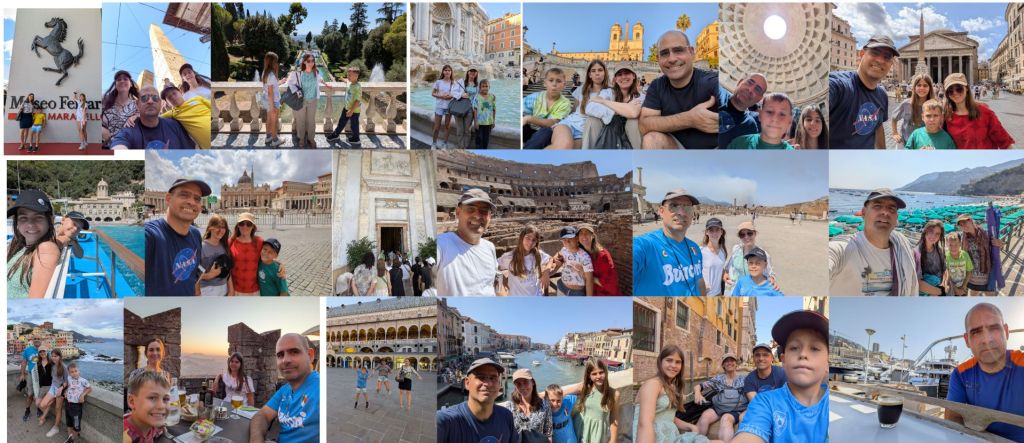
Traveling in Italy.

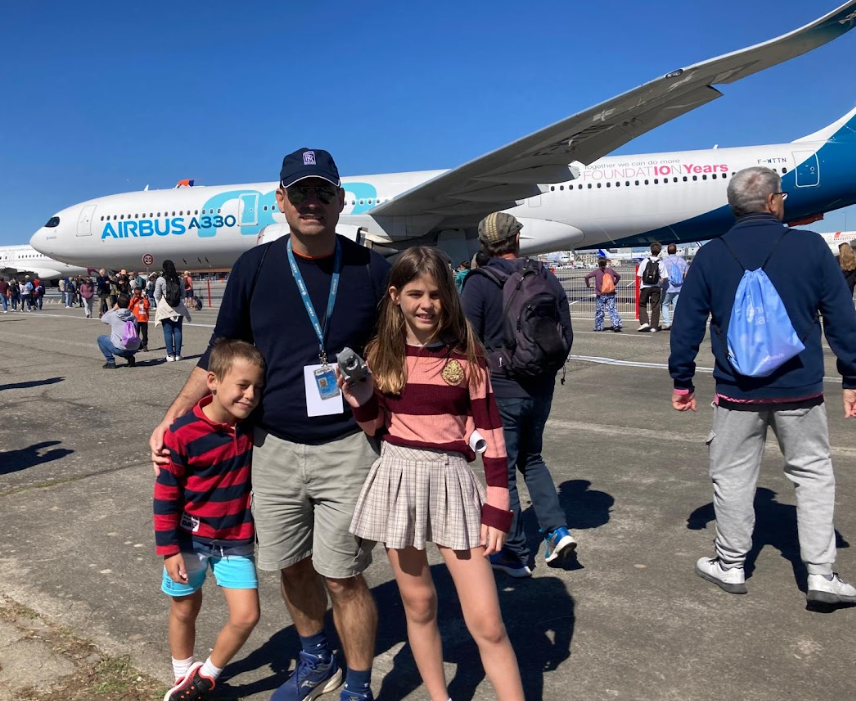
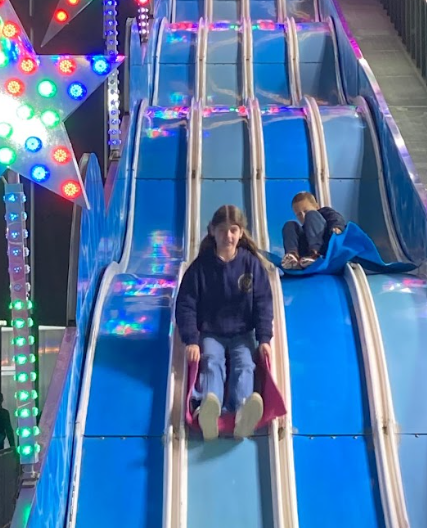
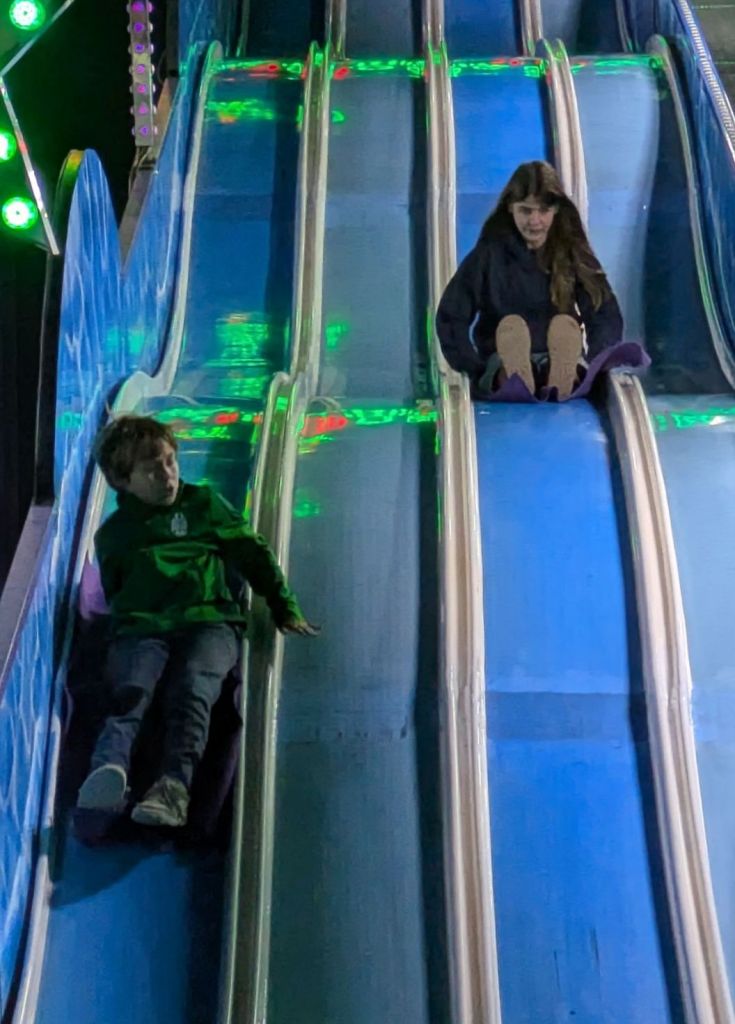
Family. Andrea is now 12 years old and David, 9.

Andrea did very well in grade 6 and has also started grade 7 well, with very good marks. She especially enjoys Science, Maths and researching for her History assignments. She continues to take Spanish lessons, to play piano and volleyball in the village team. A highlight of her school year was the musical they put together in the school, Peter Pan.
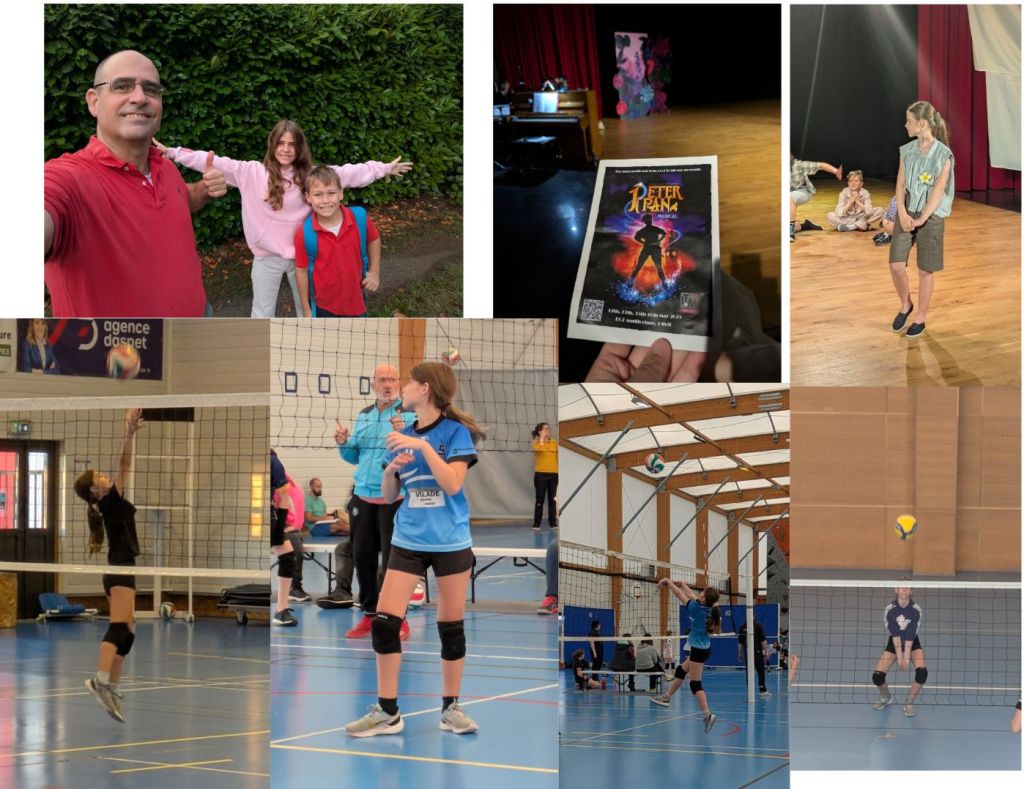
Andrea in 2025

David now loves most of all football, playing it in the school, with the village team or in video games. He is also a very good student in his grade 4, where he enjoys Math and French. He is very helpful at home and he is now in his third year of Spanish lessons. They both spent several weeks alone with my parents in Madrid during school holidays, which they loved.
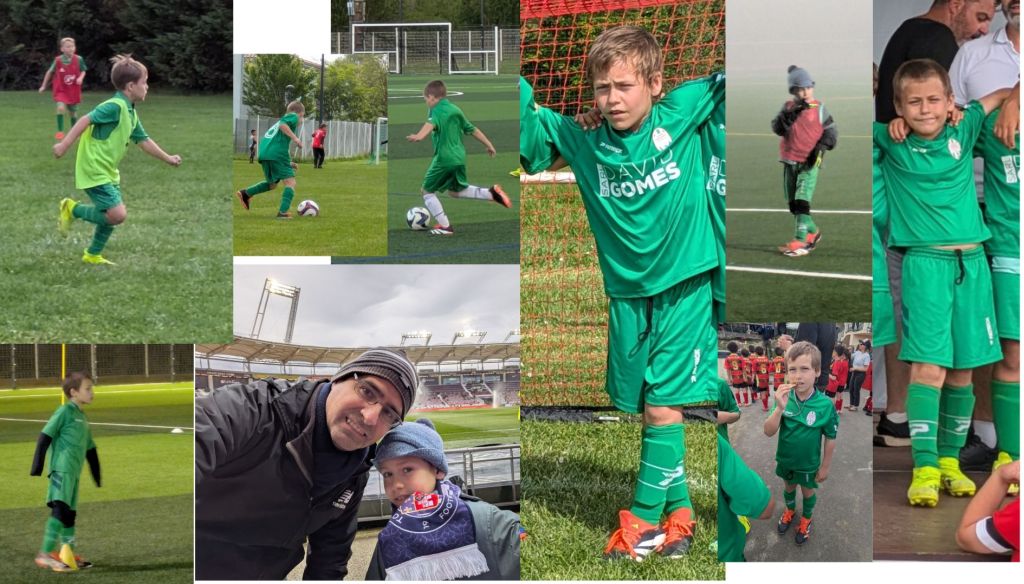
David in 2025

Running: My objectives for 2025 were to avoid injuries and to complete at least another marathon, and I managed to achieve both. I kept a good habit of running without pushing too much to avoid injuries, including adapting the marathon training plan I followed in the Autumn. I ran over 1,200km in 2025, not as much as I would have liked but at the level of 2024. Finally, on November 30th I completed my 25th marathon in Alicante.

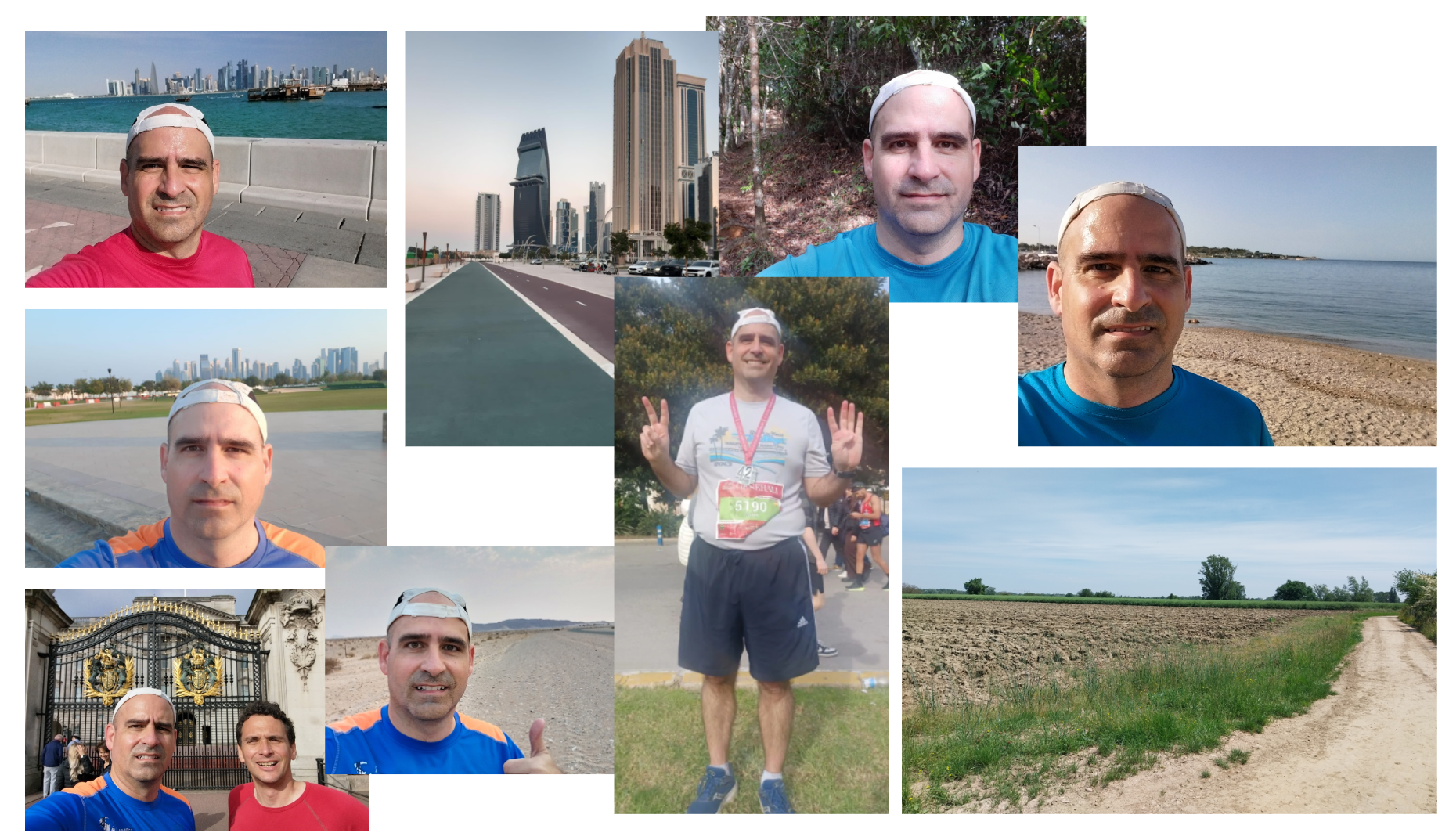
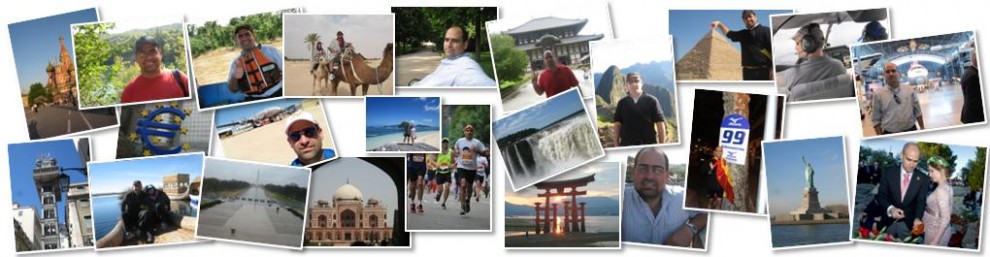
Following a mantra I try keep to the letter (when in good health), “the running shoes, always in the suitcase”, the year 2025 caught me running in: Torrelodones, Galapagar, La Grau-du-Roi, Cannes, Tuscany, Marcelli, San Marino, Padova, Monaco, Tournefeuille, Châteauroux, Péronne, Wijchen, Beijing, Shanghai, Shenzhen, Alicante, Elche and San Sebastián, plus the tens of times I trained in my village, in Blagnac and Toulouse.
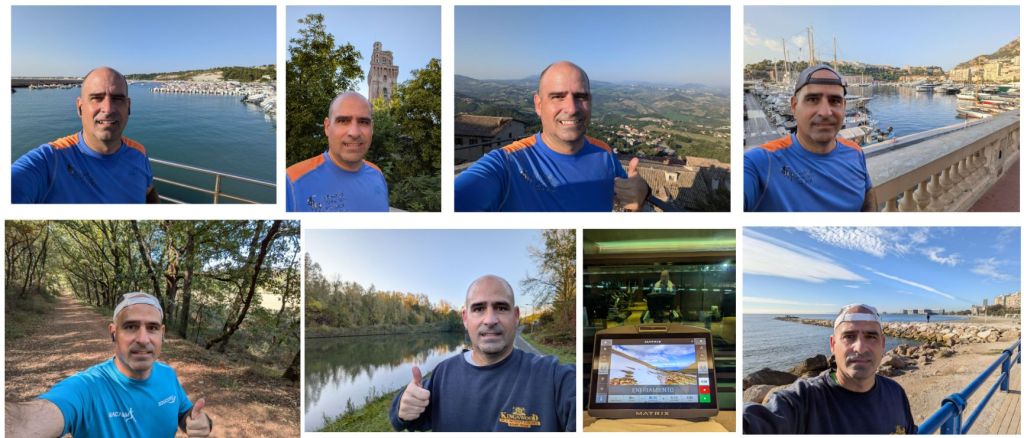
Running in places.

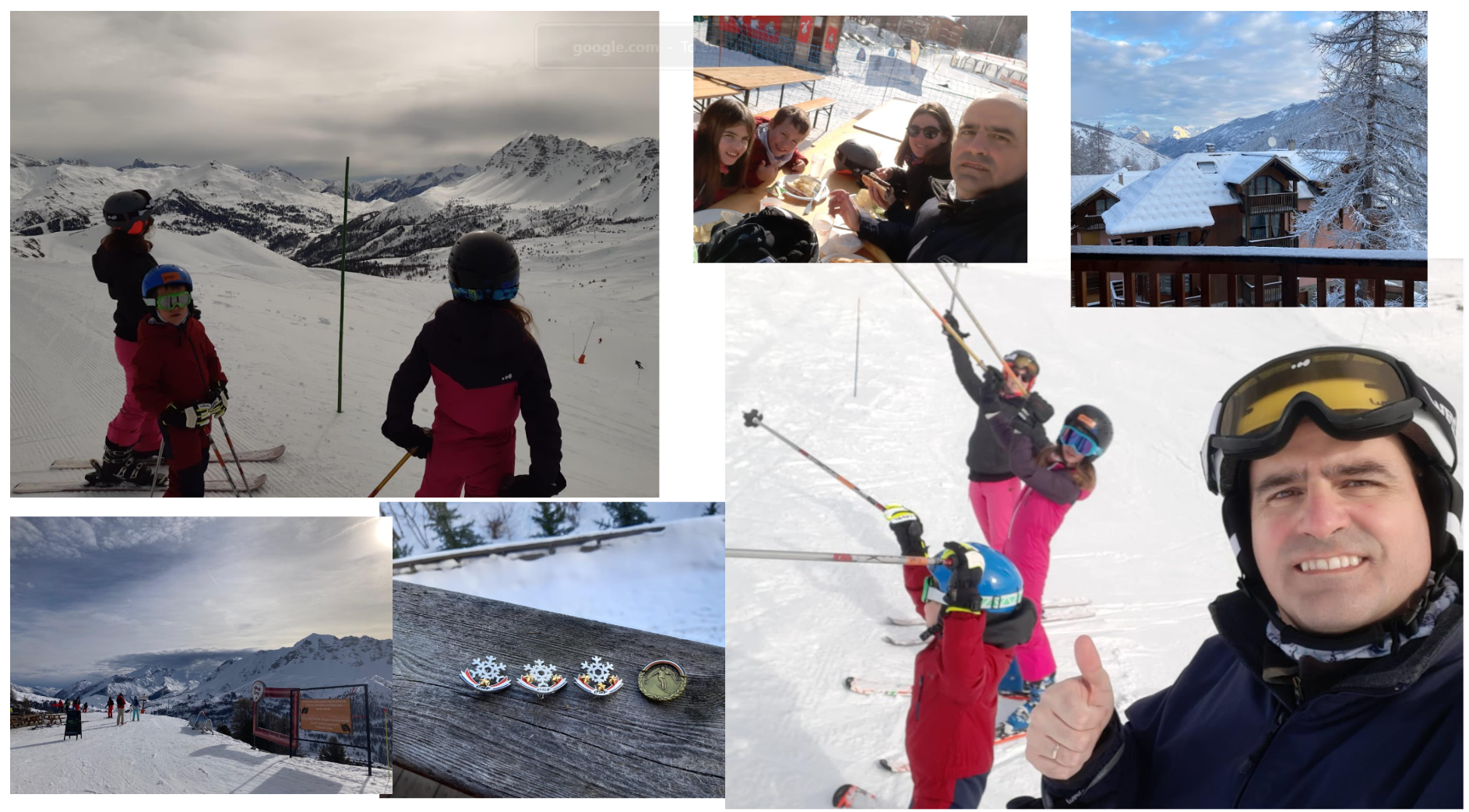
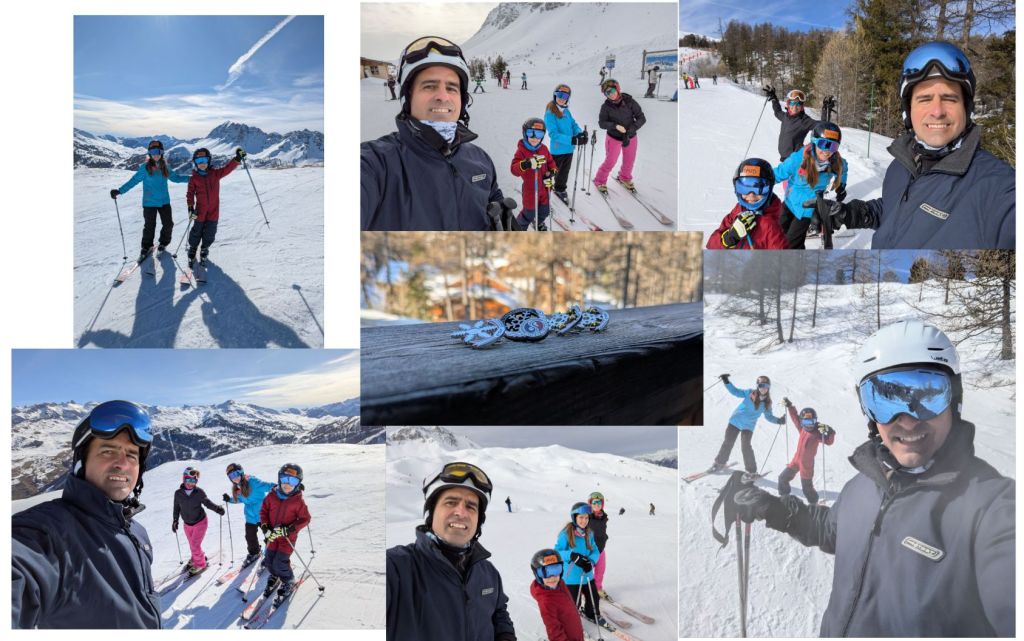
Skiing. In 2025 we went again with the family for a week to our favourite resort at Vars, in the Southern Alps. This year again we could enjoy much time skiing with the kids out of their skiing lessons. They are more daring and at ease especially skiing off tracks, and sometimes it’s difficult to keep pace with them. This year Andrea got her 3ème étoile medal and David his 2ème one (levels from the French ESF).
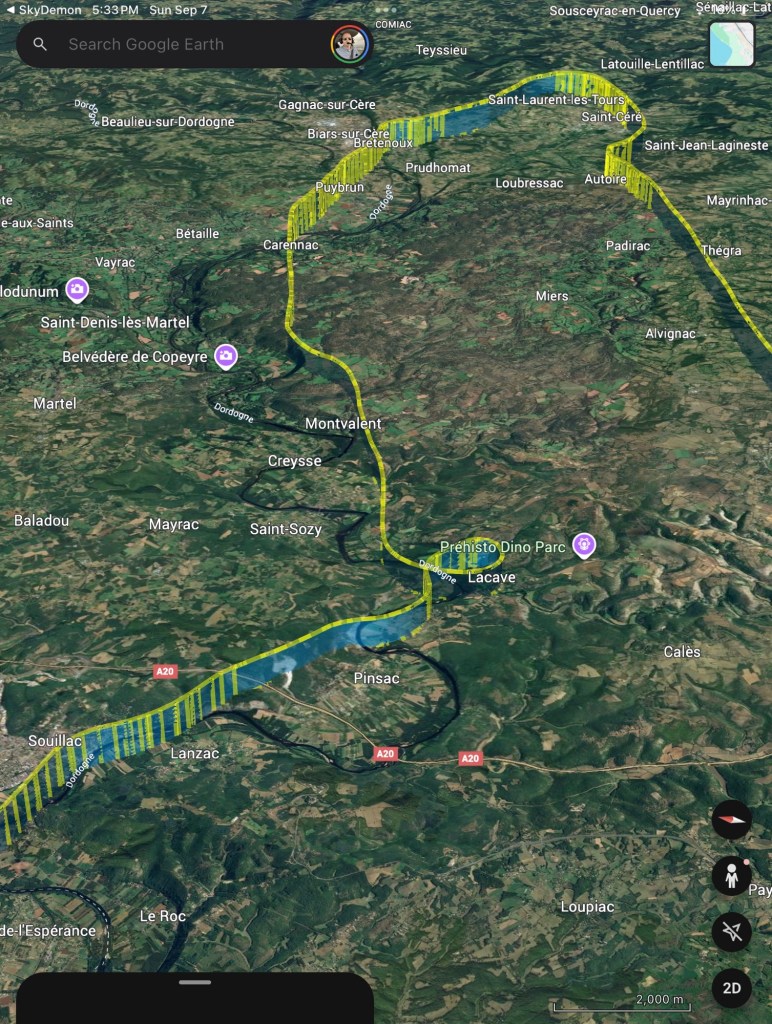
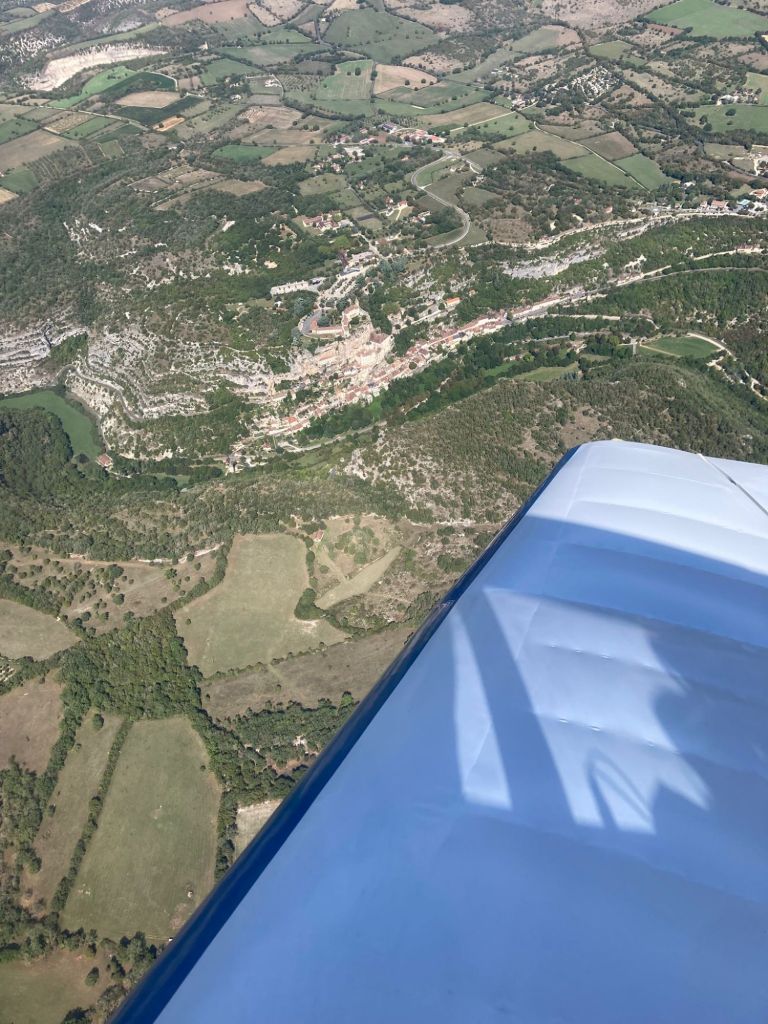
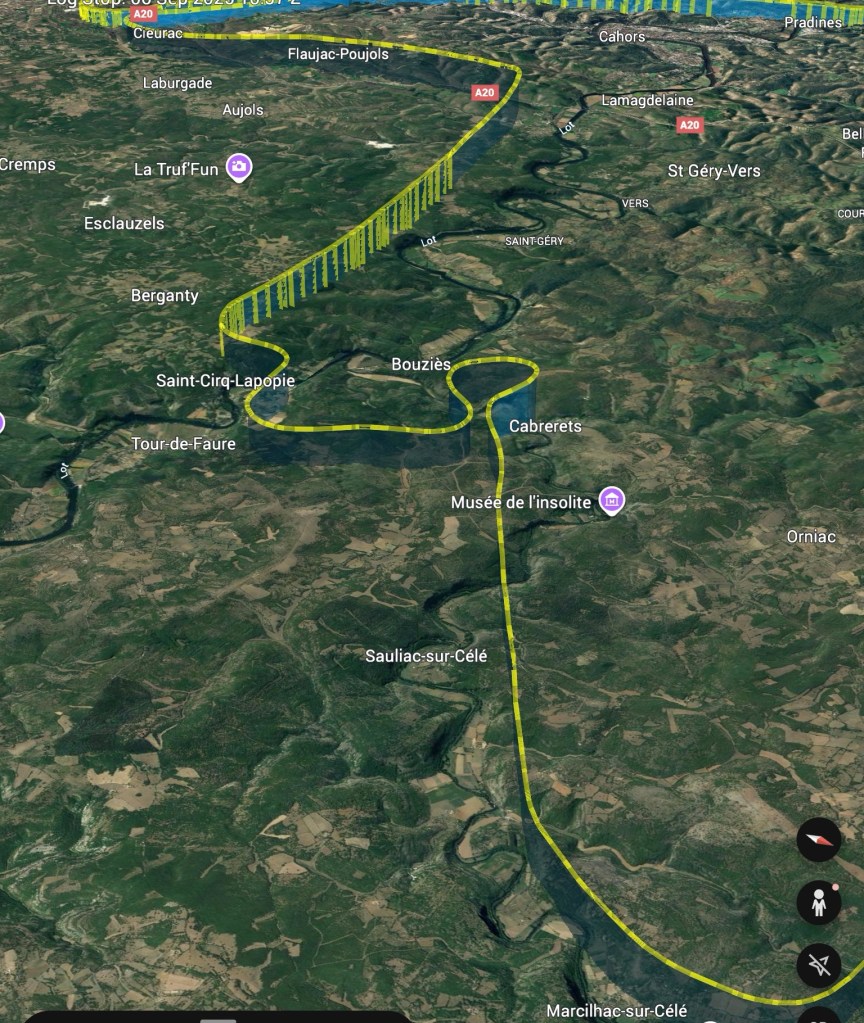
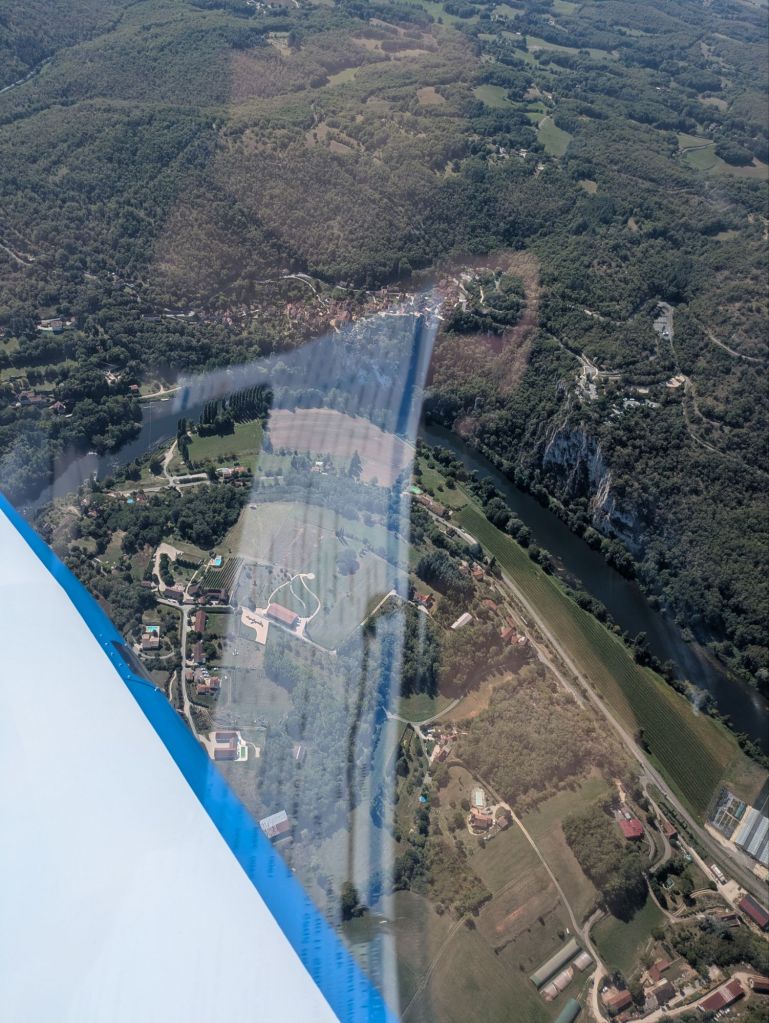
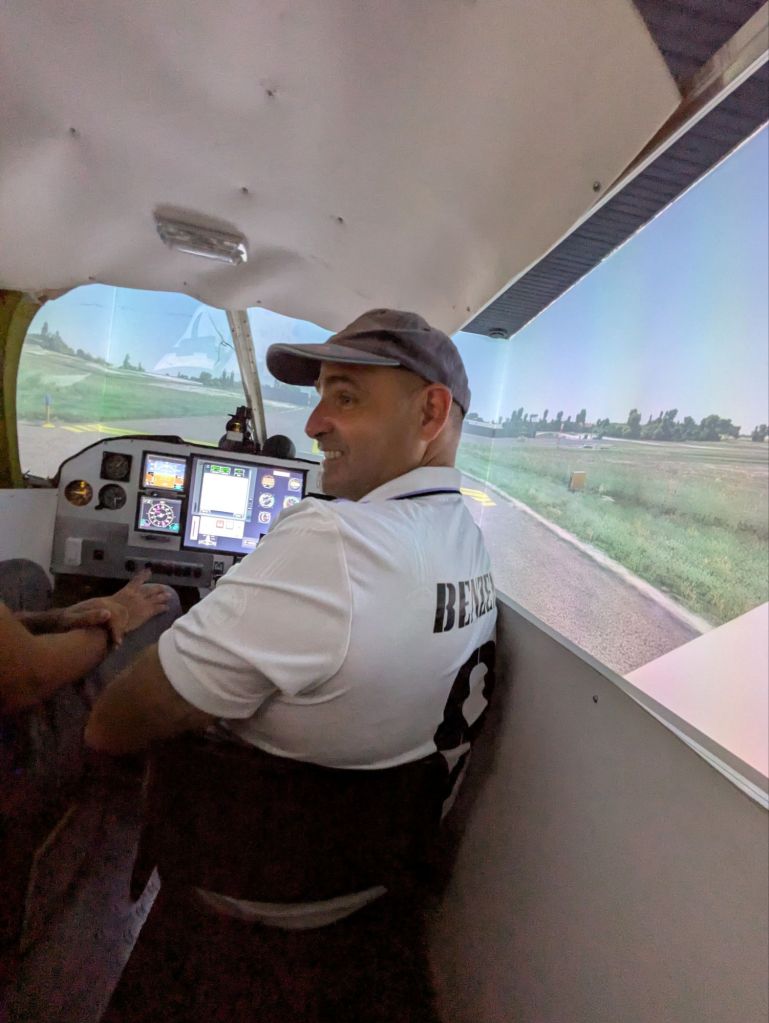
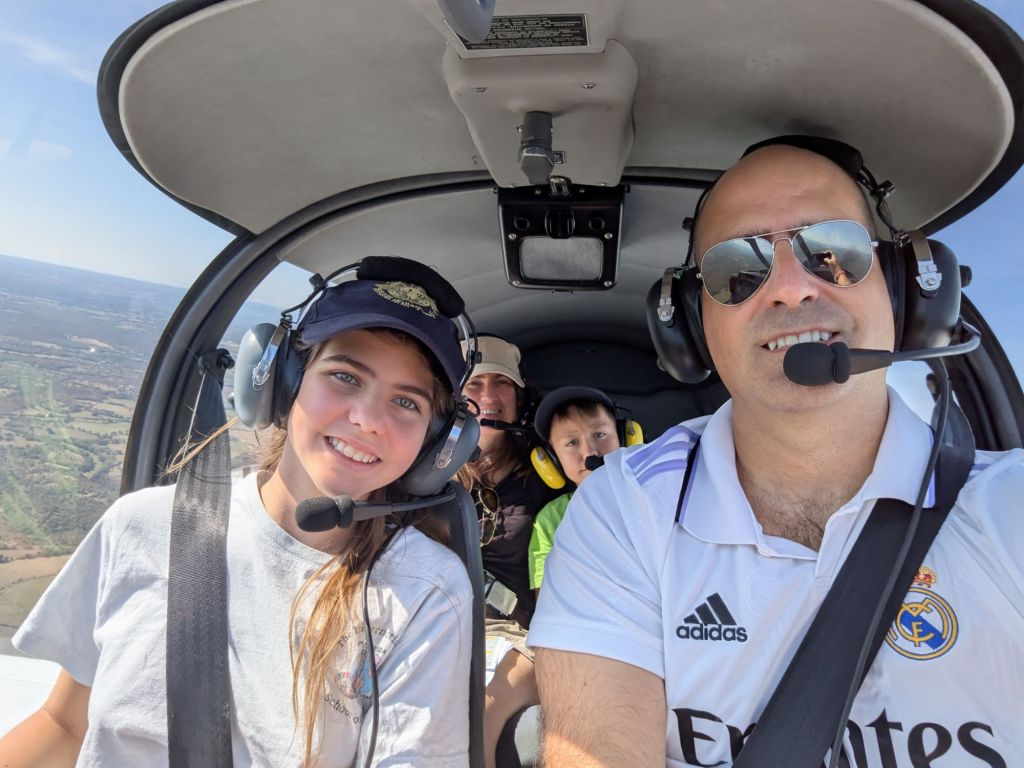
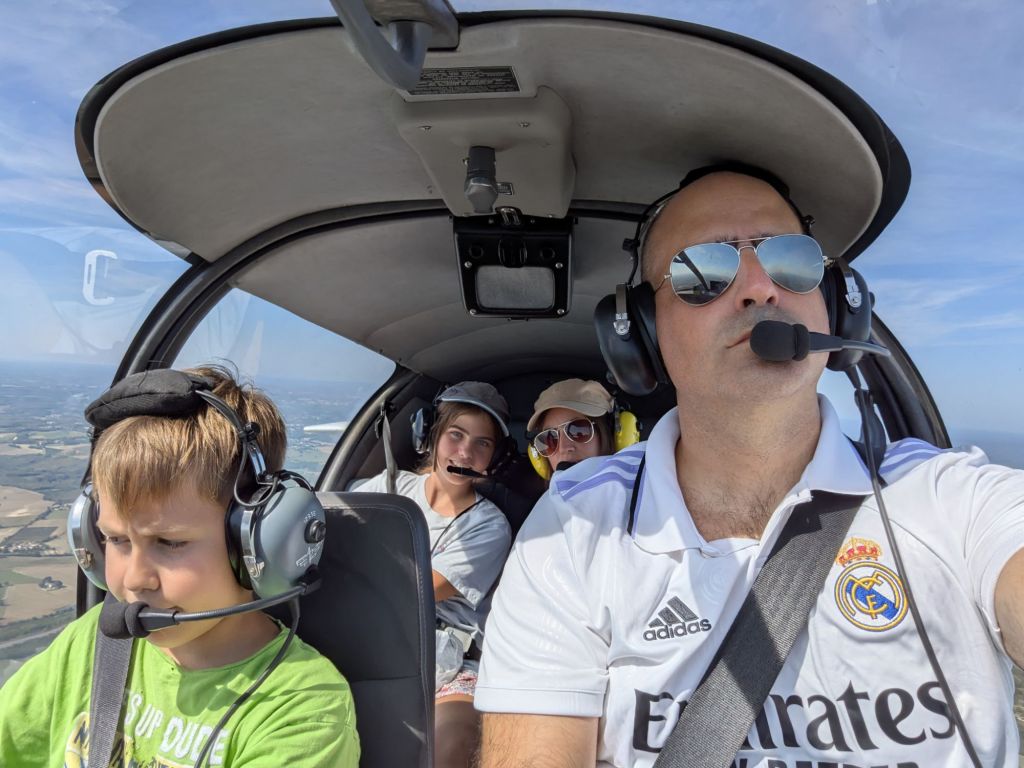
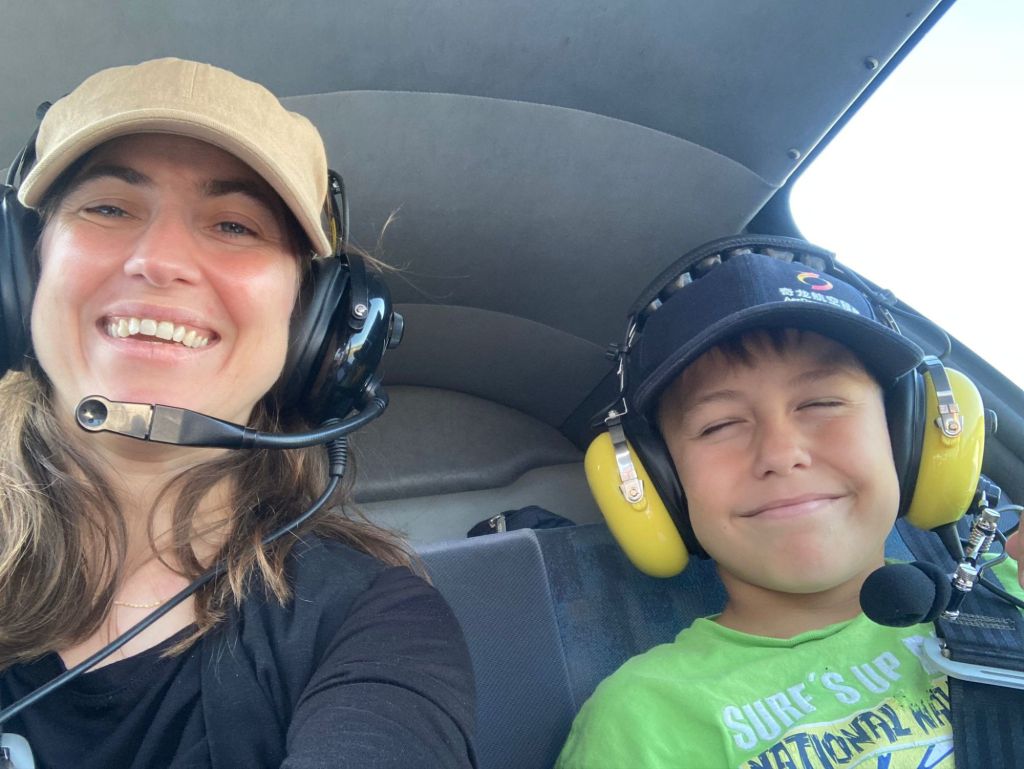
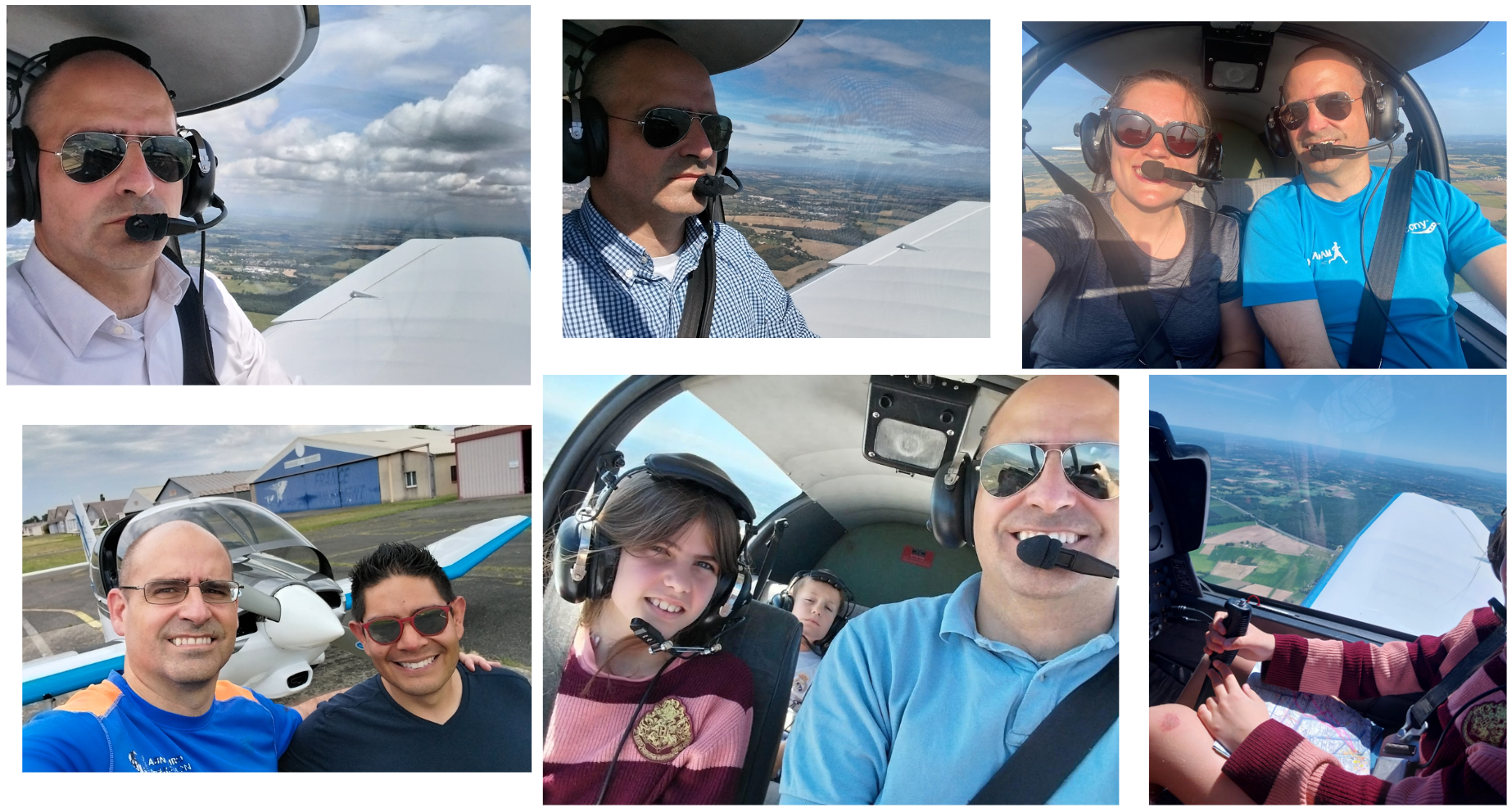
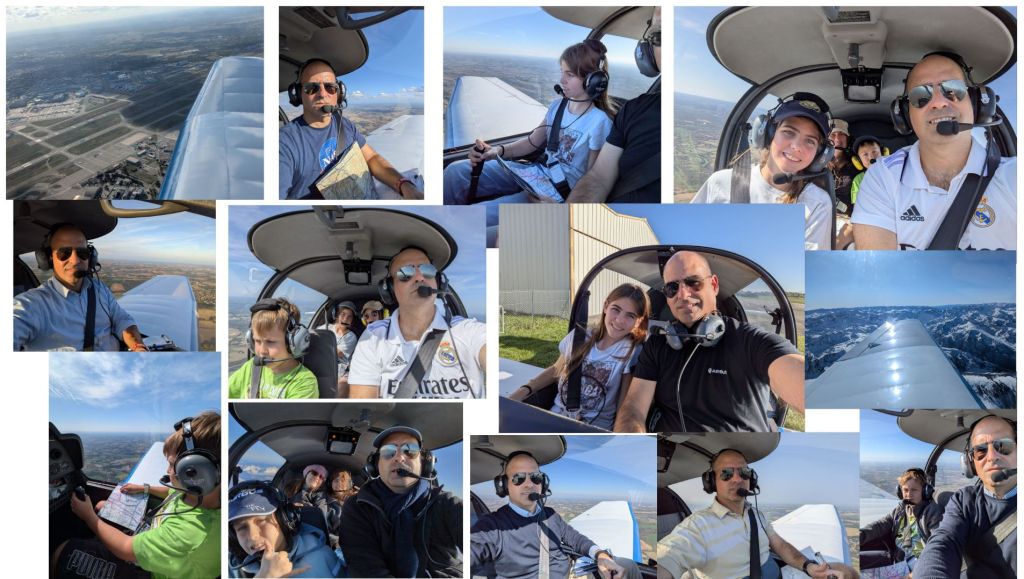
Flying. This year I managed to fly more than in 2024. I did some training flights and some others with the kids, including a nice flight excursion we did along the Lot and Dordogne valleys. In October I also had to renew my French language radio competence (FCL 055) and in November I renewed the licence by experience after flying with the instructor (SEP (single-engine piston) qualification).

In all, this year I have flown 13 flight hours, 12 flights and 30 landings. This takes my total experience to 228 flight hours and 369 landings since I started taking lessons back in 2011. Hopefully in 2026 we can take part in some excursions abroad.
Flying in 2025

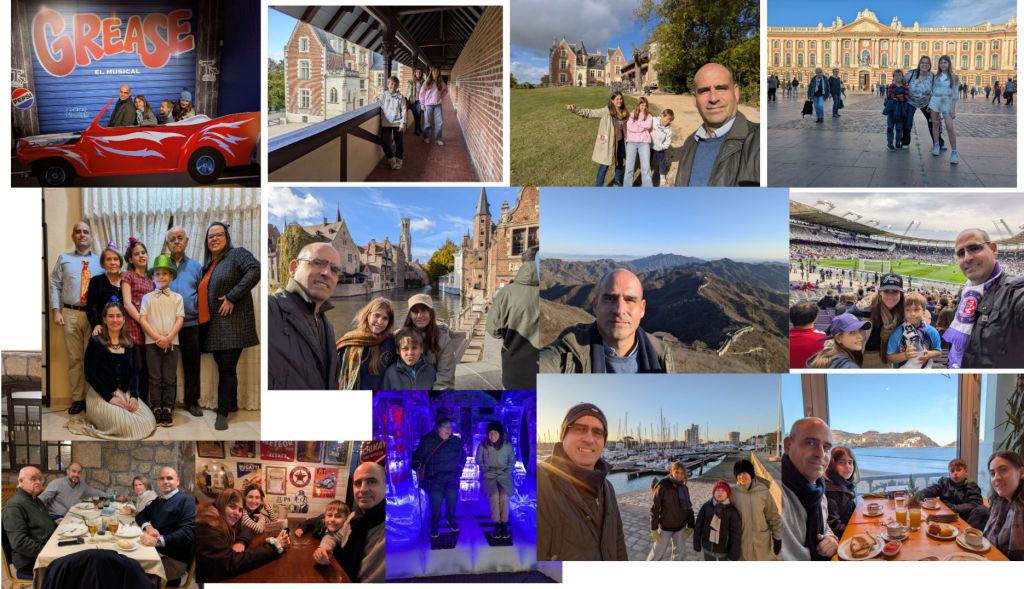
Travelling. Apart from the unforgettable trip to Italy, in this 2025 either alone or with the family we continued to visit some new and old places: Aix-en-Provence, Vars, Saint-Rémy-de-Provence, Arles, Nîmes, Burgos, Bourges, Fontainebleau, Montargis, Paris, Amboise, Brugge, Dunkerque, Pierrefonds, Beijing, Shanghai, Guangzhou, Shenzhen, Chengdu, Elche, Alicante, Wijchen, Rijswijk, Saint-Quentin, La Rochelle, Bordeaux, San Sebastián…
Reading. In this 2025, I managed to read a bit more than last year, in all 17 books, mostly in Spanish with the rest split in English and French (2 books in each language). I’m also happy to have read other 5 books of the Great Books curriculum for the bachelor in arts of Saint John’s College, a list I have been using as a reference for years. For the detailed list of books, see the post I wrote about my 2025 reading list with a brief description of each one.

Other cultural activities:

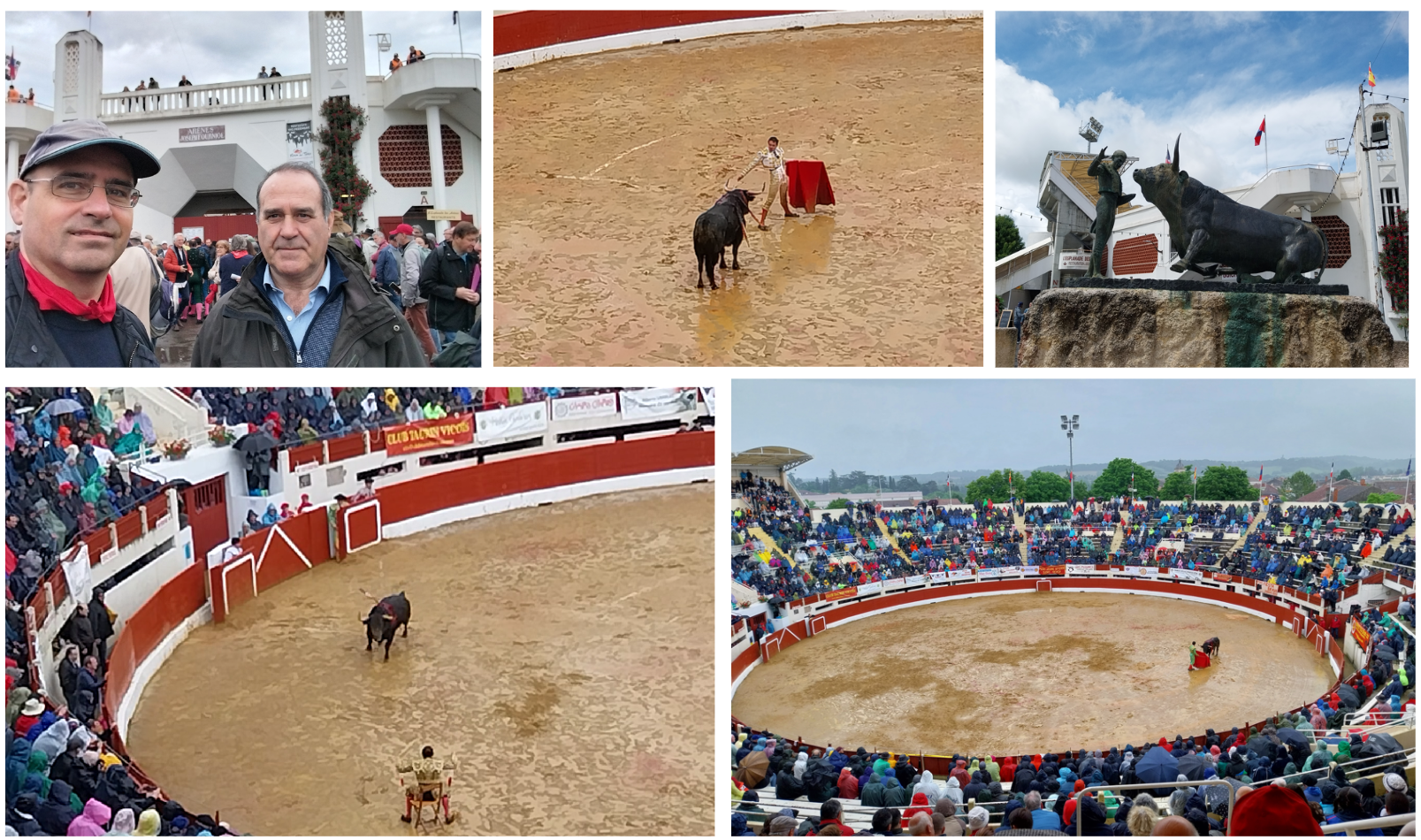
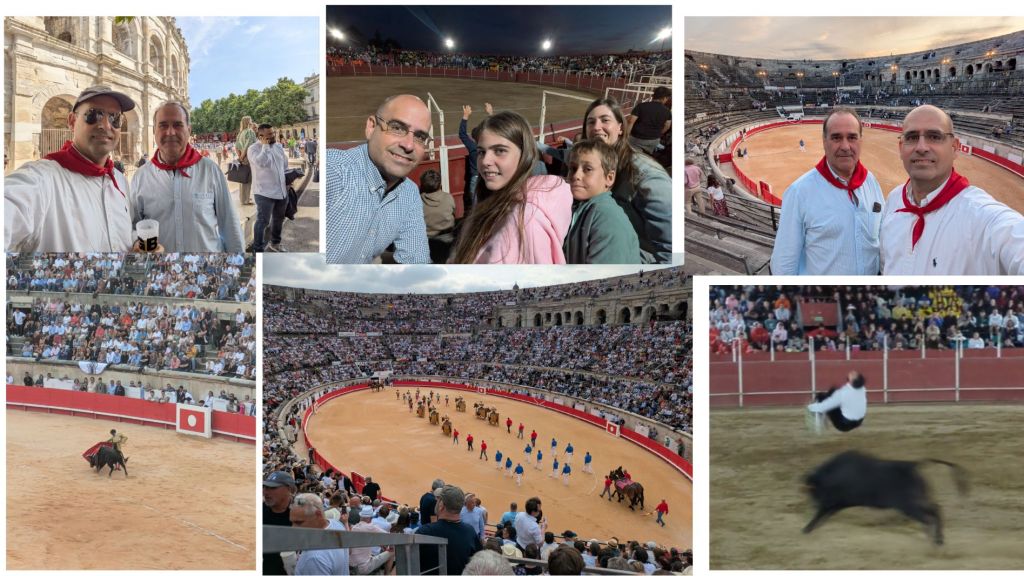
Bullfighting. This year again, together with Luismi, we went to Nîmes to attend its Feria de Pentecôte, in particular a corrida (same wording in French) with the following bullfighters: Morante de La Puebla (who had an incredible 2025 and retired in October; in Nîmes he did a good job but wasn’t lucky with the bulls), Talavante and the young Marco Pérez, the latter two were awarded 2 ears and exited through the puerta grande.

Later, in July we went with the family to a concurso de recortadores at Las Navas del Marqués (Ávila), a contest in which 12 men went into the arena one by one to dodge the bull when running towards them in impressive ways, including jumping over it. The winner was Paquito Murillo, who had been Spanish champion of that variety in the past.

I also renewed my membership to the foundation Toro de Lidia to keep supporting the art.
Theatre. We started the year with a great musical in Madrid, Grease (thanks to a wonderful invitation from my sister Beatriz!) and the Pantomime show in Pibrac where they played Rapunzel (which was hilarious). At the end of the school year we also attended the great show put up by the kids of the school with Peter Pan.

Other shows: we went with the family a few times to the cinema, with Formula 1 being the movie we liked the most. We also went to a concert of the string quartet Mascarade. We also went a couple of times to see matches from the Toulouse FC at the stadium, against Montpelier and Metz. Those were great fun especially for the kids. What we want to do in 2026 is to rather see the rugby team with the family and possibly more music concerts.

Museums. This year again we took benefit of every trip to visit as many museums and castles as we could (some of them were visited for a second or third time): Arles theater and  amphitheater, Saint Remy Provence St Paul Mausole (where Van Gogh was interned), Palais Jacques Coeur and Cathédrale in  Bourges, Château Fontainebleau, Panthéon, Notre Dame, Musée du Louvre and Les Invalides in Paris, Sainte-Marie-Majeure in Marseille, Abbazia di San Fruttuoso, Museo Enzo Ferrari Modena, Museo Ferrari Maranello, Basilica di San Petronio and Basilica di San Domenico in Bologna, Archiginnasio di Bologna, Lamborghini Museo in Sant’Agata Bolognese, Casa Museo Luciano Pavarotti, Basilica di San Francesco in Assisi, Abbazia di San Pietro in Perugia, Duomo di Orvieto, Villa d’Este in Tivoli, Pantheon, Chiesa di Sant’Ignazio di Loyola, Santa Maria sopra Minerva, Chiesa di Sant’Agnese in Agone, Musei Vaticani, St. Peter’s Basilica, Basilica di San Giovanni in Laterano and Scala Santa, Basilica di San Clemente al Laterano, Terme di Caracalla, Colosseum, Roman Forum and Palatine Hill, Basilica di Santa Maria Maggiore, Basilica di San Paolo fuori le mura, Catacombe di San Callisto, Napoli Sotterranea, Duomo di Napoli, Pompeii, Abbazia di Montecassino, Basilica di Santa Maria di Collemaggio in L’Aquila, Duomo di Atri, Santuario della Santa Casa in Loreto, Palazzo Ducale in Urbino, the towers Cesta and Guaita in San Marino, the Basilica de San Vitale, Galla Placidia, the Orthodox Baptistery, Sant’Apollinare Nuovo and the Basilica de St Francesco in Ravenna, the Basilica di San Marco, Correr Museum and the Palazzo Ducale in Venice, Château du Clos Lucé in Amboise (where Da Vinci lived his last years), Stadhuis and the Basilica of the Holy Blood in Brugge, Aviodrome museum, Museum Dunkerque 1940 Operation Dynamo, Château de Pierrefonds, Great Wall of China in Mutianyu, the Palacio de Altamira and Torre de la Basílica de Santa Maria in Elche, Aachen Rathaus, Netherlands ice sculptures Festival, Wonder van Empel, Château de Compiègne, Basilique Saint-Martin de Tours, Cathédrale Saint-André de Bordeaux.

Blogging. This is the 16th year since I started the blog in February 2010. This year I wrote just 9 blog posts, in line with the past years since 2020. It helps me to structure some ideas in some posts, to dig into some topics other times, and as a personal repository to which I come back every now and then. The blog received just over 20,800 visits, a bit more than in 2024 (in line with the past few years) and over 533,000 views since 2010.

Work. No changes in the scope of the work this year (A330neo product marketing since January 2023), neither in the team, so it was a stable year in that front.

Since 2023 the markets keep being quite active, and in 2025 we had a good year for the A330neo in terms of aircraft orders.

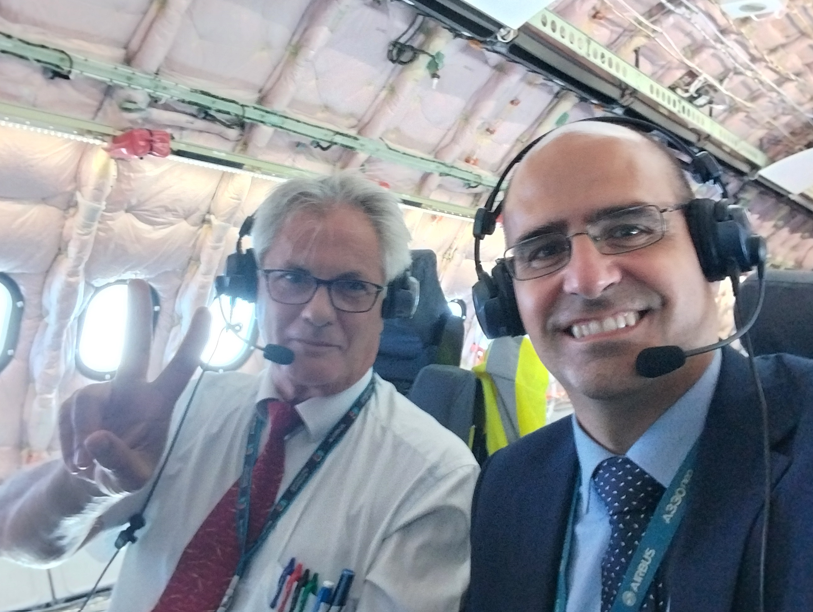
This year I had the opportunity to join a great demo tour where we rented the aircraft from an airline and we visited different pages to showcase the A330neo with colleagues from Airbus and Rolls-Royce to varied groups of customers or institutional representatives. That was a very intense week but full of new experiences. These included the first time I flew an airline’s A330neo! (I had only flown before the Airbus A330neo flight test aircraft).
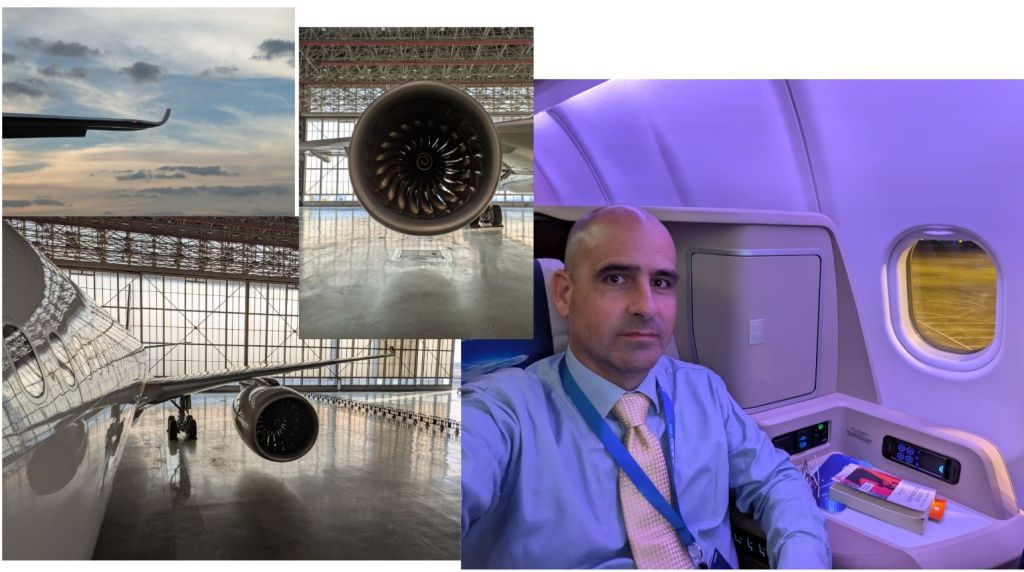
Working on the A330neo.

Now it’s time to rest, celebrate with the family and hope for the best in 2026. For the moment we have just a few days in Madrid to enjoy with family and friends and a planned skiing week in Vars; hopefully that will be just the beginning of another memorable year.

I wish you the best for 2026, enjoy it!

(*) You can see here my 2010, 2011, 2012, 2013, 2014, 2015, 2016, 2017, 2018, 2019, 2020, 2021, 2022, 2023 and 2024 recaps.

1 Comment

Filed under Uncategorized

My 2025 reading list

In this post I wanted to share the list of books I read along the year (1) with a small comment for each one. I have also included a small rating from one to three “+” depending on how much I do recommend its reading.

  1. Gobierno omnipotente” (Omnipotent Government: The Rise of the Total State and Total War) by Ludwig von Mises (++): Written in 1944, the book shares a critique of state interventionism and central planning on their diverse varieties (socialism, Marxism, nationalism, Nazism), analyzing similarities and differences among them, and the economic and social disasters generated by them in the first half of the XX century, including disastrous wars. [Twitter thread]
  2. El origen de las especies” (On the origin of species) by Charles Darwin (++): In this famous book written in 1859, Darwin shares his theory of natural selection and survival of the fittest. The book includes numerous examples of evolutionary changes, variations, mutations in different species across the world, counter points and many references to previous studies on the topic (the theory didn’t occur to him out of the blue, but this book is more a compendium of different elements supporting it). The laws that in general terms define evolution are: growth with reproduction, heritage, variation (due to changes of life conditions, use or lack of use), a rate of growth so great that leads to the fight for survival and as a consequence of this natural selection determined by a divergence of characters and the extinction of the less perfect forms. The 6th edition that I read includes as well a review of previous criticisms made to his first editions. The book also includes a discussion of how evolution can still work with the divine creation of a short number of different forms that later evolve.  [Twitter thread]
  3. La mayor ocasión que verá el siglo XXI” by Rafael Acedo (+++): Rafael Acedo is one of my former bosses at Airbus Military and most importantly a senior executive of the company that held different positions, in particular in Programme management and Engineering. This book tells with a unique point of view the fascinating story of the genesis of the A330 MRTT (multi role tanker transport) aircraft. The book offers a blend of technical aspects of the design and development, insight into the sales campaigns with their various requirements that shaped the products, the personnel selection searching for the right engineers to lead those developments, the leadership struggles and styles at CASA and with the integration into EADS… It is an excellent book.
  4. A room of one’s own“, by Virginia Woolf (+): This short book is based on 2 lectures given in 1928 about women and writing. It emphasizes the need for financial independence, a room without interruptions, access to education and time (“give her hundred years“) for women to shine in literature. [Twitter thread]
  5. Tractatus logico-philosophicus” by Ludwig Wittgenstein (-): Essay written in 1918 about language, logic, mathematics and their limits, and how the meaning of the world, ethics, mysticism are outside of what can be expressed. The language used and writing style make for a very difficult read even if it is a very short book. [Twitter thread]
  6. La cuestión P vs. NP” by Jordi Delgado Pin (-): This is a short book from a collection of Mathematics books I started reading some years ago. This particular one is an introduction to computational complexity, and the analysis of the time it takes to solve problems. Too technical for a reader that it’s not into programming like myself. [Twitter thread]
  7. Elements” by Euclid (++): The book I read is Simson’s translation of 1774, and includes the books I to VI, XI and XII of the geometry manual of the 3rd century BC by Euclid, a classic of Western civilization. Throughout the different books Euclid departs from few definitions, postulates and axioms and goes into graphically calculating different distances, angles, surfaces, etc., with the help of what has been proven before. Some of those exercises are studied in a high school technical drawing course (e.g., how to circumscribe a circle about a triangle) many others are technical drawing on steroids. [Twitter thread]
  8. Faust” by Goethe (+): Written in 1832, the book is a dramatic poem (in rhyme in the original German) where Faust makes a pact with the devil Mephistopheles to grow in knowledge and live all kinds of experiences; including the love of Grechten and Helen, various parties and military conquests. [Twitter thread]
  9. Politics” by Aristotle (++): The book, written in the IV century BC, offers a critique of Plato’s Republic, and it’s essay on constitutions for different states, forms of government (monarchy, aristocracy, democracy, oligarchy, tyranny), on virtues, citizens, the separation of powers, the different magistracies, about private property, slaves, women, the natural inequalities among individuals… [Twitter thread]
  10. Peter Pan” by James M. Barrie (++): Narrated form (1911) of the play (1904) about the adventures of Peter Pan, Wendy, Hook, Tinker Bell… Peter Pan is today a character of world fame, a boy who refuses to grow up and goes to live in Neverland. An aviation angle: his passion for flying and the fact that to fly the only thing which is required are happy thoughts. [Twitter thread]
  11. Dinero, crédito bancario y ciclos económicos” (Money, bank credit and economic cycles) by Jesús Huerta de Soto (+++): Huerta de Soto is a Spanish economist of the Austrian School of economics. The book, written in 1998, calls for a system of free banking with 100% reserve requirement for deposits, the elimination of central banks and a return to the gold standard. To arrive at those proposals the book analyzes the business cycles and how fractional reserve banking distorts investments decisions, capital allocation, creates inflation and crises. The book offers a comprehensive historical overview of several authors and schools of thought (back to the Middle Age), with numerous citations and an extensive bibliography. [Twitter thread]
  12. Historiones de la Geografía” by Diego González (+++): The book is a collection of short stories and curiosities about islands, remote territories, unique borders, time zones… Very much like the blog Fronteras (in Spanish) but now compiled in a book, with the fresh style of its author Diego.[Twitter thread]
  13. La energía nuclear salvará el mundo” (Nuclear energy will save the world) by Alfredo García (+++): A brilliant exercise in popularizing nuclear energy, the science and technology behind it, its unique safety levels (contrary to popular beliefs and the defamation campaigns against it; in particular I loved the detailed analysis of how there’s no risk with eating fish from Fukushima! Much less than with eating bananas), the most well-known accidents (their origin, an account of what happened and what not! i.e., it turns out that most of those accidents are success stories despite how they have stayed in the collective memory), waste management, the need for nuclear energy in the energy decarbonization path, new technologies… The author, Alfredo , works at a nuclear plant and is very active in Twitter / X, follow him (in Spanish) for more information.[Twitter thread]
  14. Annals” by Tacitus (+): Written around 102 AD, it describes year by year (consulship by consulship), from the death of Augustus in the year 14 to the fall of Nero in 68, with large gaps not preserved. The book mainly deals with the reigns of Tiberius and Nero. Every year it gives an account of the relevant events of the empire: about wars and their development, conquests and appointments in the provinces; discussion of some laws being passed, trials, betrayals, notable executions and suicides in Rome. [Twitter thread]
  15. Cyrano de Bergerac” by Edmond Rostand (+++): Written in 1897, the book is a theatre play entirely in verse, which is based on some true characters of the XVII century and which has as themes the choice (that Roxane has to make) between beauty (Christian) and the talents, the words and the pen of Cyrano. Along the play the characters exhibit honor, humor, the Gascon spirit, freedom (“panache“). Only by the end, when it might be too late, Roxane discovers what had been going on and how wrong she was. A very amusing and dynamic opening. [Twitter thread]
  16. Human Action, a treatise on economics“, by Ludwig von Mises (+++): Written in 1949, Human Action is the main work of Von Mises (4 volumes), an economist from the Austrian school. In the book he defends that human action is directed to reduce current uneasiness, that there’s a time preference, that humans are beings that show social cooperation that allows division of labor, which enables individuals to save and accumulate capital. This will lead to an increase of productivity, increasing added value, offering better products at lower prices, the beauty of capitalism, the market economy, prices, consumer satisfaction as the ultimate goal and profits only accrued when that has happened… as opposed to government intervention, socialism and lack of economic calculation, leading to miss allocation of capital, increase in poverty, etc.
  17. Réconciliation. Mémoires” by King Juan Carlos I & Laurence Debray (+++): In this rare autobiography by a king, Juan Carlos talks about childhood in exile (Italy, Switzerland, Portugal) and in Madrid during the Franco regime (where he was raised away from his family). The formation of his family in the 1960s and his relationship with other royal houses. He shares some of his exchanges with Franco and the dictator left to the future king some of the reforms to be made. He talks about coronation, how he shaped the government that would launch the transition to democracy and the following modernization of Spain. He also discussed his abdication, his current retirement in Abu Dhabi and he explains the sadly limited relationship he has now with his son, king Felipe VI. An overarching theme in the book is the importance of the Crown for the unity of the country and its long term vision. Finally, he explains that he is publishing this book to counter the attacks on the Crown by the current socialist government and its revisionism of History.

This year I read more than in 2024, with a good habit in the first half of the year and the last 3 months, but struggling to find continuity in the summer months, when I was stuck with Annals. In the end I read 17 books and nearly 7,300 pages (~20 pages a day on average), most of them in Spanish with a couple of books in English and another couple in French. Among them I read 5 books out of the Great Books list.

A resolution for 2026 will be to keep the habit, for which I will be following these two tips that I share every year:

  • a blog post from Farnam Street blog “Just Twenty-Five Pages a Day“, which was published well after I had adopted such an approach to reading but captures it very well,
  • the Wikipedia article about the Pomodoro Technique, which enables you to efficiently use the last hours of the day.

Another question that I have got a few times is about the source of the list of some of the classics that I read. That one comes from yet another blog post from Farnam Street blog. That post mentioned the Great Books curriculum for the bachelor in arts of Saint John’s College in Annapolis. You can get the list from the Wikipedia or directly from the college website. As I am not reading exclusively those books I advance at a pace of 5 to 8 books out of that curriculum per year, thus it will take me other 20 years to finish the program.

I wish you all very interesting reads in 2026!


(1) You can find here: my 2012 reading list, 2013, 2014, 2015, 2016, 2017, 2018, 2019, 2020, 2021, 2022, 2023 and 2024 ones.

1 Comment

Filed under Books

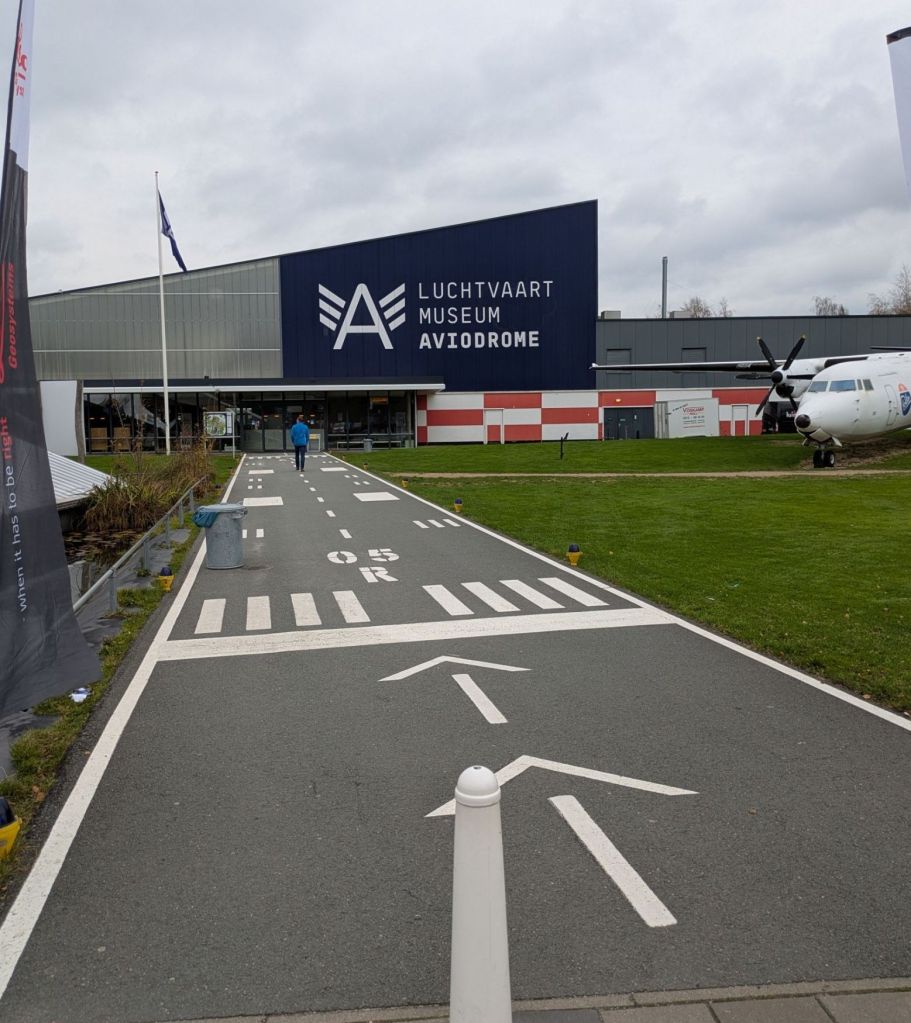
Aviodrome, the Aviation museum of The Netherlands

A couple of months ago we visited for a second time the Luchtvaart Museum Aviodrome, the Aviation museum of The Netherlands, located in Lelystadt, a village on reclaimed land of the former Zuiderzee. The village was founded in 1967 and named after Cornelis Lely, the civil engineer behind the Afsluitdijk dyke. Shortly after, the construction of a local airport started and the first flights took place in 1971, in which today is the biggest general aviation airport in The Netherlands.

The museum is organized around 4 sections: the main indoor exhibition with a chronological tour through aviation history with a particular focus on Dutch contributions, the outdoors exhibition with a former KLM Boeing 747 open for visits as the main attraction, a hangar with some old aircraft with a Douglas DC-2 as main attraction and a replica of how Schiphol airport looked like in 1928.

Indoor exhibition

The main exhibition starts with the dawn of aviation from Da Vinci, to Montgolfier, to the Wright brothers, including some replicas and plenty of interactive games for kids to play with and understand some basics of aerodynamic, flight control, etc. Then the focus of the museum is on the Dutch side of aviation with the main characters of Anthony Fokker (aircraft designer), Frederick (Frits) Koolhoven (an automobile engineer turned aircraft designer) and KLM Royal Dutch Airlines with a focus on its first president Albert Plesman (who remained its CEO for 35 years until his death).

Some of the aircraft in the collection that I liked the most were the ones below:

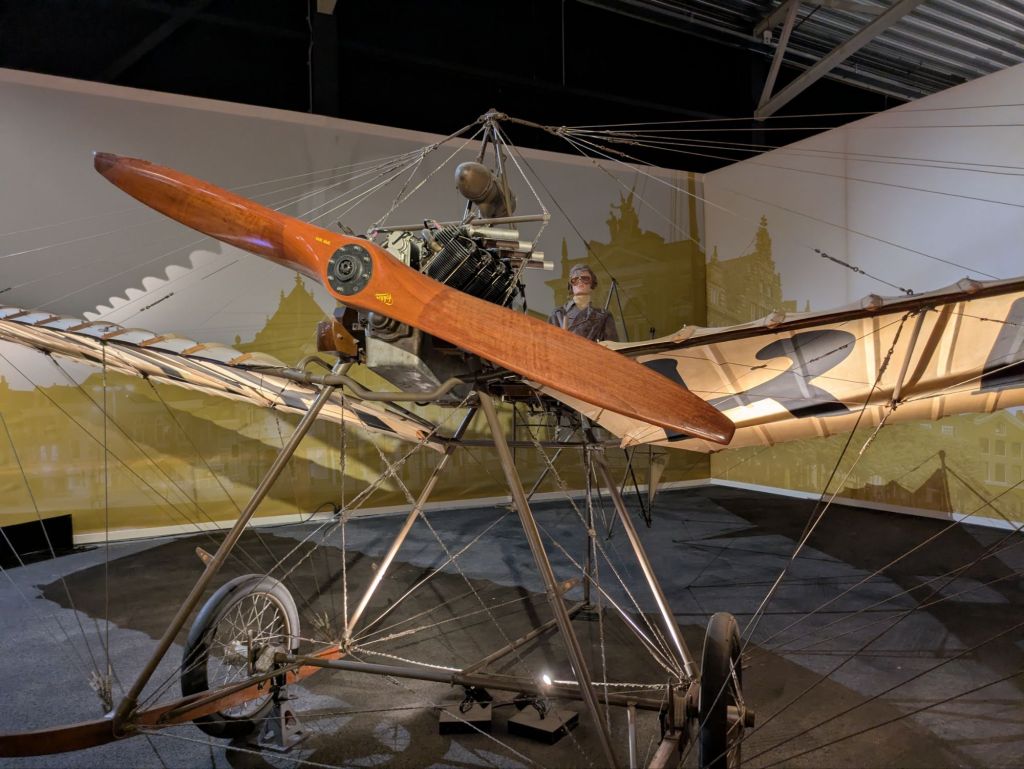
Fokker Spin: Fokker’s first airplane.
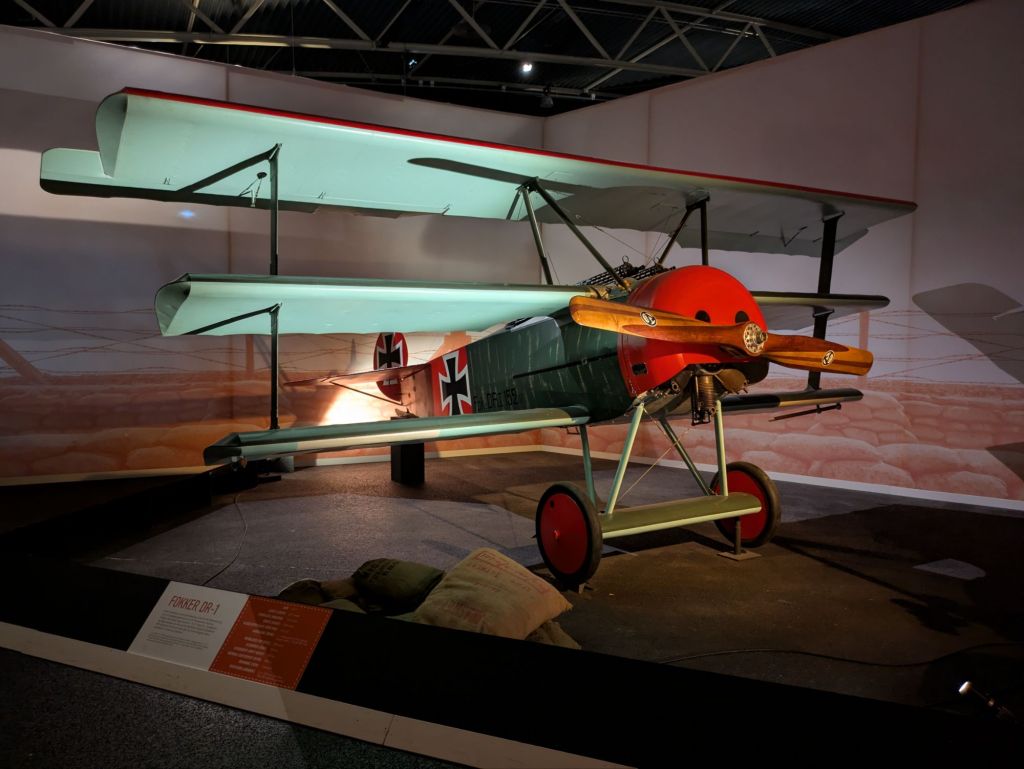
Fokker Dr.1: the famous triplane. The one flown by Manfred von Richthofen, the “Red Baron“, who created the aura with the nickname and red coloured plane to intimidate opponents in the air, who would immediately know they had such an effective ace on their tail!
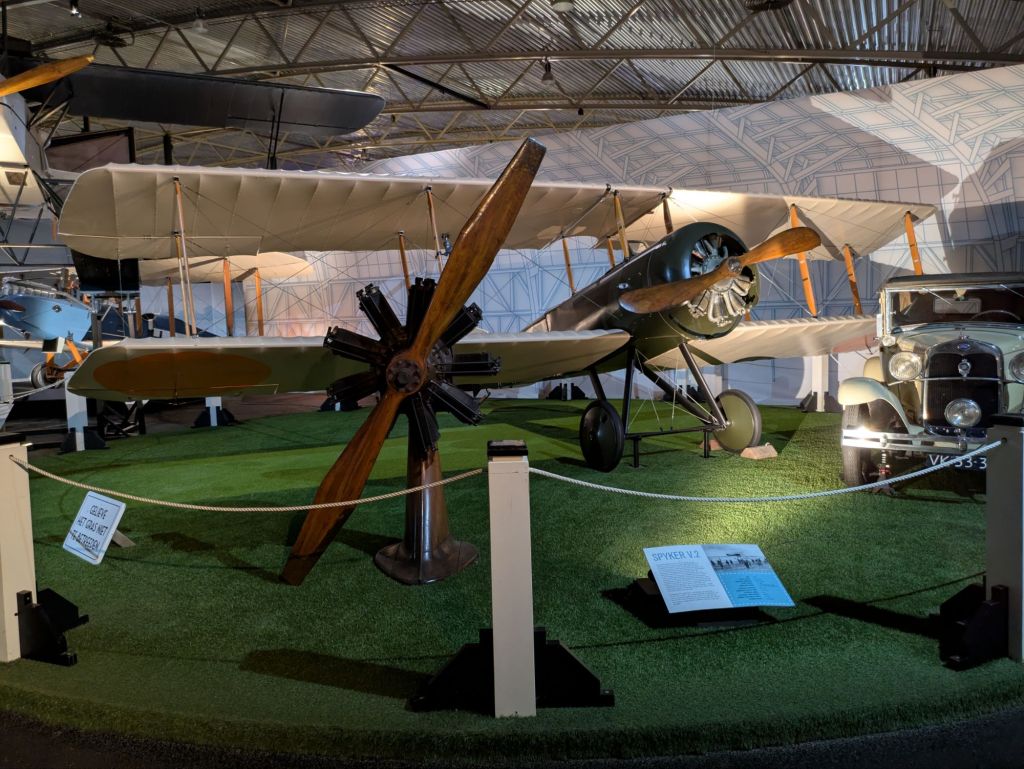
Spyker V.2: the first aircraft designed in the Netherlands to be produced in series.
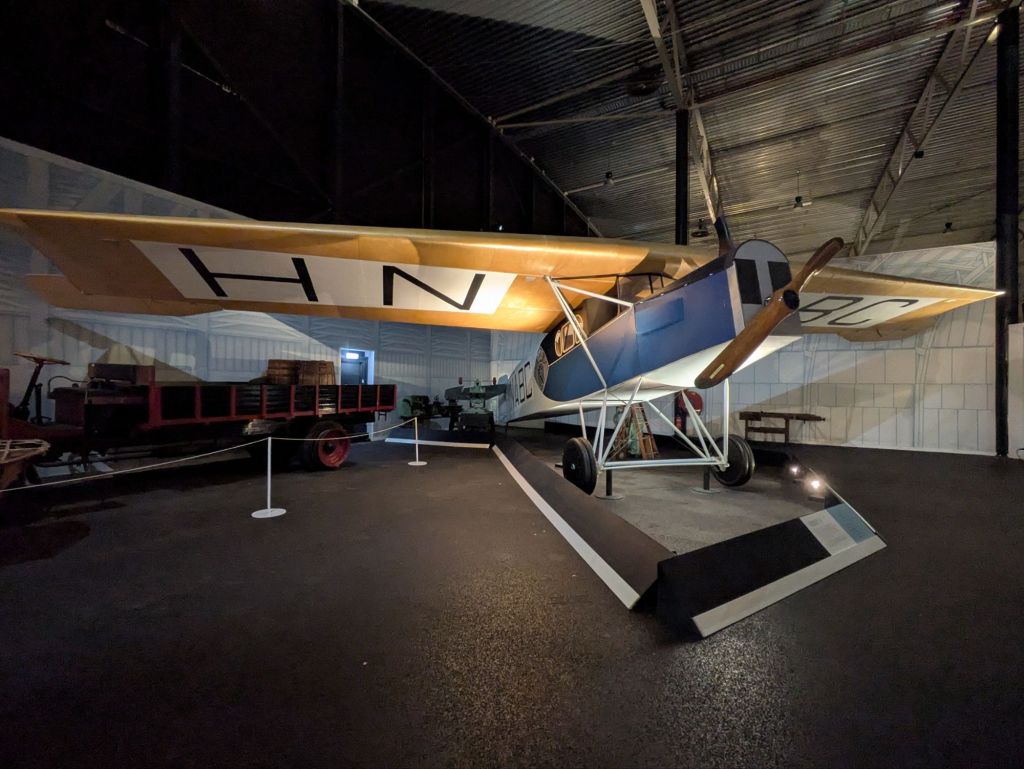
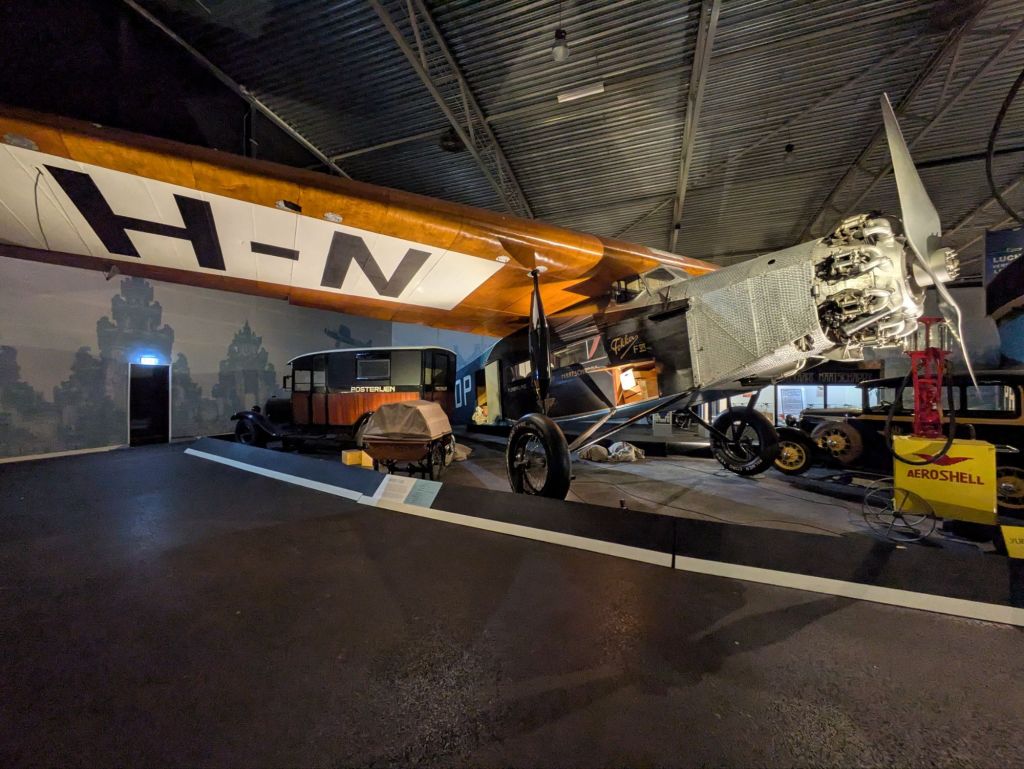
Fokker F.II: the first aircraft acquired by KLM with which KLM connected The Netherlands with England; also the first passenger airplane with a closed cabin.
Fokker F.VII: which flew for the first time between The Netherlands and the Dutch East Indies, in 1924.
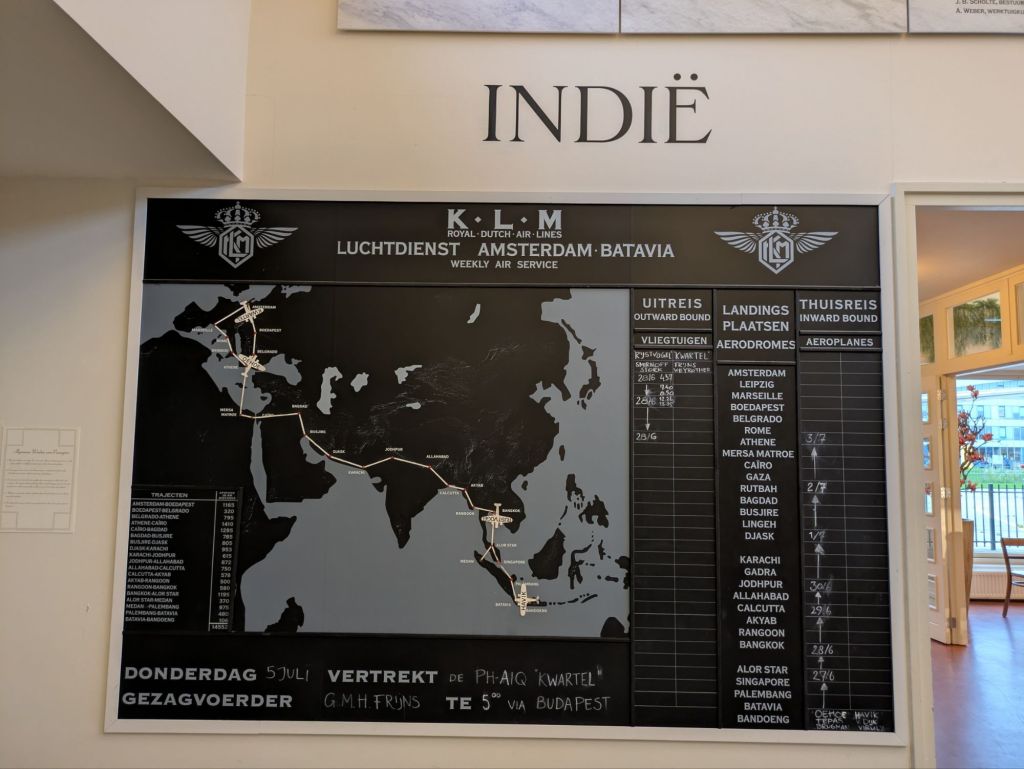
Route from Amsterdam to Batavia (1933).
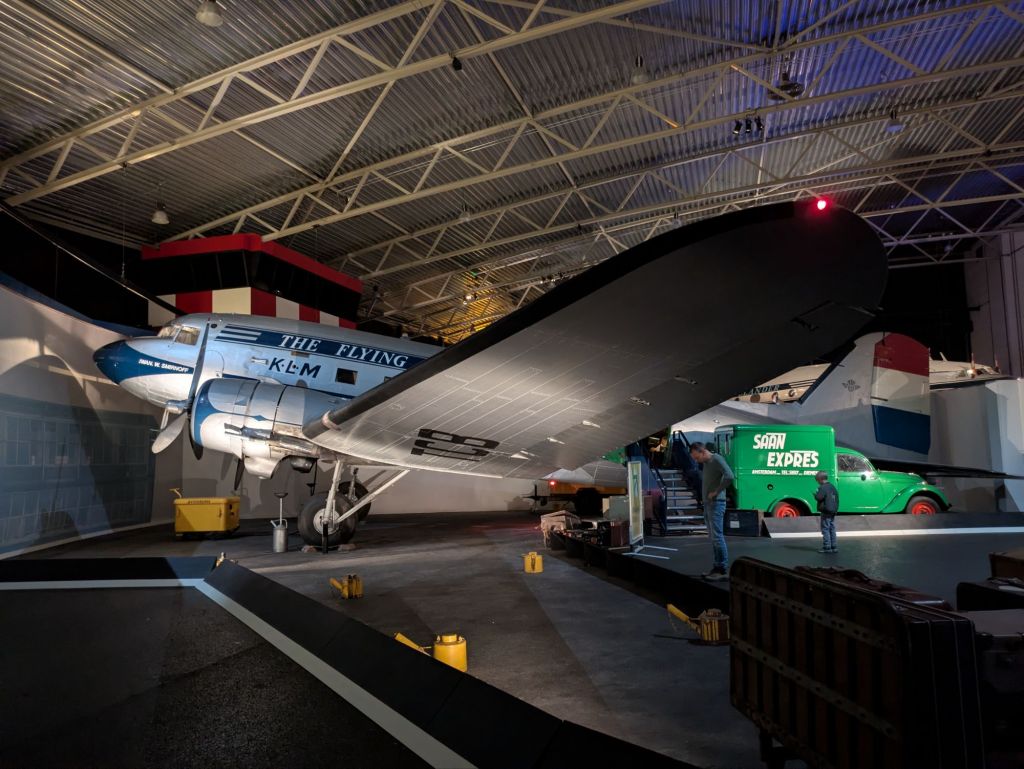
Douglas DC-3: which KLM flew before WWII and until 1973.
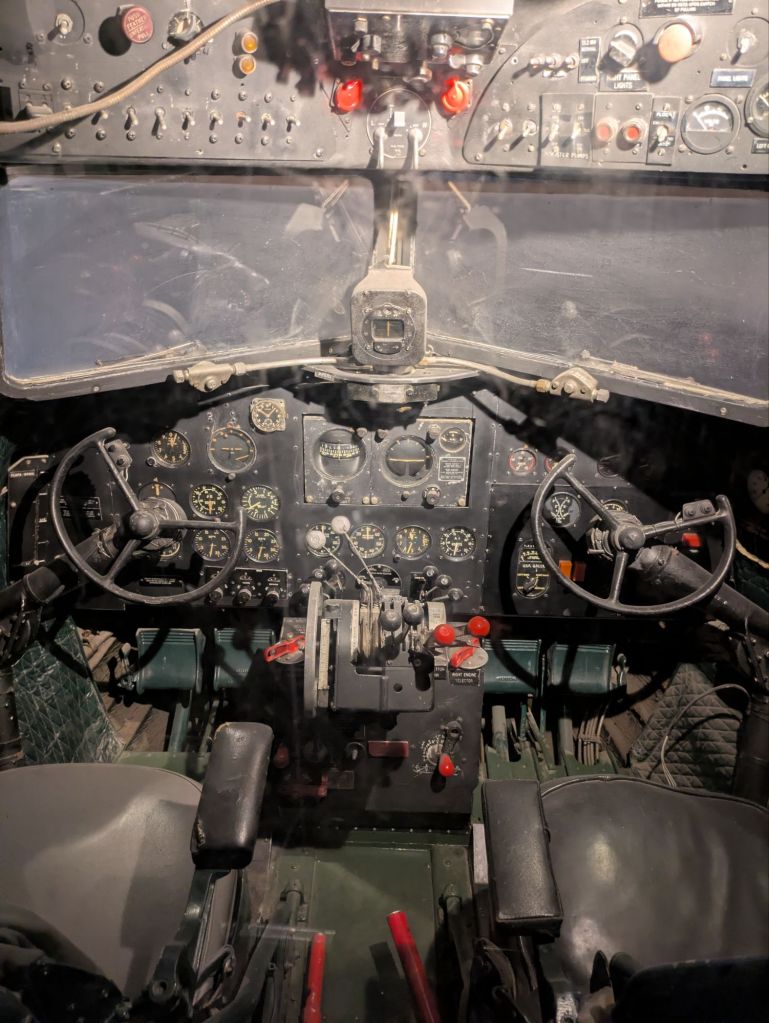
Douglas DC-3 fight deck.
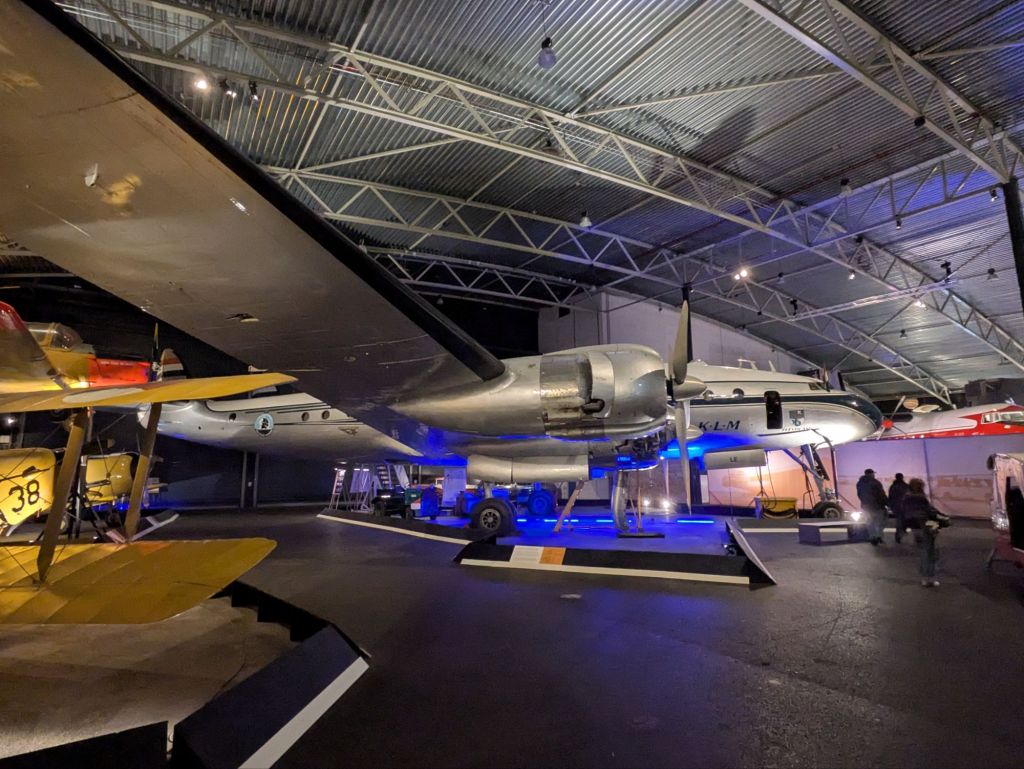
Lockheed L-749 Constellation.
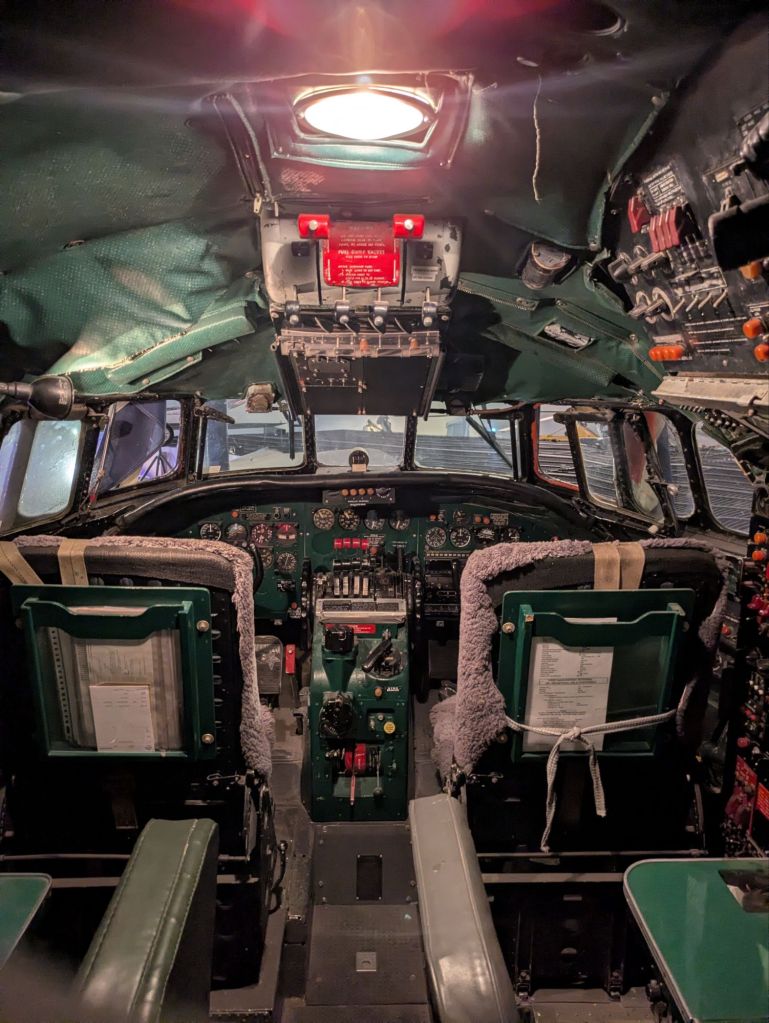
Lockheed L-749 Constellation flight deck.

Outdoors exhibition (747)

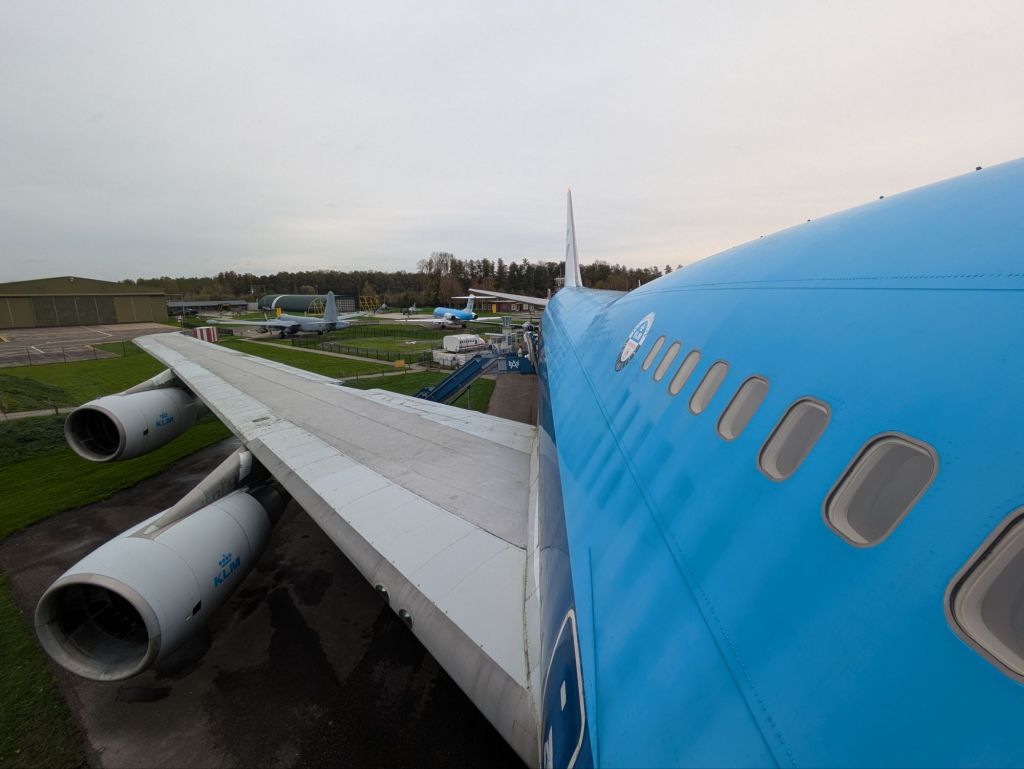
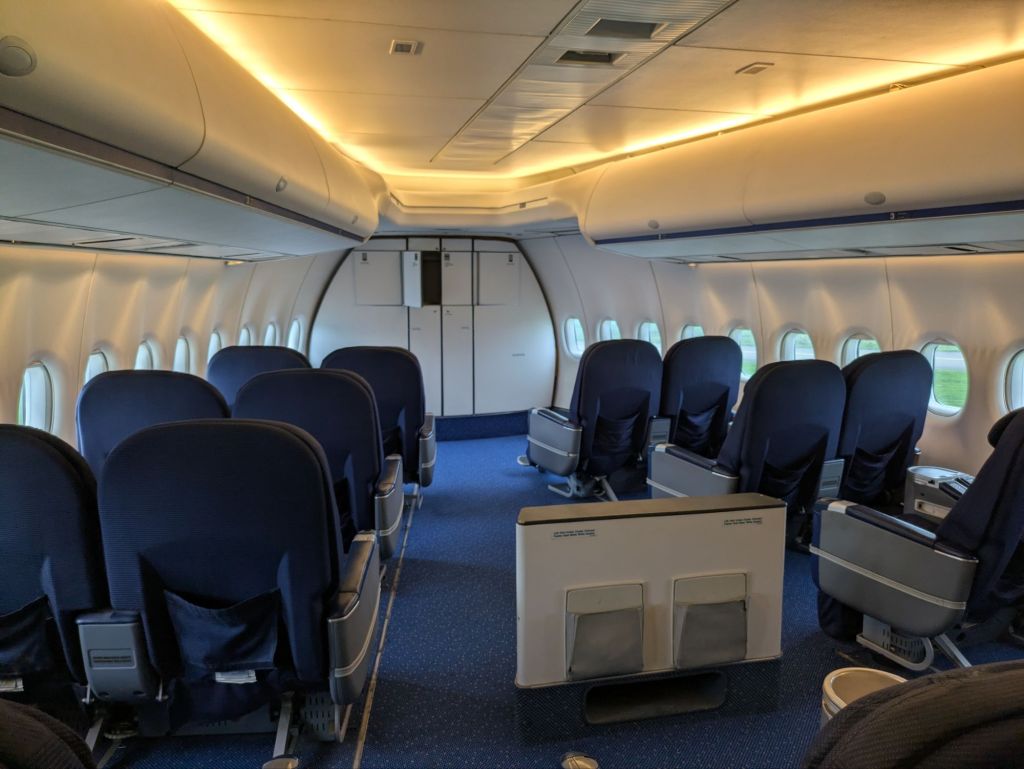
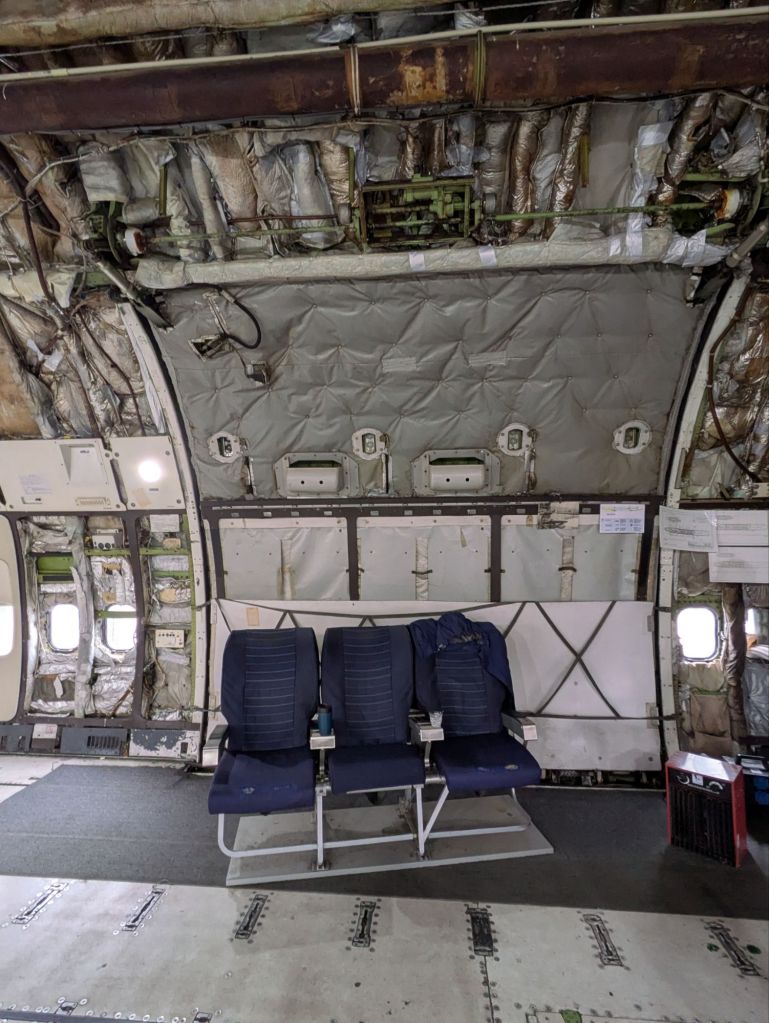
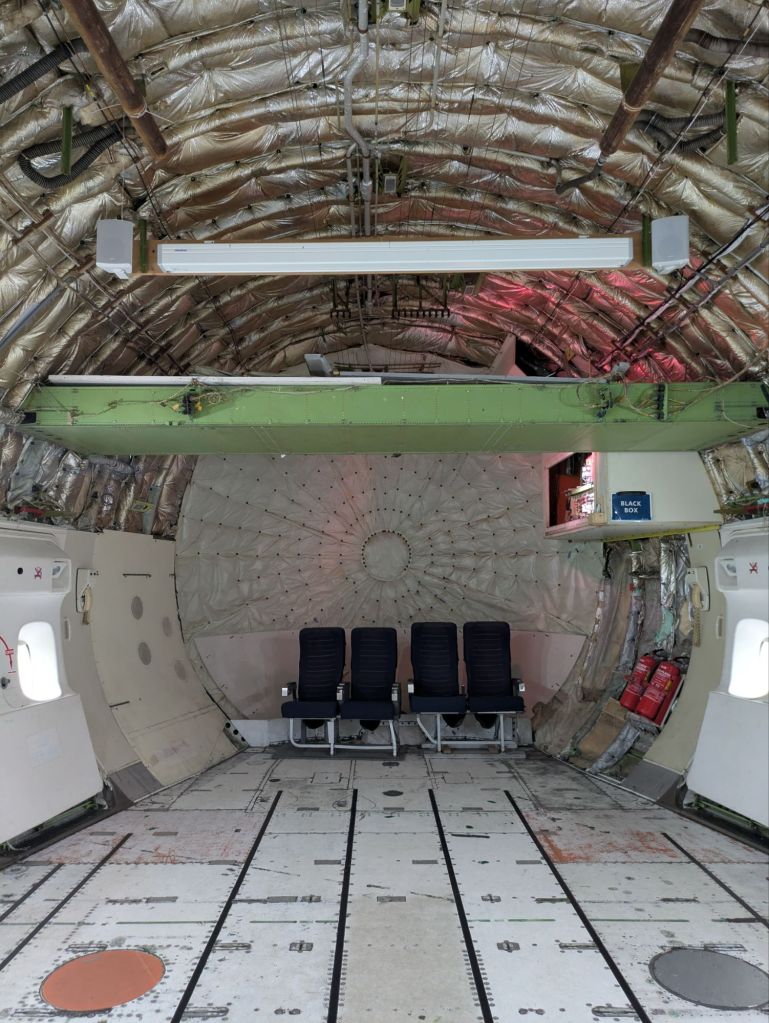
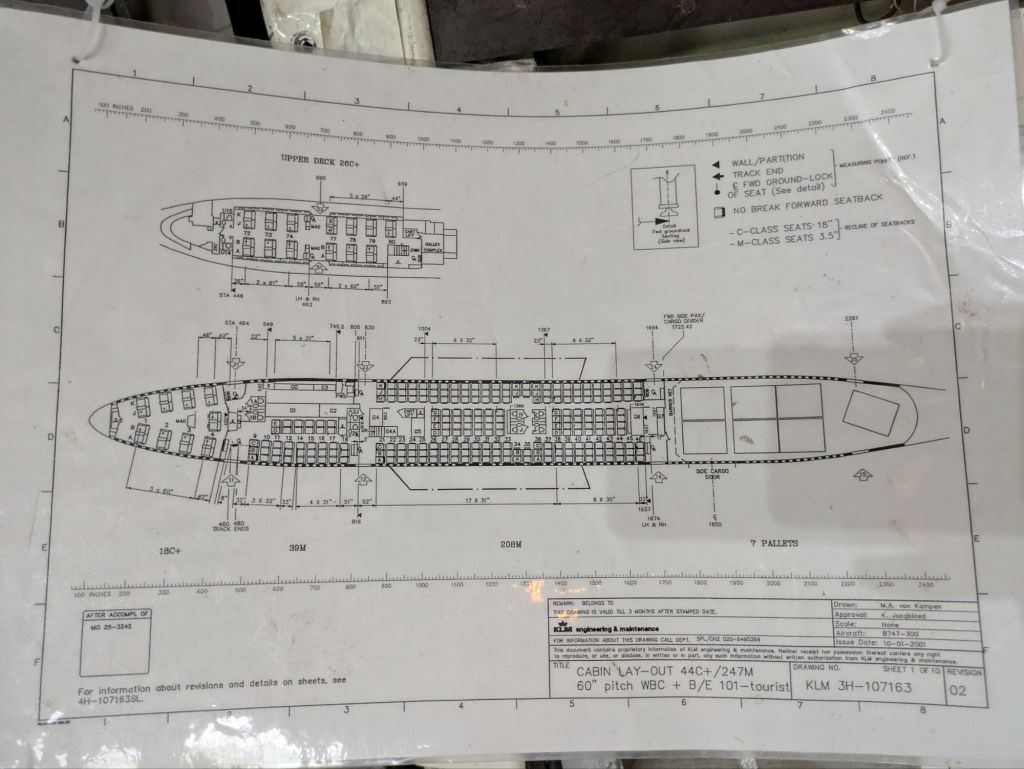
In the outdoors exhibition there are a few aircraft like a Fokker 100, a DC-4, an Antonov An-2, but the star is a former KLM Boeing 747 in combi configuration, where visitors can walk through the cargo deck, the economy and business classes and take a look into the flight deck. I leave some pictures below.

Boeing 747 from the upper deck.
747 flight deck.
747 business class cabin on the main deck.
Cargo door in the rear fuselage.
Rear pressure bulkhead.
747 combi layout.
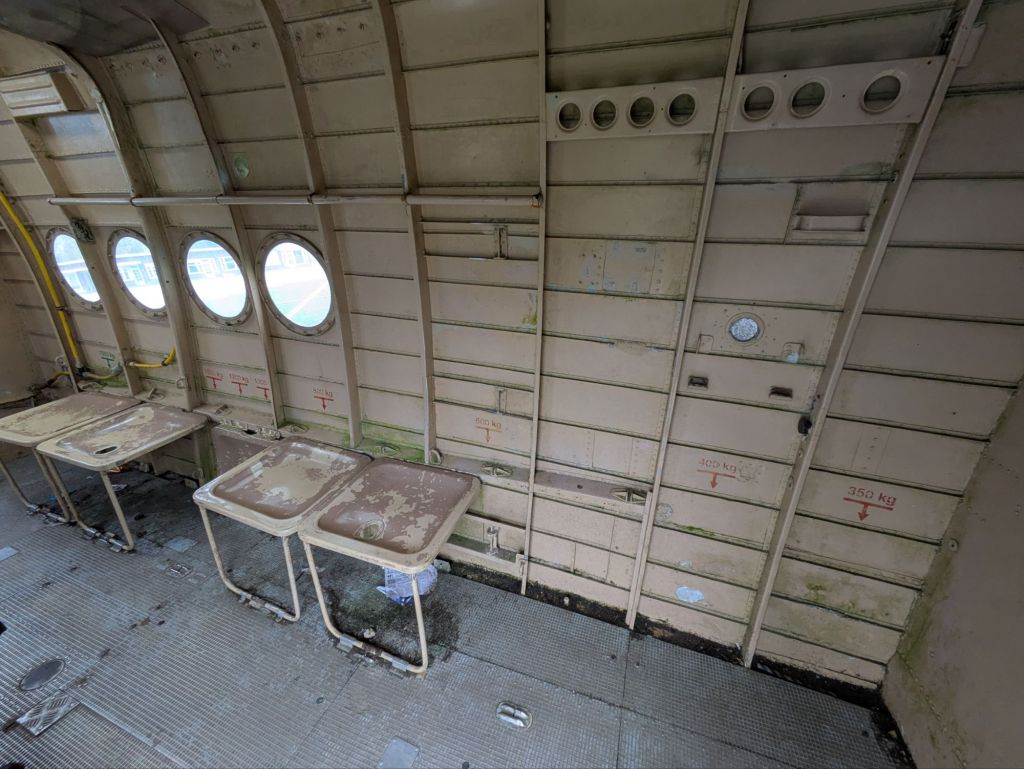
Antonov An-2.
Running loads written on the An-2 inner fuselage.

Hangar (DC-2)

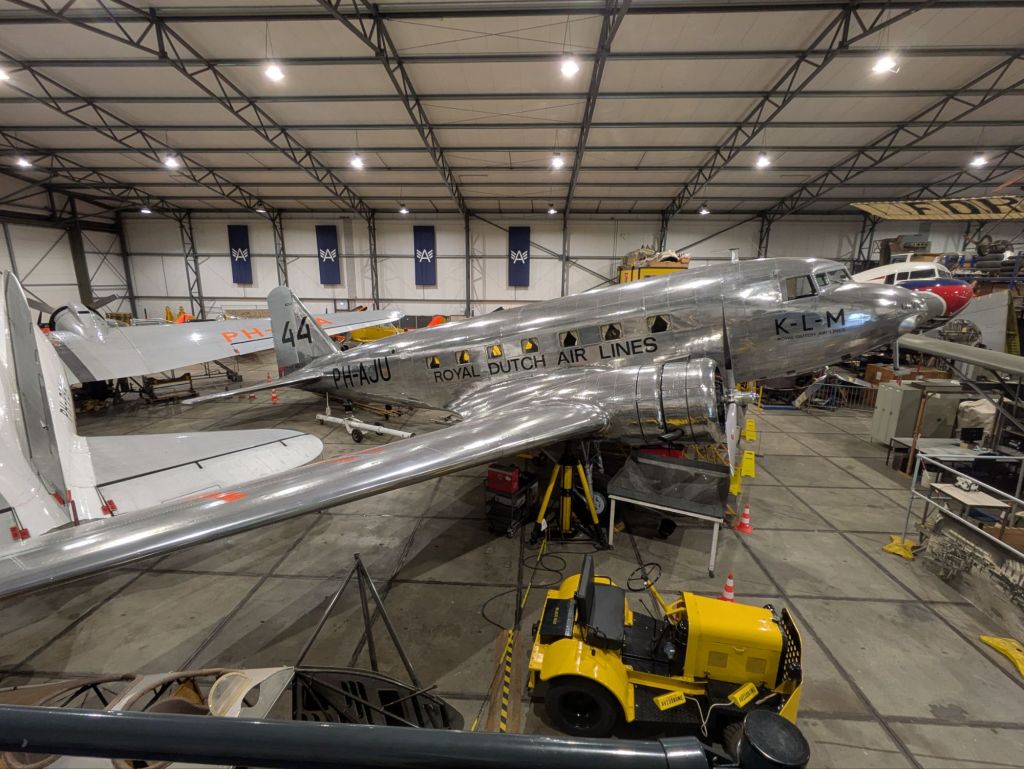
The main item in the hangar is the DC-2 called “Uiver” that won the handicap competition of the MacRobertson Air Race (to commemorate Melbourne centenary celebrations) flying from London to Melbourne in 1934 (and came second in speed) covering 19,877km in 90 hours and 17 minutes. (The one in the exhibition is not the original Uiver as it crashed years after the race in operation; but another DC-2 restored and painted in the same colors)

DC-2 Uiver

Schiphol airport 1928 replica

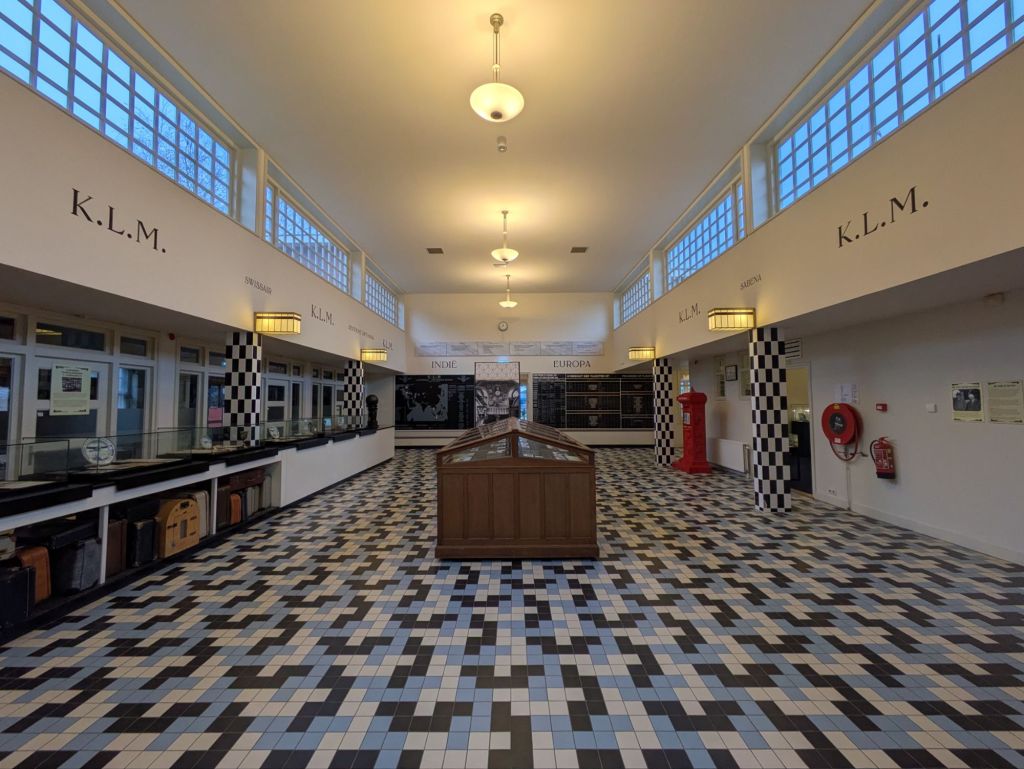
I leave some pictures below of what was the hall with the counters of the different airlines, a schedule of KLM route to Batavia and some posters with references to the legendary ghost ship The Flying Dutchman.


The museum is great. For the international visitor it misses some panels’ translations. But you can easily follow most of it and spend as many hours as you please.

1 Comment

Filed under Aerospace & Defence

Milagro de Empel

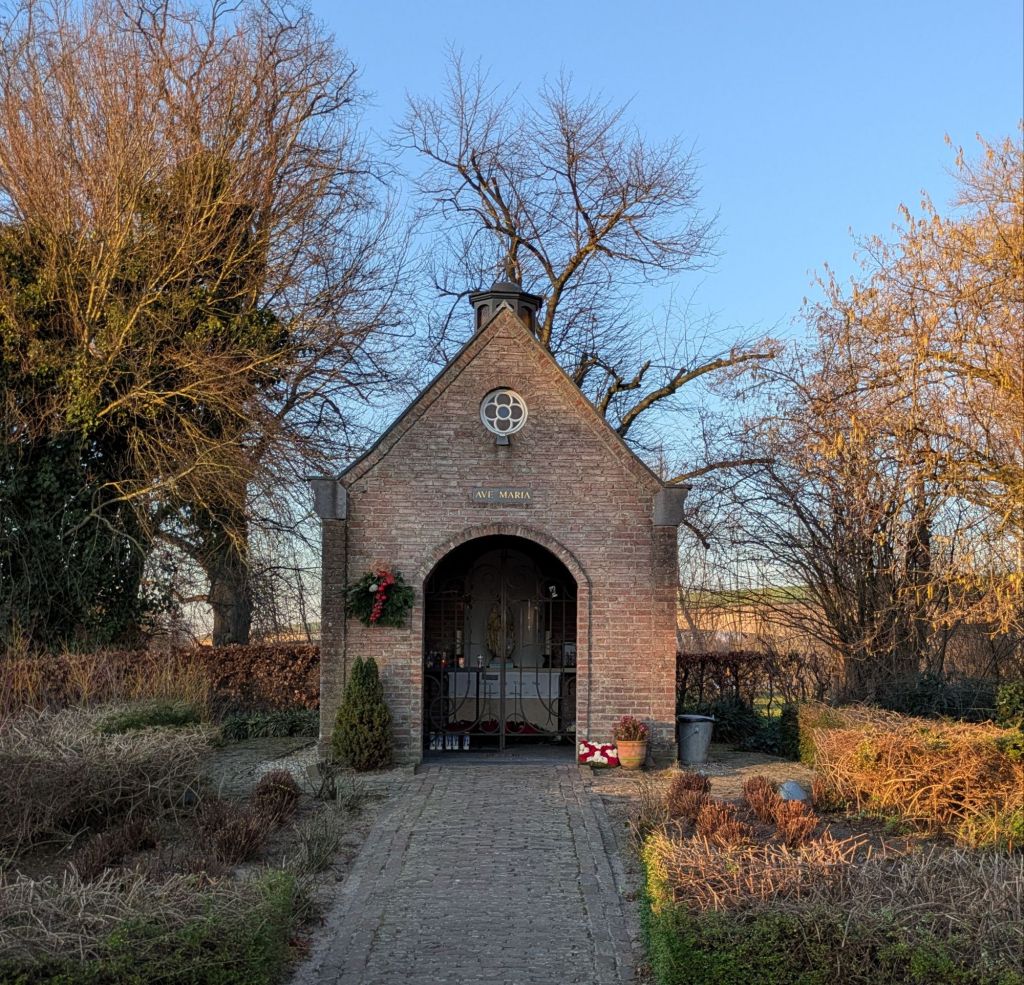
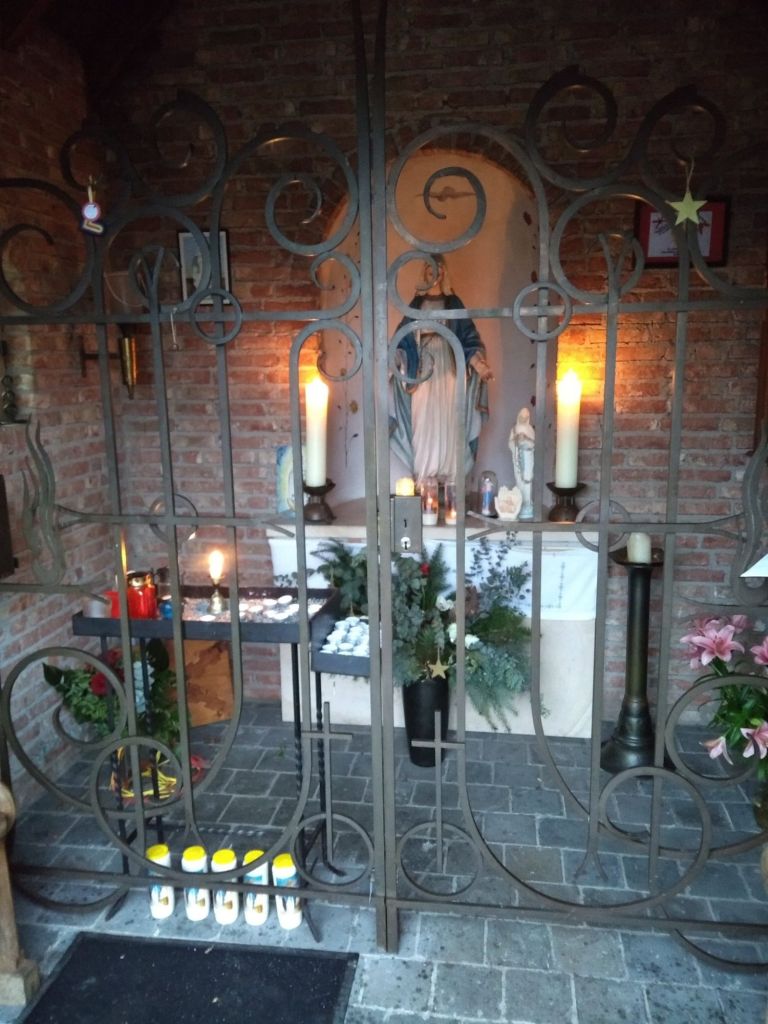
En la Navidad de 2018 fui a visitar la capilla de Empel, y en la Navidad de 2025 me he vuelto a acercar, así que en este post quería compartir algunas fotos, referencias y mapas.

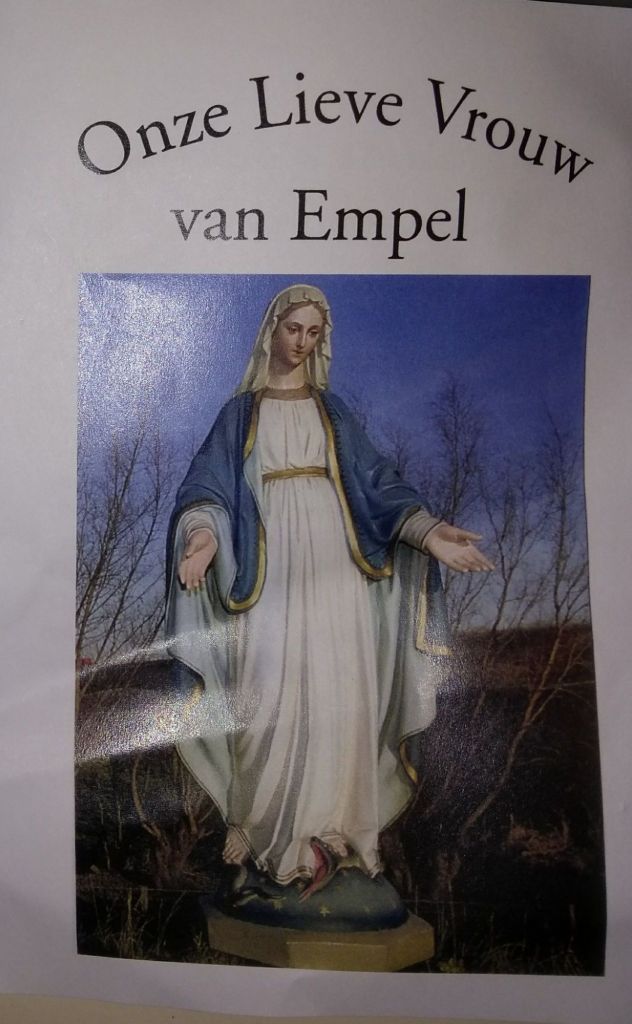
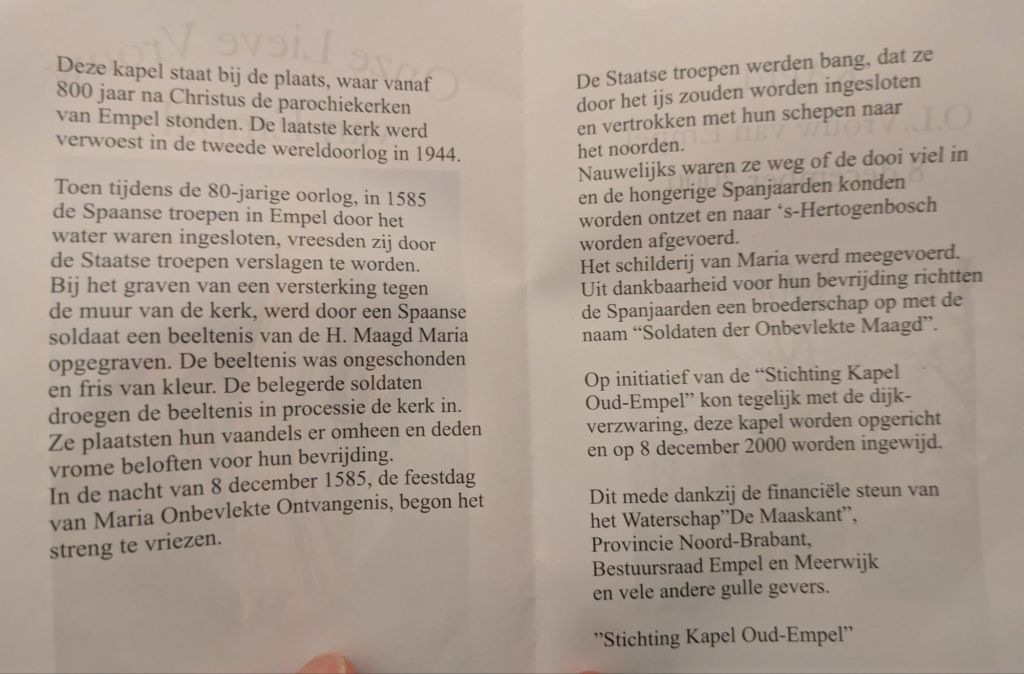
En la web de la asociación del milagro de Empel se ofrece una descripción detallada del mismo. En la página de la Wikipedia sobre el milagro de Empel se ofrece una descripción todavía más detallada. En la propia capilla hay unas cuartillas que ofrecen la siguiente explicación en neerlandés, cuya traducción incluyo debajo:

Esta capilla se encuentra en el lugar donde, a partir de 800 años después de Cristo, se levantaron las iglesias parroquiales de Empel. La última iglesia fue destruida en la Segunda Guerra Mundial en 1944.

Entonces, durante la Guerra de los Ochenta Años, en 1585, las tropas españolas en Empel quedaron atrapadas por el agua, temiendo ser derrotadas por las tropas de los Estados. Mientras cavaban una trinchera contra el muro de la iglesia, un soldado español desenterró una imagen de la Santísima Virgen María. La imagen estaba intacta y fresca de color. Los soldados sitiados llevaron la imagen en procesión a la iglesia. Colocaron sus armas alternadamente alrededor y debajo de ella e hicieron solemnes promesas por su liberación. En la noche del 8 de diciembre de 1585, fiesta de la Inmaculada Concepción de María, comenzó a helar intensamente.

Las tropas de los Estados temieron quedar atrapadas por el hielo y se retiraron bruscamente hacia el norte con sus barcos. Apenas se habían alejado, los españoles hambrientos salieron y fueron conducidos en gran número a ‘s-Hertogenbosch con gran escolta. El cuadro de María fue llevado consigo. En agradecimiento por su liberación, los españoles y la hermandad la nombraron “Soldados de la Virgen Inmaculada”.

Por iniciativa de la “Stichting Kapel Oud-Empel” [Fundación Capilla Oud-Empel], en combinación con el refuerzo del dique, esta capilla fue erigida y consagrada el 8 de diciembre de 2000.

Esto gracias al apoyo financiero del Waterschap “De Maaskant”, la Provincia de Brabante Septentrional, el Consejo de Empel y Meerwijk y muchos otros generosos donantes.


En esta breve descripción se dejan sin nombrar a los principales protagonistas: el tercio de Francisco de Bobadilla (cuyo origen era el tercio de Zamora) y el almirante holandés Felipe de Hohenlohe-Neuenstein que atacaba con una flota de barcos que llegó por el río Waal al norte de la isla Bommel. En las descripciones más detalladas de la asociación o de la Wikipedia se añade que las tropas de Bobadilla se quisieron instalar en la isla de Bommel entre el Mosa (Maas) y el Waal, pero que ante el ataque de los Estados, quienes destruyeron algunos diques que provocaron inundaciones, tuvieron que cruzar el Mosa hacia el sur y cobijarse en Empel. También se añade que Bolduque (‘s-Hertogenbosch) y su población eran católicos y leales al rey Felipe II.

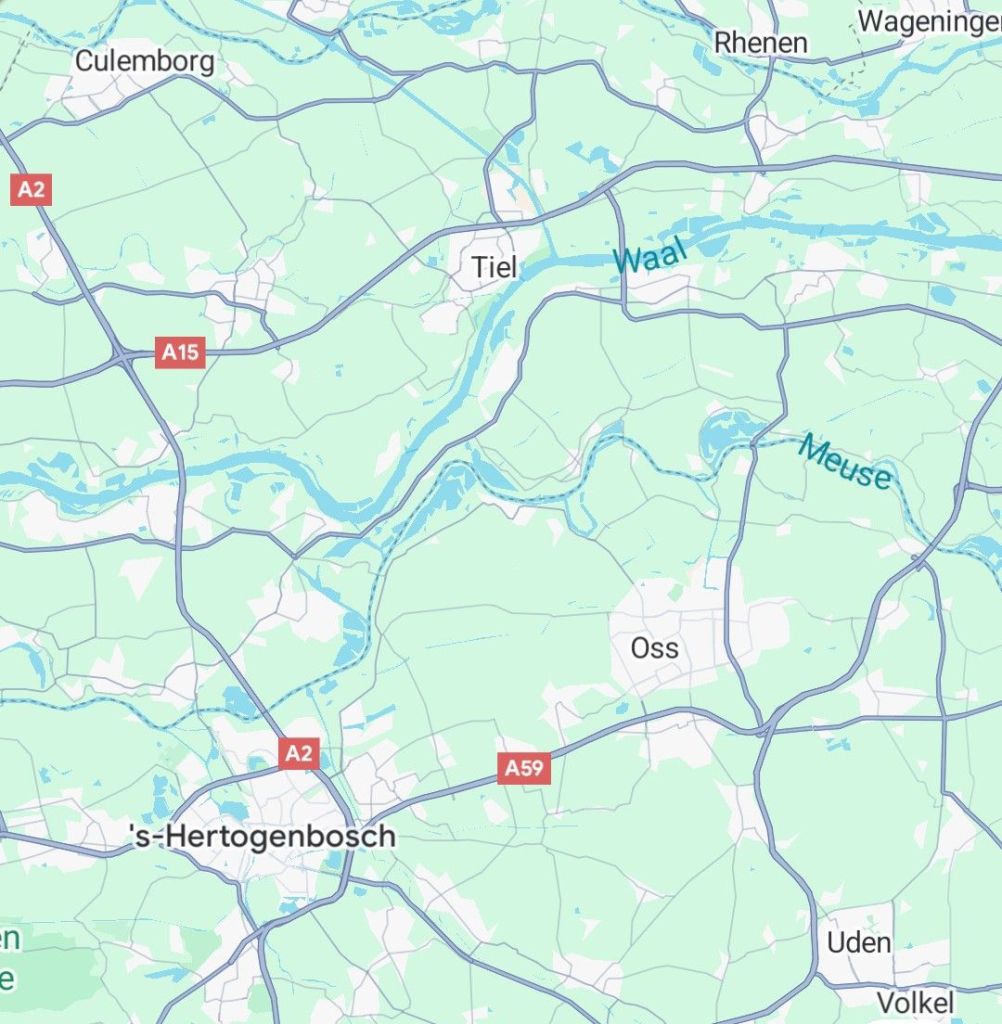
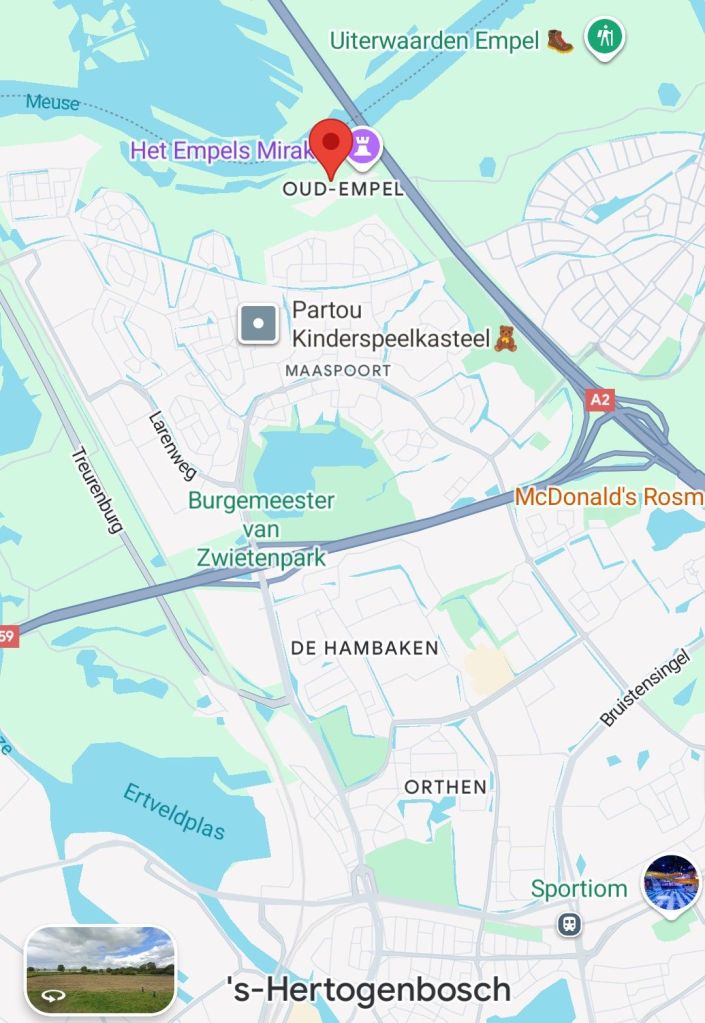
A continuación dejo un par de capturas de Google maps de la zona para visualizar la situación y una imagen del grabado de Frans Hogenberg de la Batalla de Empel.

Mapa donde localizar ‘s-Hertogenbosch (Bolduque) y los ríos Waal y Mosa (Meuse en francés). La isla Bommel está entre los dos ríos al norte de Den Bosch.
Mapa donde localizar la capilla en el Viejo (Oud) Empel, Den Bosch y el río Mosa.
Grabado de Frans Hogenberg de la Batalla de Empel

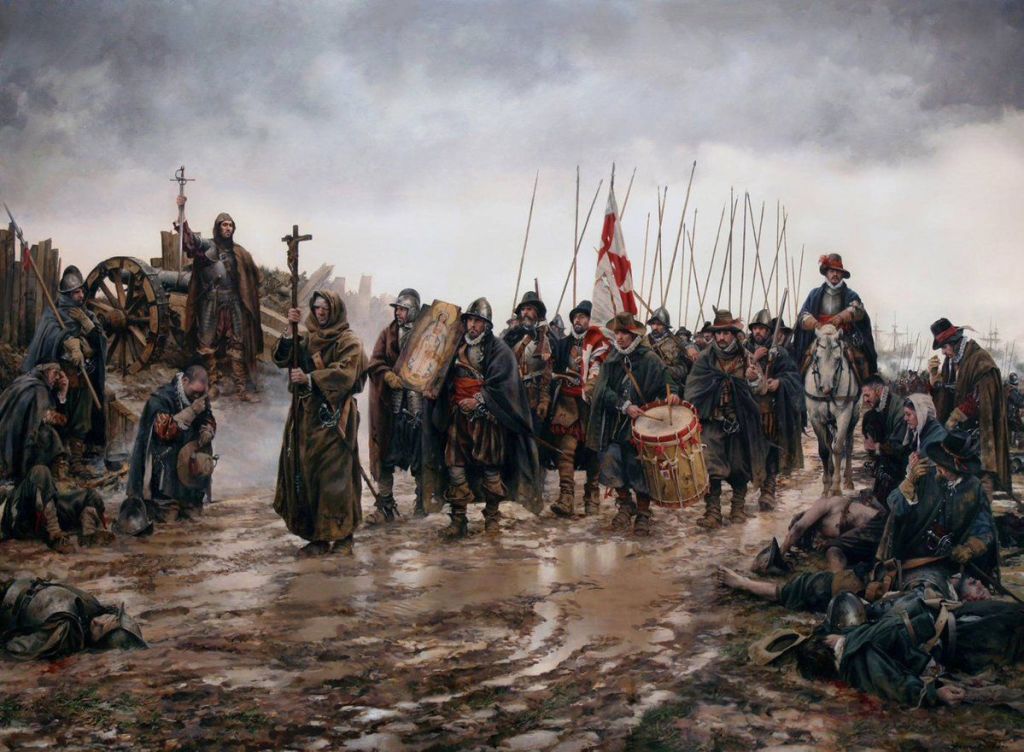
Sobre el encuentro de la imagen de la Virgen y la procesión que se organizó, el pintor Augusto Ferrer-Dalmau tiene dos cuadros preciosos, cuyas copias se pueden adquirir en su página web.

Virgen de Empel, Augusto Ferrer-Dalmau
El Milagro de Empel, Augusto Ferrer-Dalmau

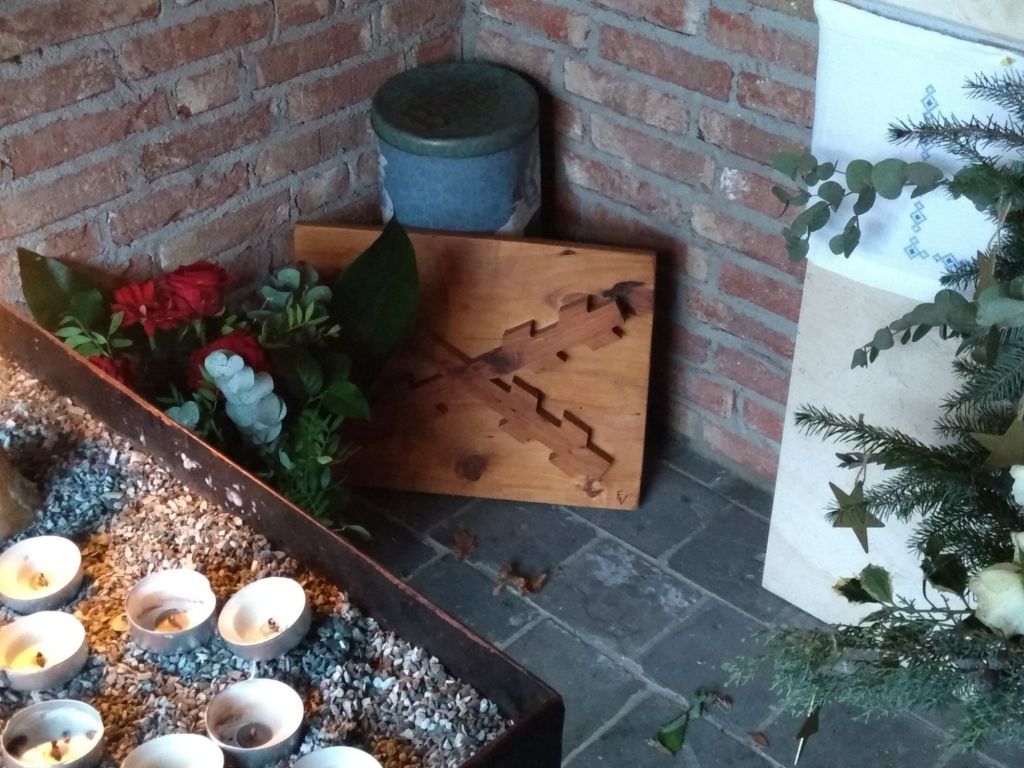
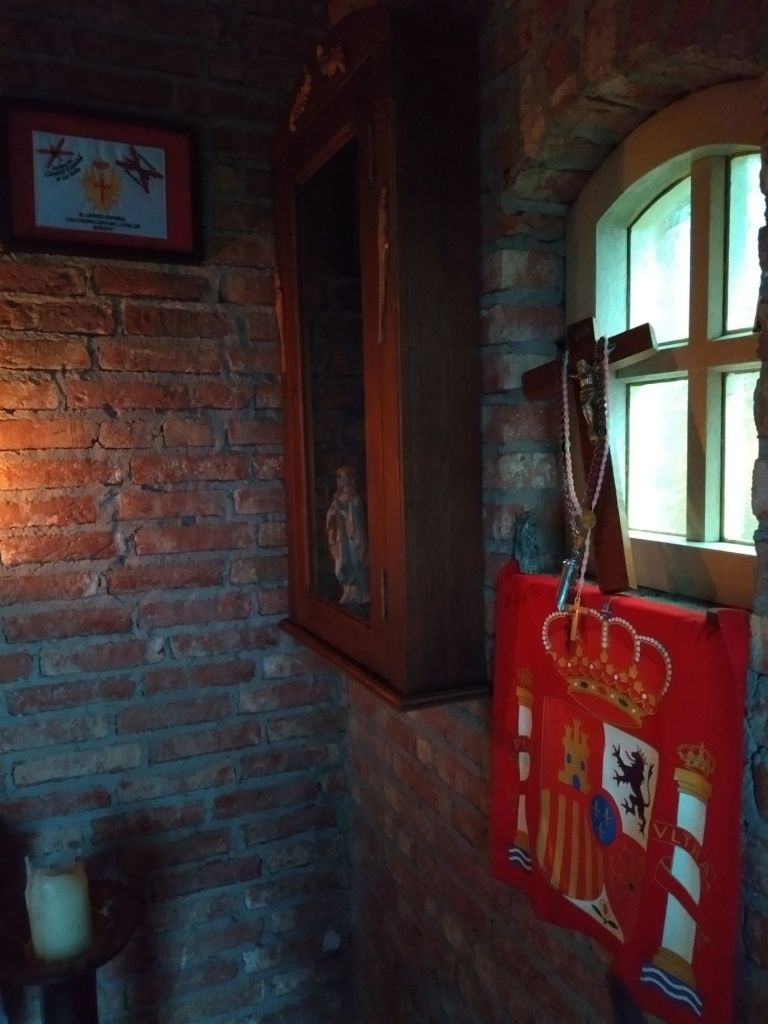
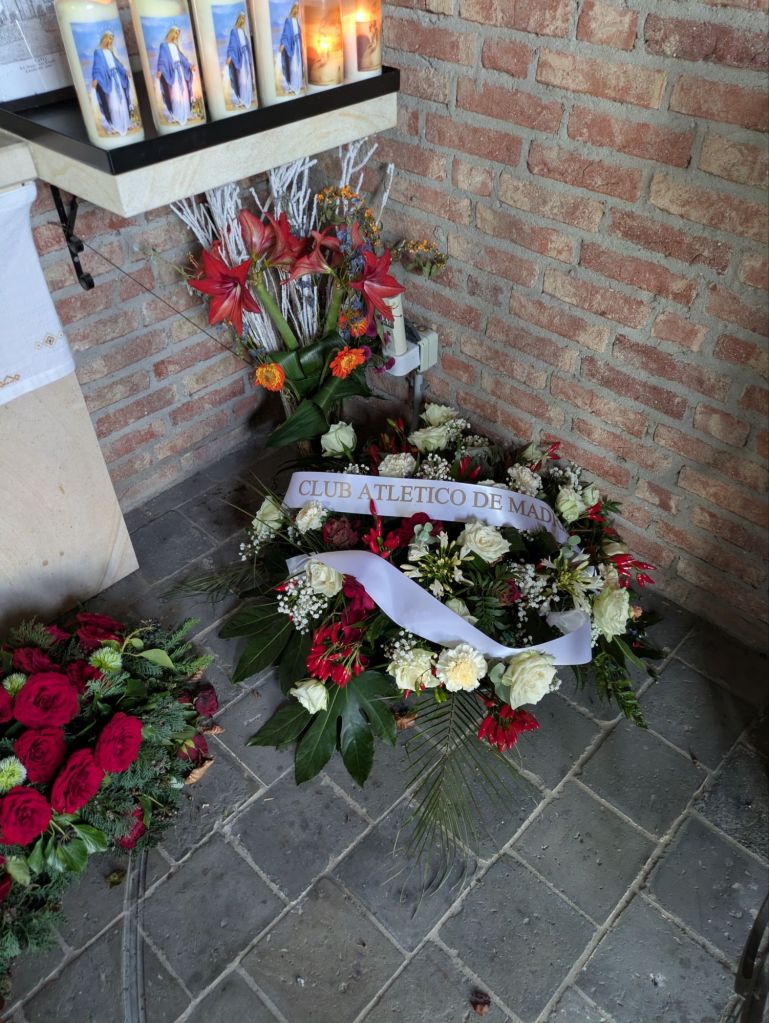
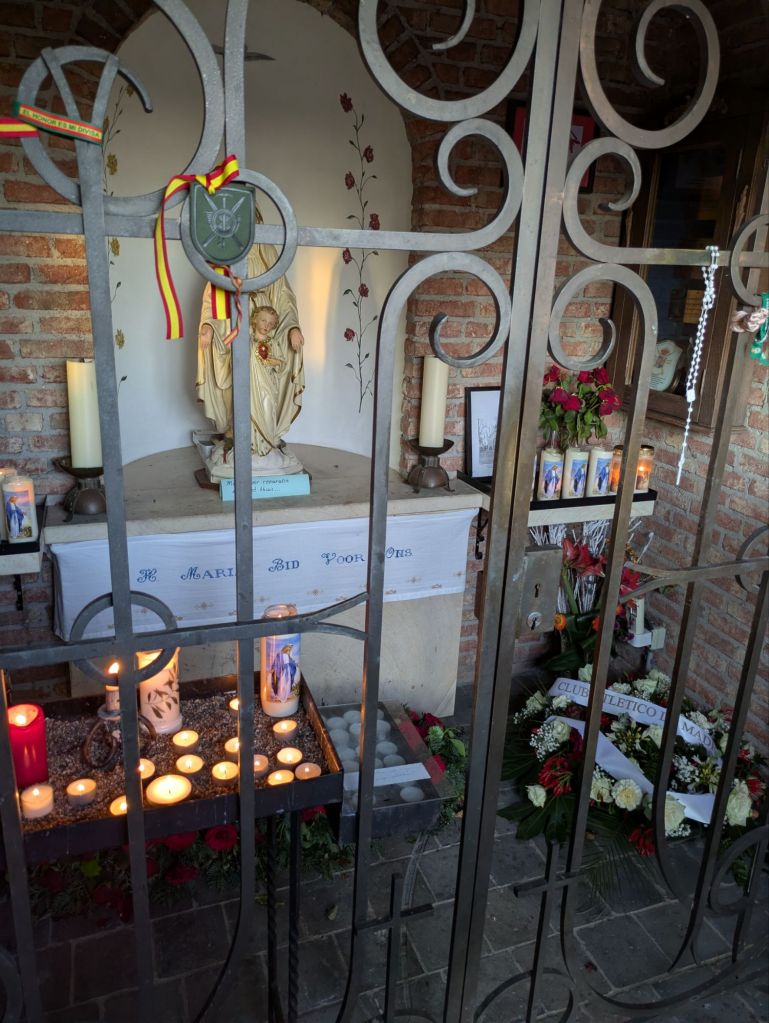
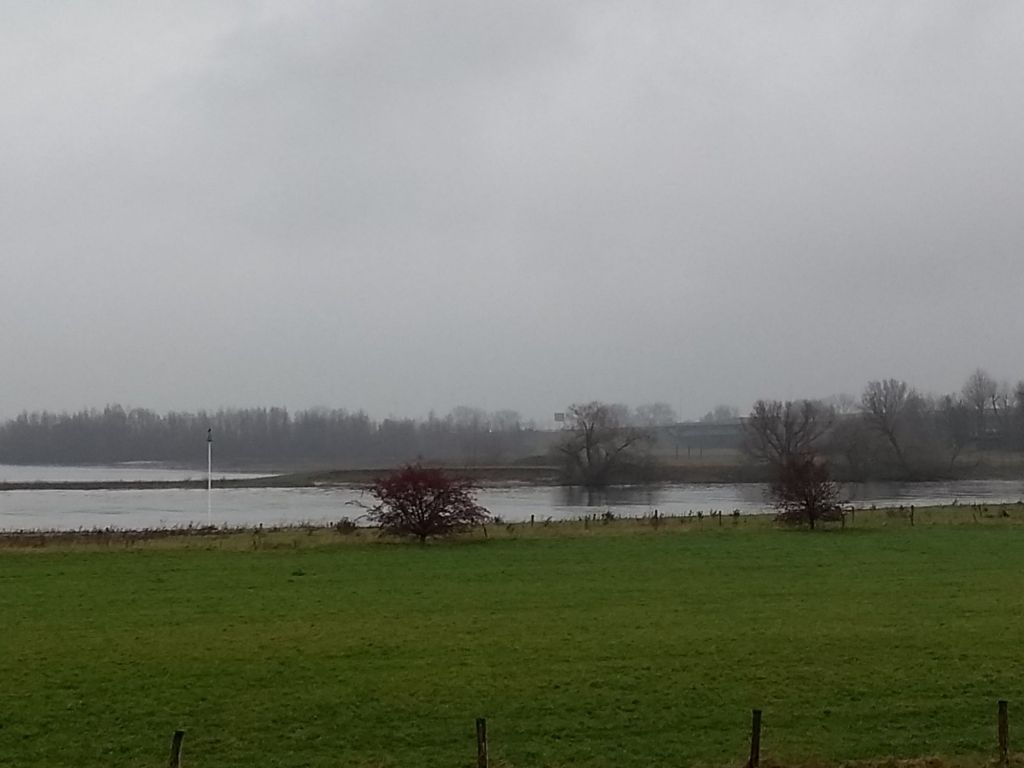
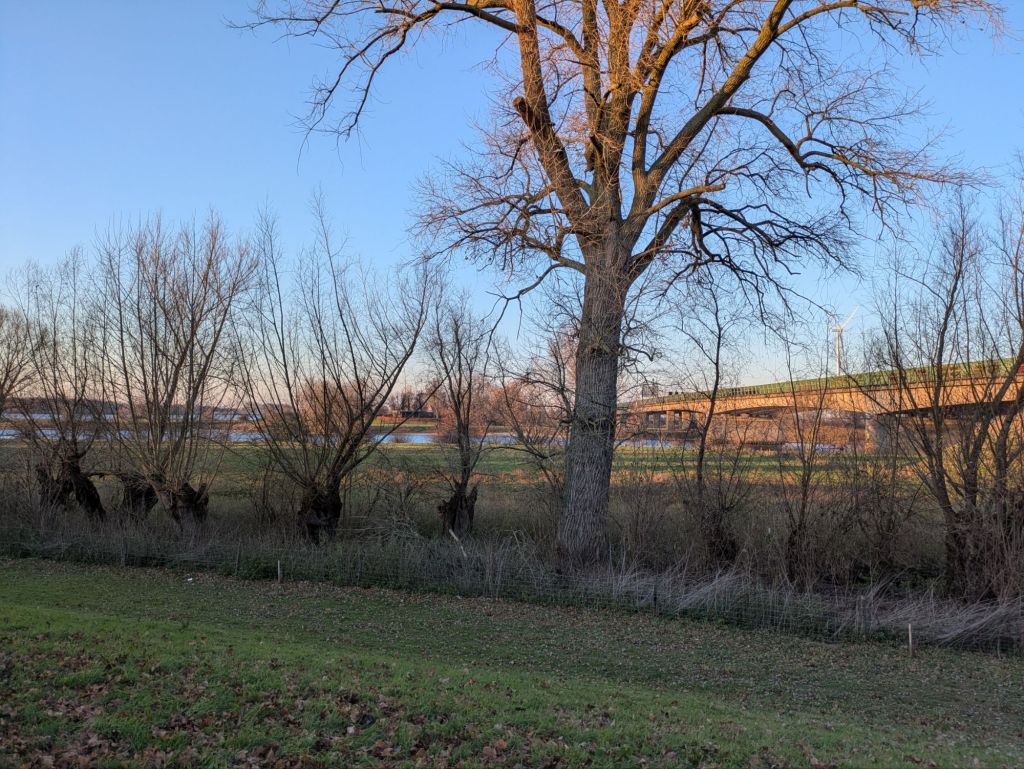
Por último dejo algunas fotos (algunas tomadas hace 7 años y otras de ahora) de cómo es la pequeña capilla, los objetos que hay, y de la vista del río Mosa y la isla Bommel desde Empel. En la capilla hay siempre objetos del ejército español, dado que por decreto de 1892 fue “Declara Patrona del Arma de Infantería a Nuestra Señora la Purísima e Inmaculada Concepción“, y continuamente hay visitas de militares como así se puede ver en el libro de firmas.

1 Comment

Filed under Travelling

Elche – Alicante marathon 2025

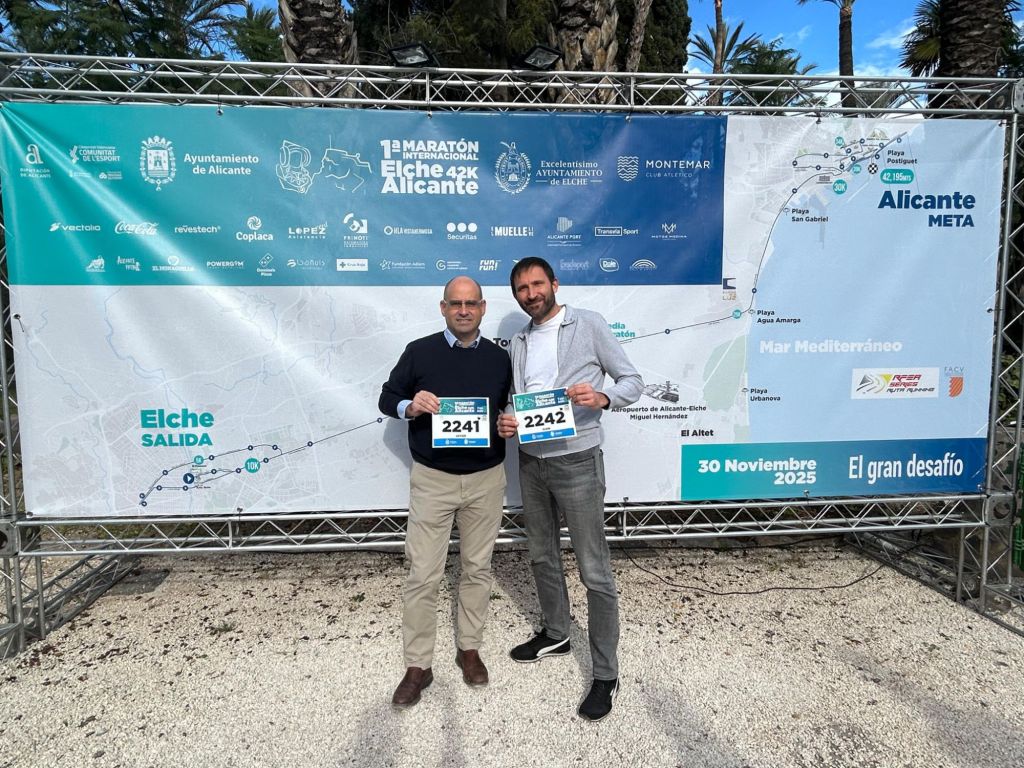
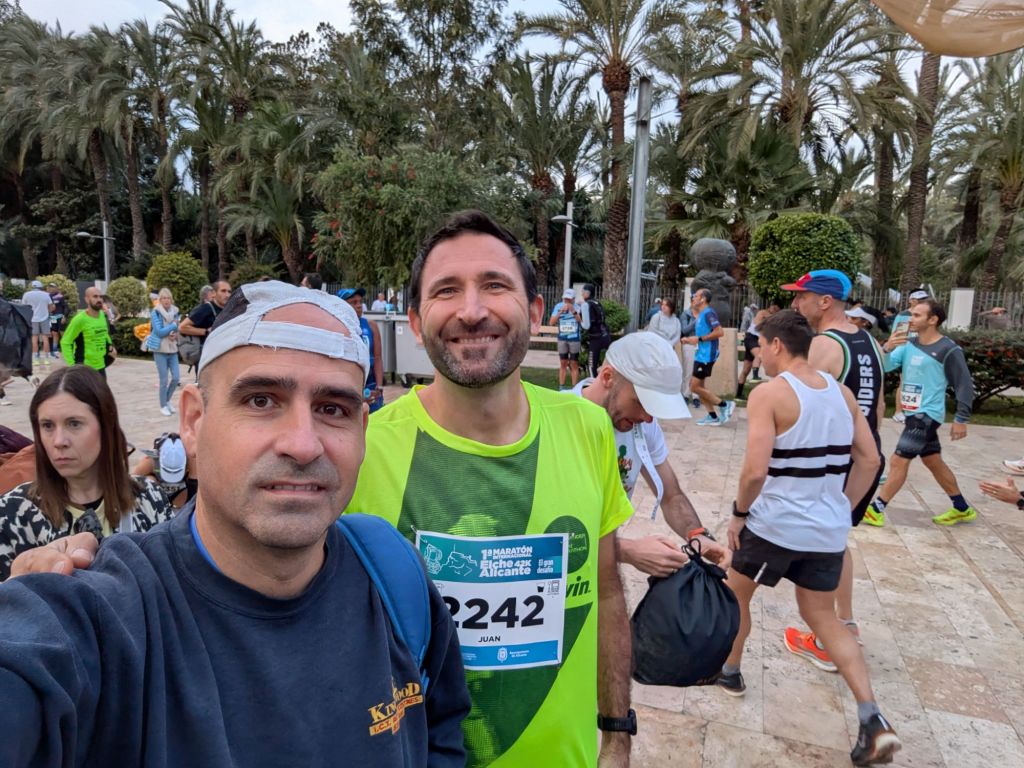
Last Sunday, November 30th, together with my friend Juan we traveled to Alicante to take part in its marathon, with over 3,000 runners registered in the distance.

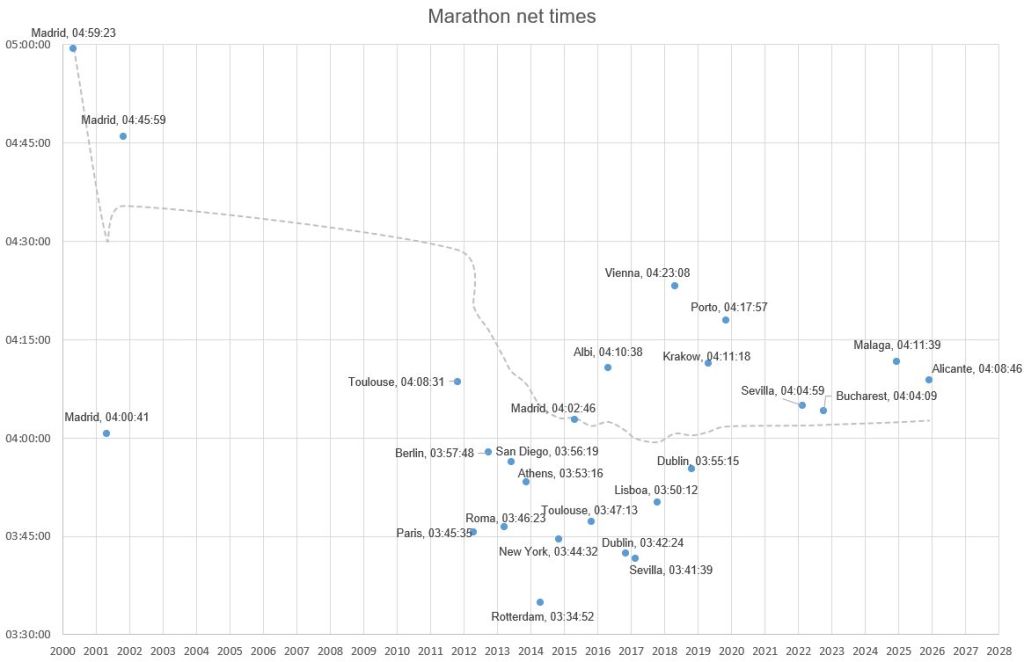
We picked Elche – Alicante following our series of marathons abroad (to combine tourism with long distance running) that has taken some of us to run together in Paris, Berlin, Roma, Athens, Rotterdam, New York, Sevilla (x3), Madrid, Millau, Dublin (x2), Lisboa, Vienna, Krakow, Porto, Bucharest, Malaga and now Alicante (in bold those run with Juan).

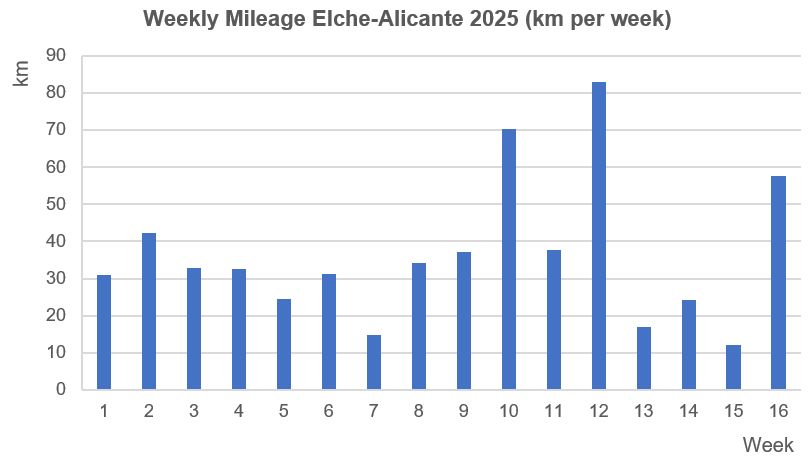
To prepare for this marathon I followed the same 16-week training plan I had used in the past. I started with the plan in mid August during our holidays in Italy. In the end I arrived to Alicante with 540km in the legs in those 16 weeks, a bit less than I would have liked. For some months I felt the Achilles tendon of the left leg a bit sensitive, hence I decided to run a moderate weekly mileage for over a month before starting with the long runs. I also chose to skip the series training, as being overweight (94kg the day after the race), the series would hurt the tendon. By mid October I started to run some long runs. Not many though, just 3 over 20km: 27km, 30km and 30km. I then had some business travel during which I managed to run some days even if on the treadmill. With that training behind and the experience of the last 3 marathons I was somewhat confident in being able to complete the marathon in a time between 4h05′ and 4h15′ even if the final mark was uncertain.

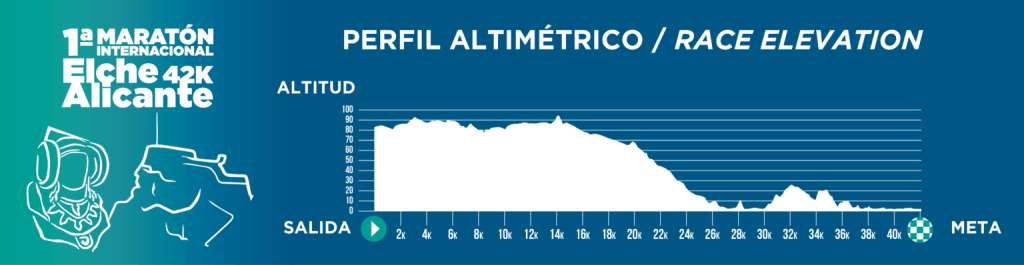
The profile from Elche to Alicante was rather flat on each of the cities and with a 10km descending stretch from one to the other. The race started in Elche by the castle and finished by the port in Alicante. We stayed in Alicante and we counted with another friend, Nacho, to bring us to Elche on the morning of the race.

Race profile

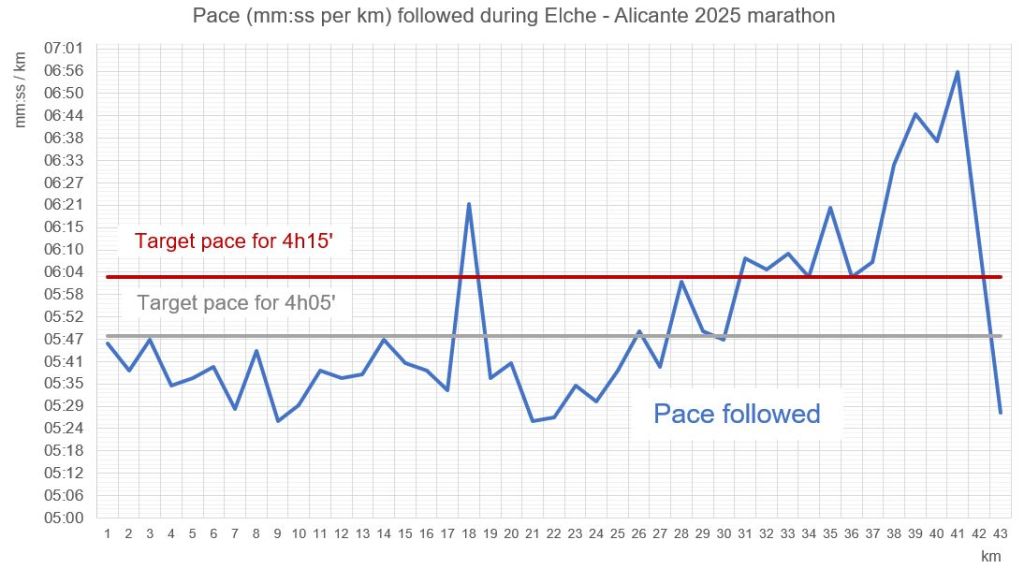
The temperature was a bit fresh in the morning (~8°C), the sky was clear and it would be a bit warmer towards the end of the race, though the temperature did not exceed 19°C. My strategy was to start at a pace just below 6min per km, and then, if I felt well, accelerate a bit after some kilometres to build up some margin during the descent part of the circuit so that I could target a time below 4h15′. There were pacers for times aiming at every 15-minute mark and I started a bit behind the 4-hour pacers, which I kept at a short distance until the km 25.

The race started at 9:00am and Juan departed a bit ahead, hence we wished luck to each other and ran separately. I ran at comfortable and faster paces than I had targeted until the km 25. I didn’t feel any pain in the tendons. Then from the km 30 I started running at paces above 6:00/km, but I still felt good, focused and running one km after another. Until km 37… During the 4 kilometres between 38 and 41 I was unable to keep those paces and I slowed down to ~6:40/km, until I gathered some strength for the last 1.2km.

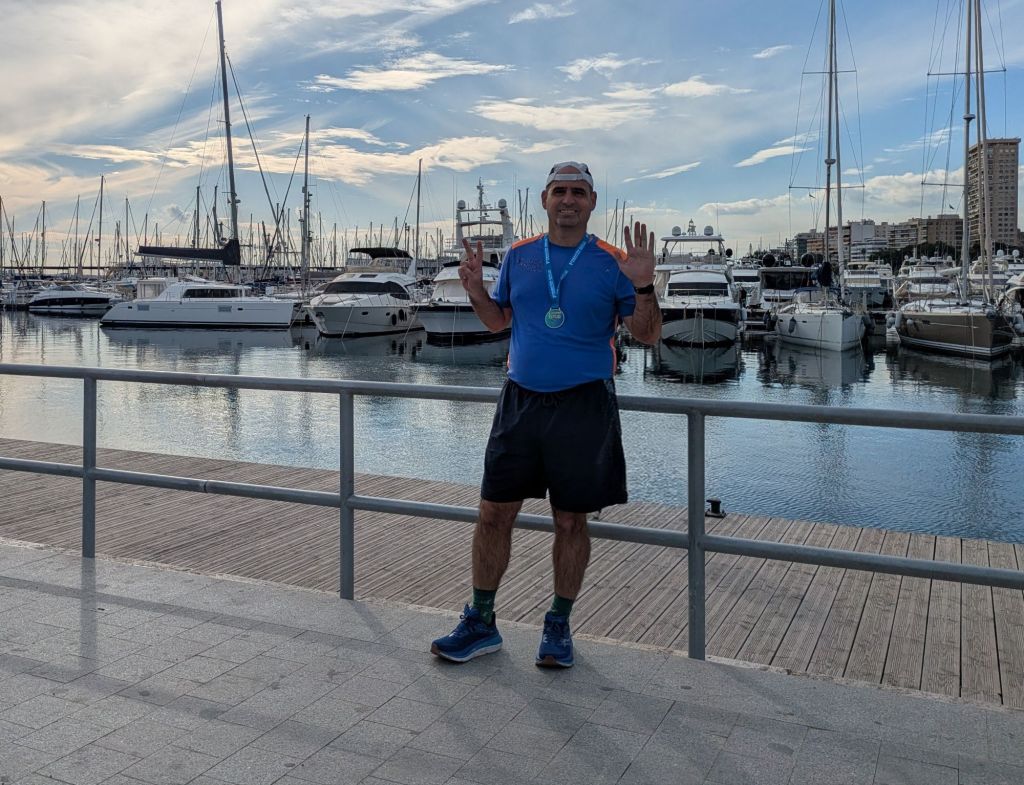
That last kilometre of the race felt great, as always. Seeing the finish line arches from afar and sprinting towards them, feeling proud of having done it again without having gone through much suffering during the race itself.

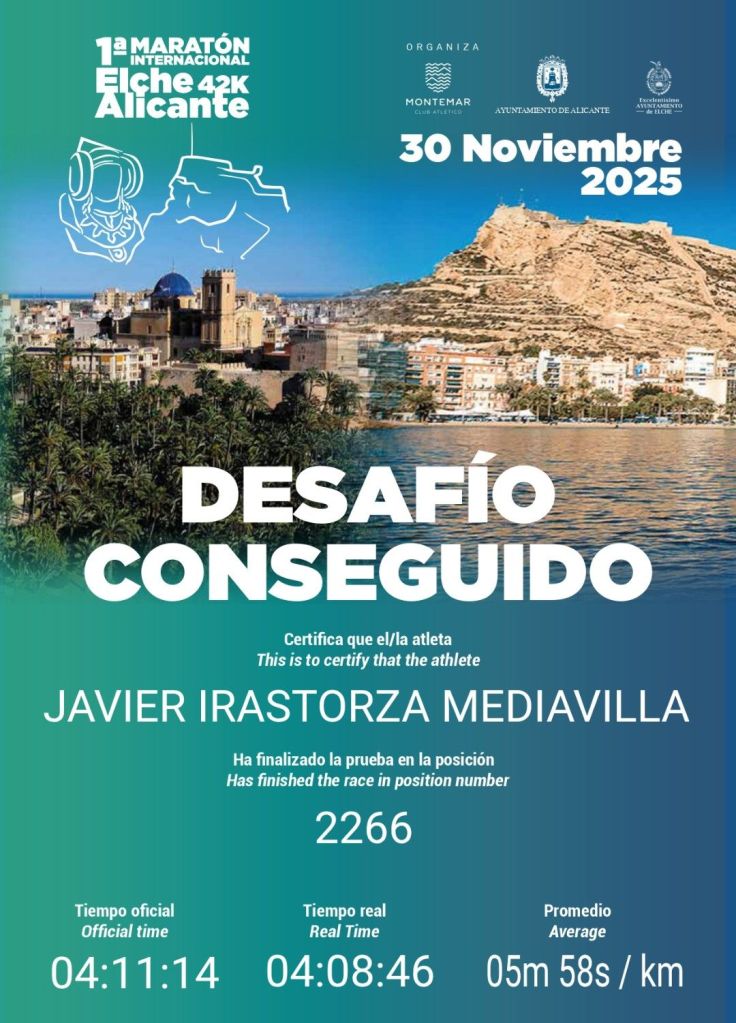
In the end, I clocked a net time of 4h08’46”, a time about what I expected given the weight with which I arrived at the race and the incomplete training that I followed, even nearly 3 minutes faster than the last marathon (Málaga). This has been my 25th marathon completed, easy to say today but not so on April 30th 2000 when I started in the distance in Madrid.

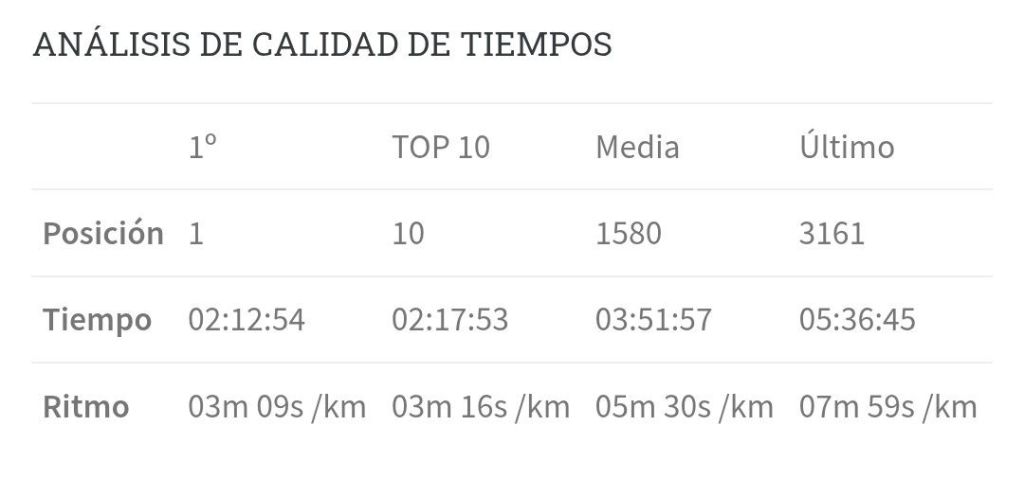
With those 4h08’46”, I was again above the 4-hour mark and finished in the 2,266th place out of 3,161 finishers (28% percentile). That time makes it my 8th worst marathon, though with a positive feeling of having completed another marathon 1 year later and a bit faster than the last. I am now looking forward to the next one.

This was the first marathon organized between Elche and Alicante. The organization of the race was rather good. They only underestimated the amount of trucks needed to provide a smooth wardrobe service for the runners’ bags. The circuit was good. They included plenty of water supply (with bottles) posts, isotonic drinks, some food (bananas and dates; a bit late in the race though) and gels (though I carried myself enough of those). It was a great experience.

I leave below some charts with statistics of the race:

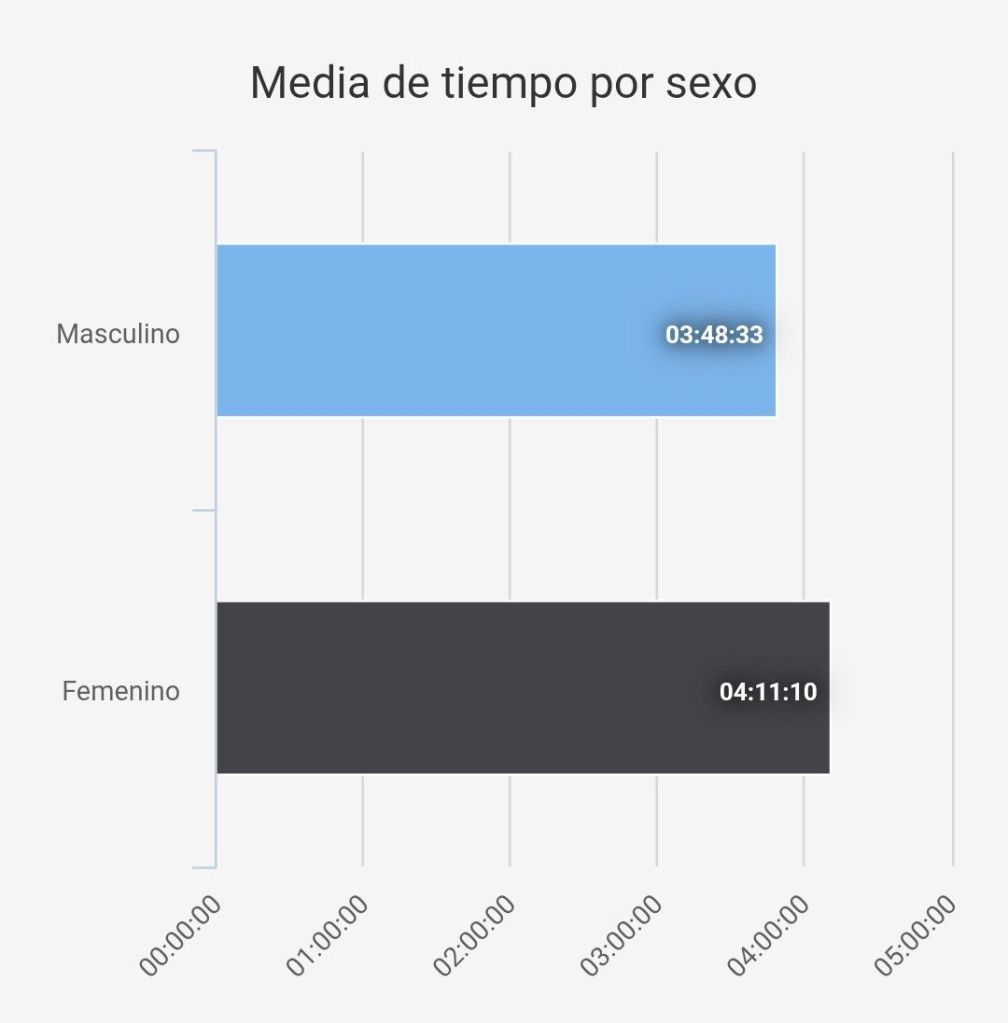
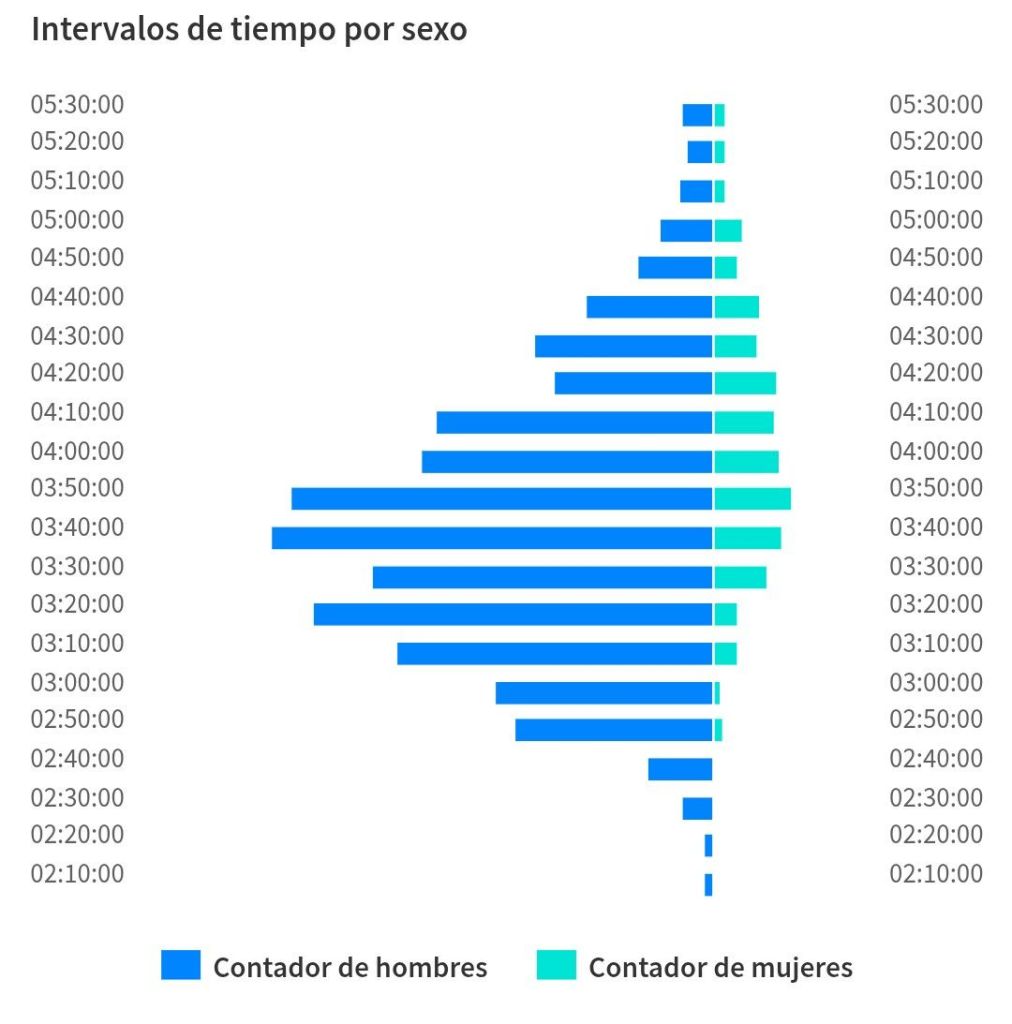
  • The average finish time was just below 3h52′. For the men 3h48′, for the women 4h11′. You can also see the distribution of runners by their times by splits of 10 minutes.
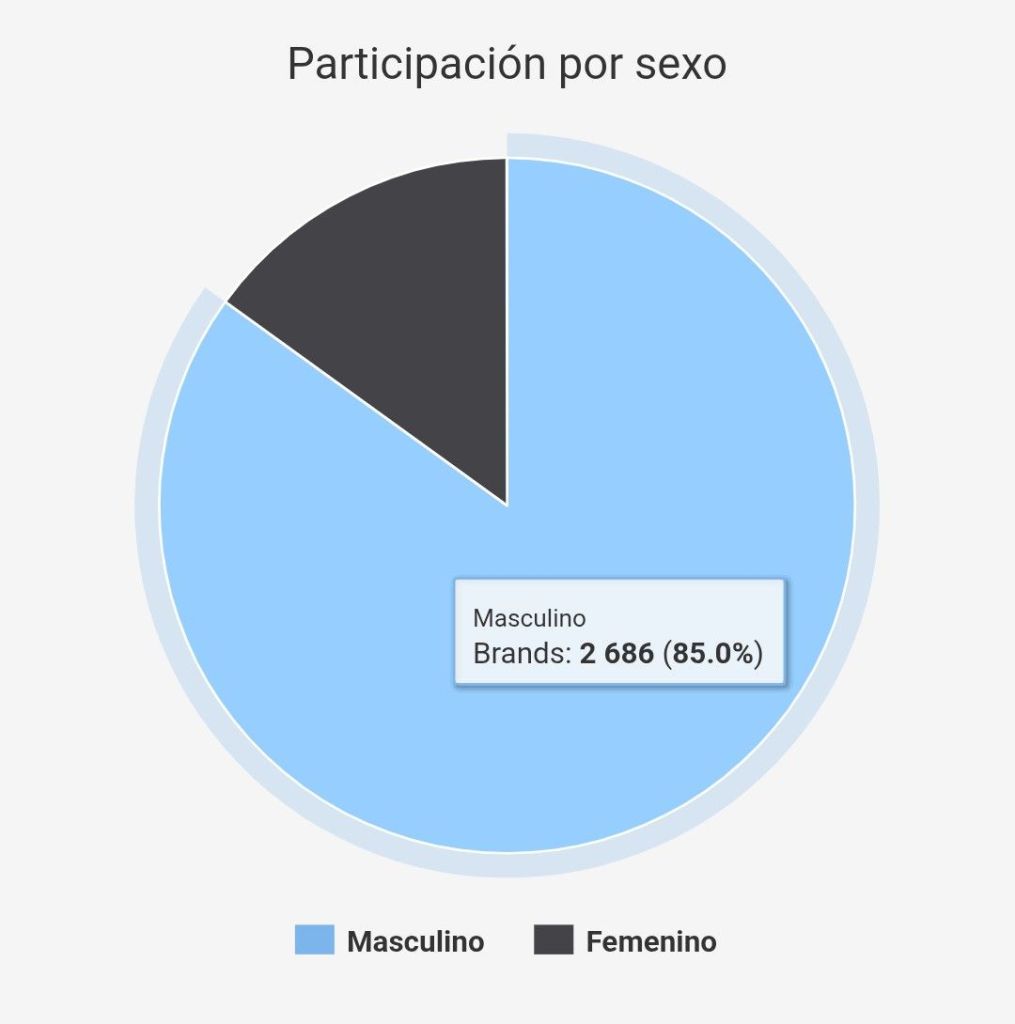
  • 85% of the participants were men.

1 Comment

Filed under Sports

Basílica de la Santa Casa, Virgen de Loreto

El pasado mes de agosto visitamos la Basílica de la Santa Casa en la localidad de Loreto (Italia).

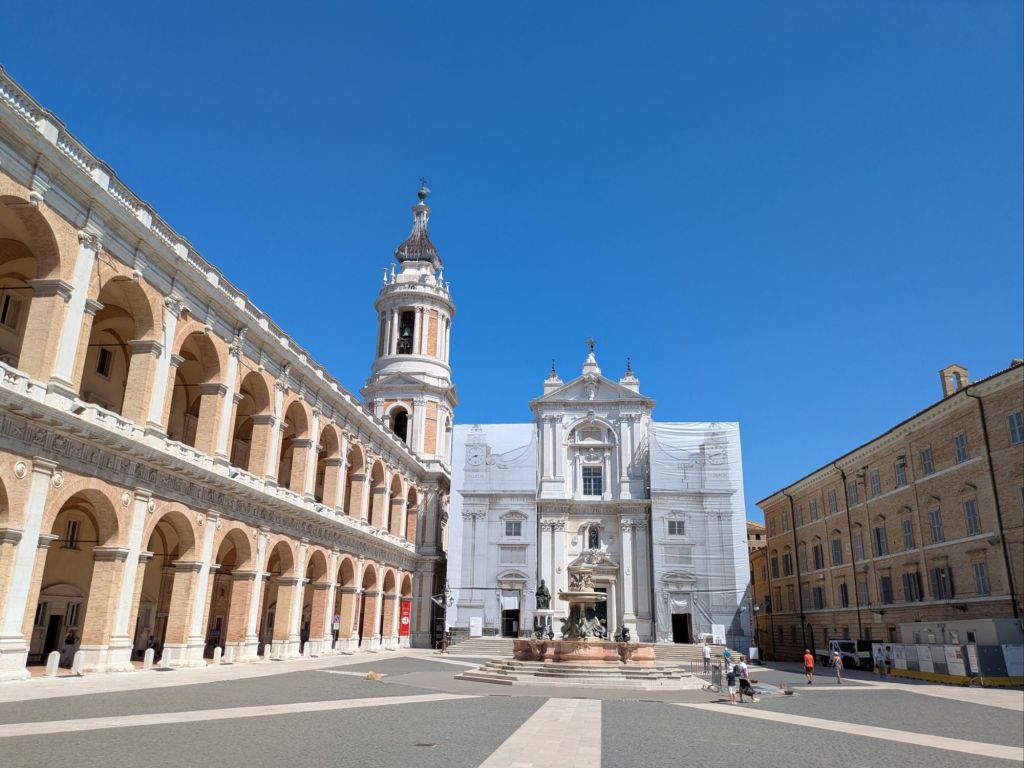
Plaza de la Virgen

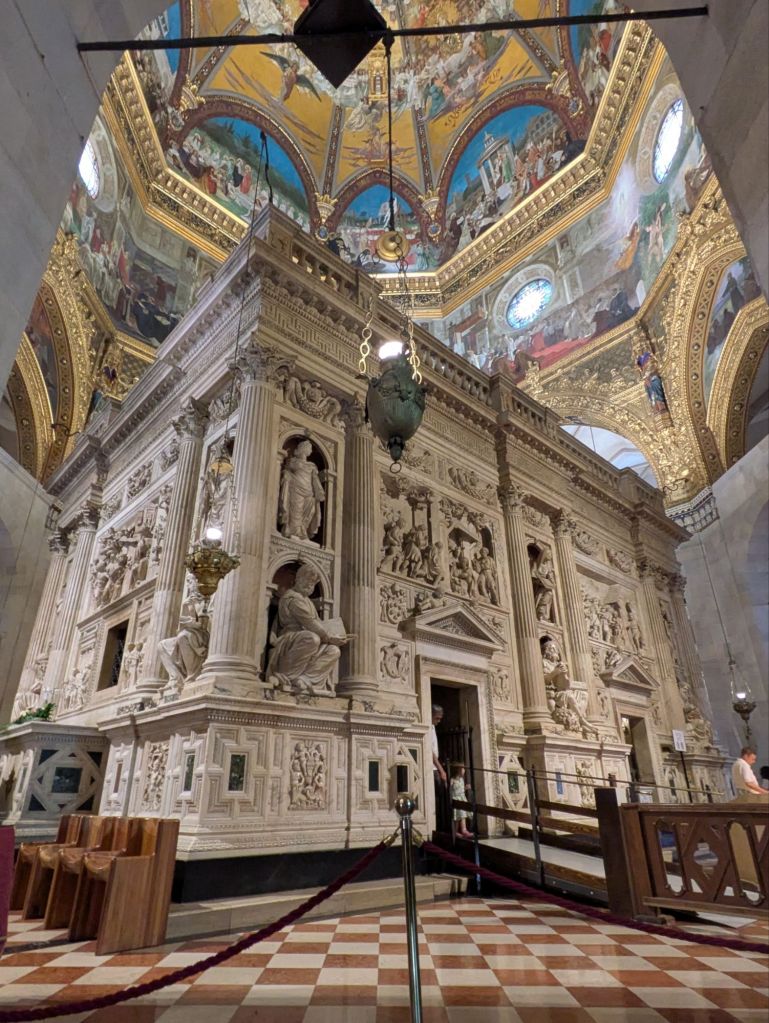
Dentro de la basílica, en el crucero, se encuentra una estructura o revestimiento de mármol, diseñado por Bramante y terminado en 1538, que protege la Santa Casa.

Revestimiento de mármol

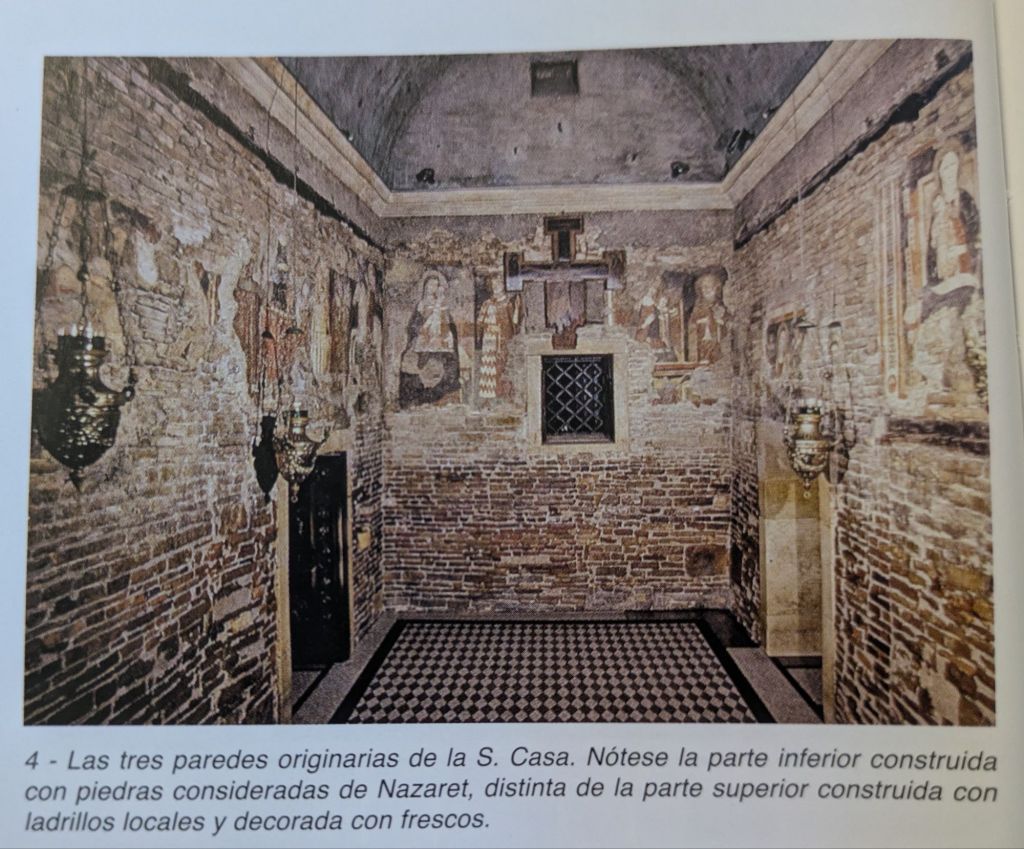
Dentro del revestimiento se accede a la Santa Casa, los muros trasladados desde Nazaret, que constituían la casa donde nació María, donde pasó su infancia, donde recibió la Anunciación por parte del ángel Gabriel y donde vivió la Sagrada Familia.

La tradición lauretana cuenta que en 1291, en época de las cruzadas, y temiendo por la integridad de la casa en Nazaret (donde sobre la cual se habían erigido templos a lo largo de los siglos), los tres muros de la casa fueron trasladados primero a Dalmacia y luego a diferentes emplazamientos en Italia, hasta llegar el 10 de diciembre de 1294 a Loreto.

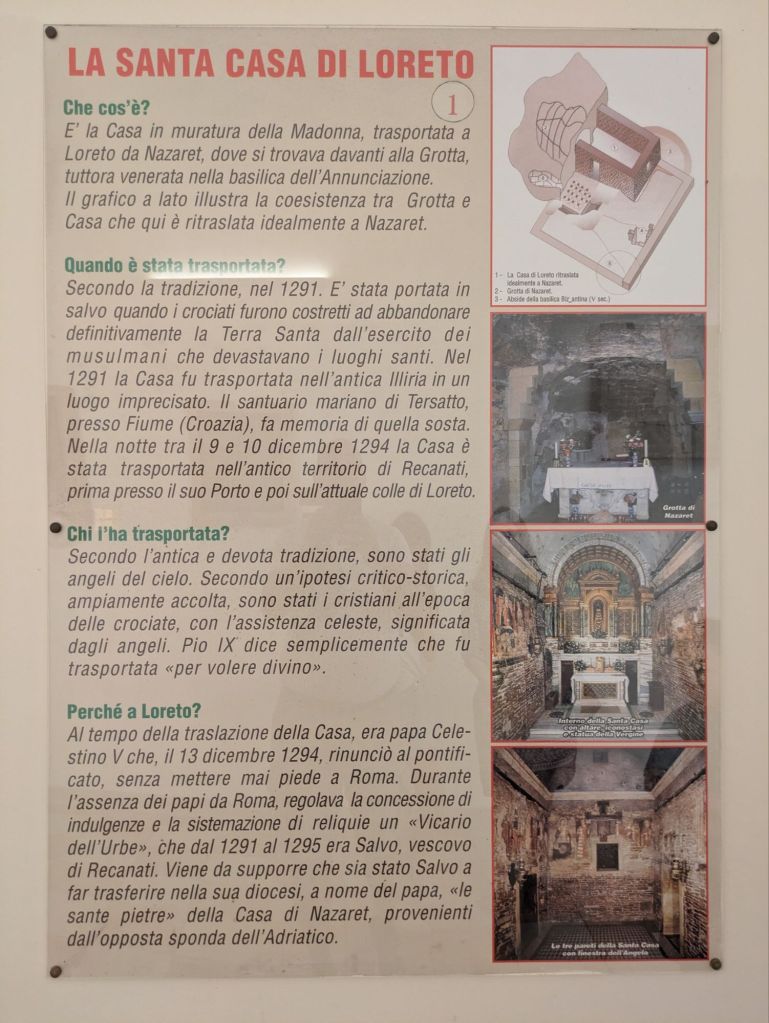
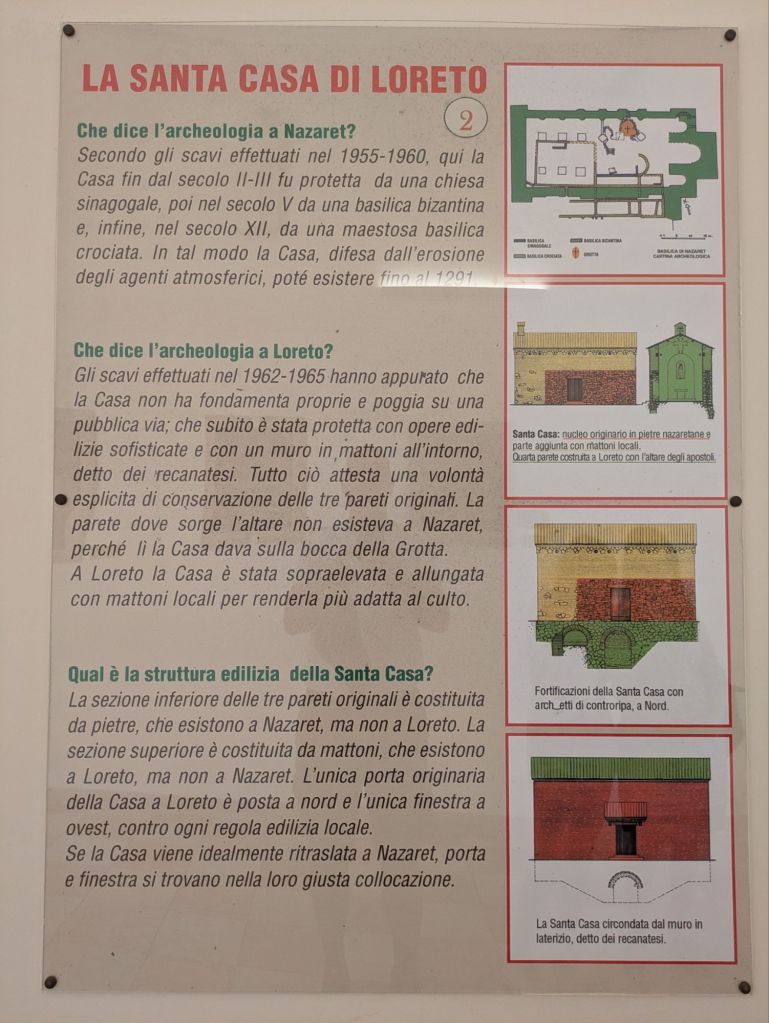
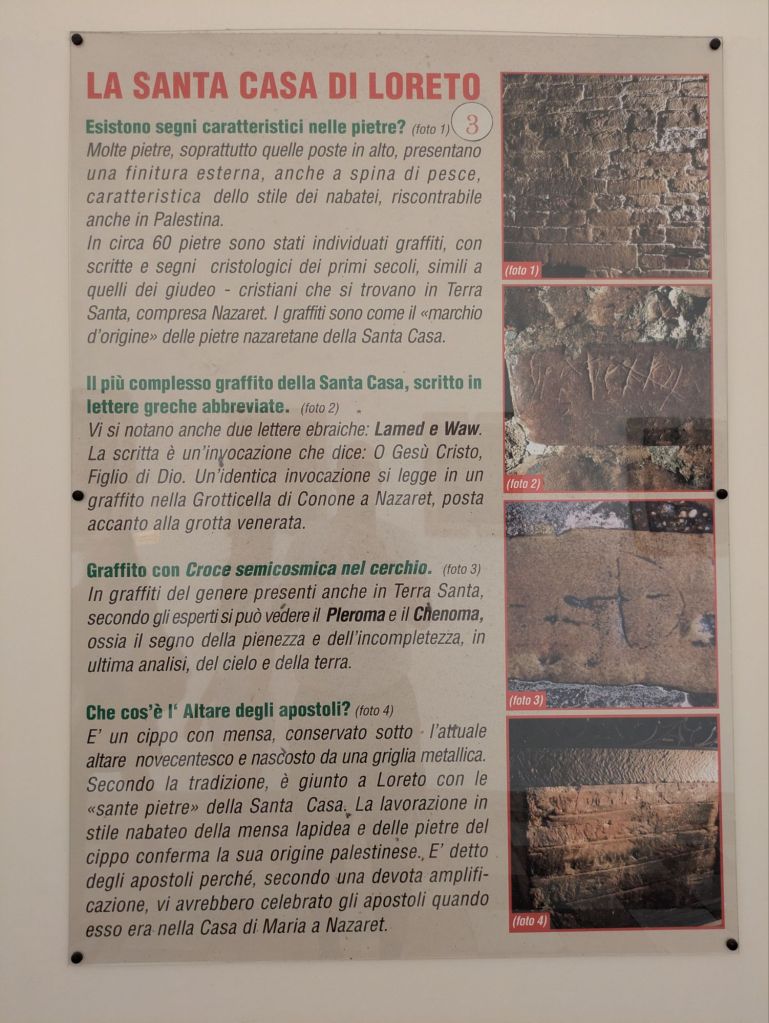
En la basílica hay una serie de paneles con explicaciones, de los cuales dejo tres aquí debajo (en italiano).

En el primer panel se muestra cómo los tres muros junto con un gruta en la roca formaban la casa de la Virgen en Nazaret. También se hace referencia a cómo dice la tradición que fue transportada: con asistencia de ángeles (otras fuentes hablan de la familia bizantina Angeli del siglo XIII que pudo estar detrás del traslado), y por qué en Loreto, localidad cercana a Recanati, de donde era obispo el Vicario del Papa, Salvo.

En el segundo panel se muestra cómo eran las basílicas que en Nazaret se erigieron sobre la Santa Casa.

También se muestra la estructura que se ha construido en Loreto para completar la Casa a partir de los tres muros trasladados desde Nazaret.

La comparación de los ladrillos en Loreto, que no son locales, con excavaciones arqueológicas en Nazaret donde se encontraron materiales y formas de construir similares son algunos de los elementos a favor de la tradición lauretana.

El tercer panel muestra imágenes de las inscripciones que se pueden ver dentro de la Casa (no se permite fotografiar dentro), en letras griegas y hebreas, como “Jesu Cristo, Hijo de Dios”, o símbolos judeocristianos como el Pleroma y Kenoma, de plenitud e imperfección, del cielo y de la tierra.

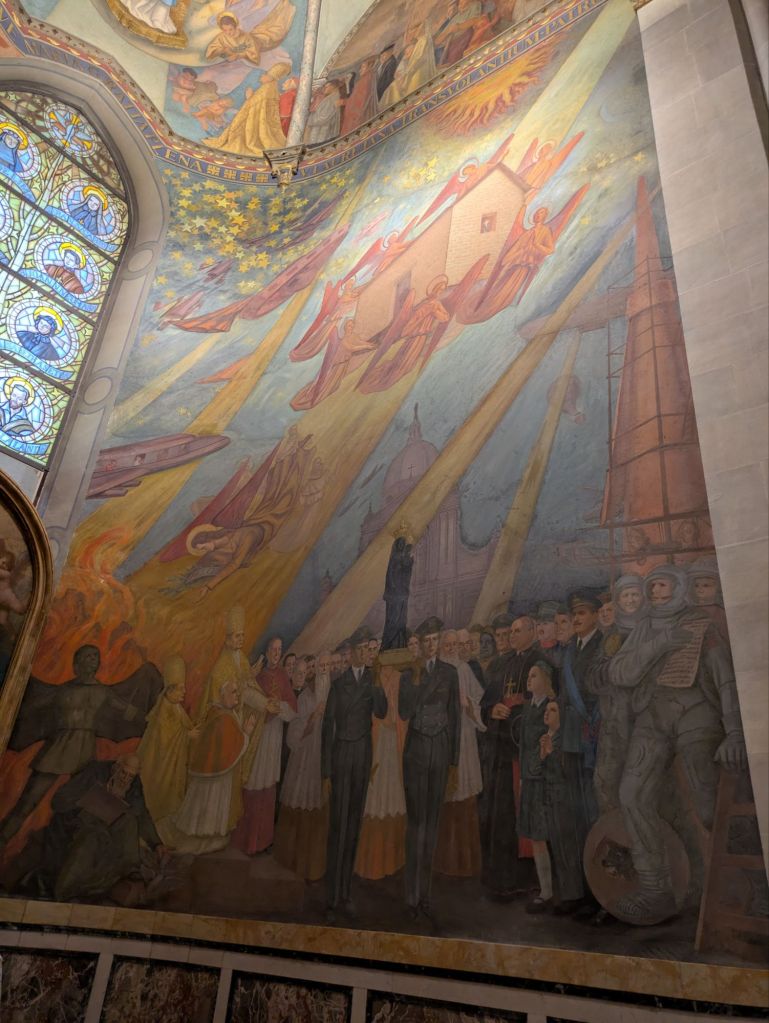
La basílica cuenta, entre otras, con una capilla “americana” o capilla de la Asunción. Está decorada con pinturas de Beppe Steffanina sobre la Asunción y sobre la “Glorificación de la Virgen Lauretana, Patrona Universal de la Aviación” (ver debajo).

En esta obra se puede ver la Santa Casa llevada en volandas por varios ángeles en presencia de varias figuras contemporáneas e históricas:

  • Benedicto XV (con el decreto de 1920 en la mano que declaró a la Virgen de Loreto como Patrona), Pío XI y Juan XXIII que la coronaron respectivamente en 1922 y 1962,
  • el mito de Ícaro y Leonardo da Vinci (abajo a la izquierda),
  • los astronautas Gagarin (CCCP en el casco) y Armstrong (papel con las palabras questo piccolo passo),
  • un tercer astronauta (a la izquierda de Armstrong) que he visto referido como McDevitt y como Aldrin, pero creo que es Frank Borman, comandante del Apollo 8, misión que orbitó por primera vez alrededor de la Luna en Nochebuena de 1968, y que siendo televisados en directo leyeron versos del libro del Génesis. En esa misión llevaban un medallón de la Virgen de Loreto, que es lo que parece que lleva el astronauta en el brazo,
  • Kennedy (a la izquierda de Borman), quien puso como objetivo llegar a la Luna,
  • la perra Laika (a los pies de Armstrong),
  • Orville Wright a bordo de su Wright Flyer,
  • un avión cuatrimotor (¿un DC-8?), varias naves espaciales indeterminadas, un globo, un dirigible…

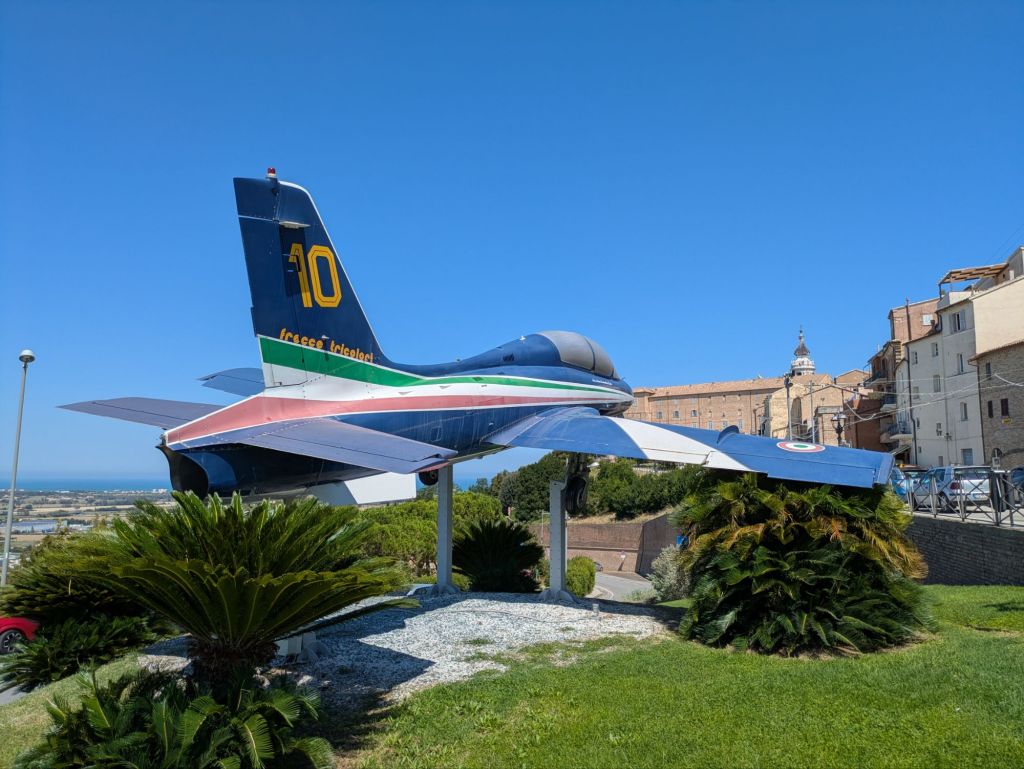
Finalmente, siendo la Patrona de la Aviación, fuera de la basílica, hay un Aermacchi MB-339 de los que usa la patrulla italiana Frecce Tricolori.

1 Comment

Filed under Travelling

Marathon world record evolution (2025)

Last time I checked all-time men’s best marathon times and the world record evolution was in 2014 ahead of running Rotterdam marathon (post back then). In this blog post I’m going to make an update, share some charts and review some statistics. For that purpose, I use the website “Track and Field all-time Performances” (maintained since years ago by Peter Larsson).

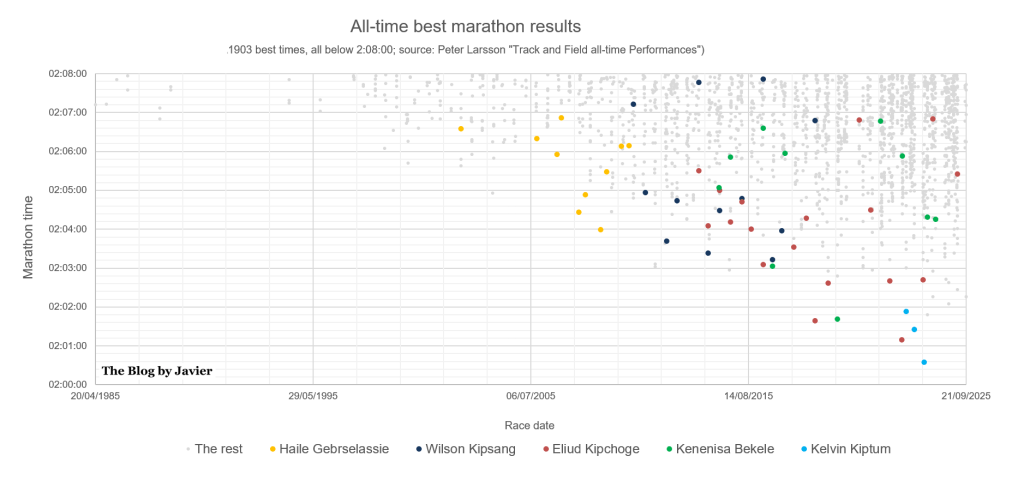
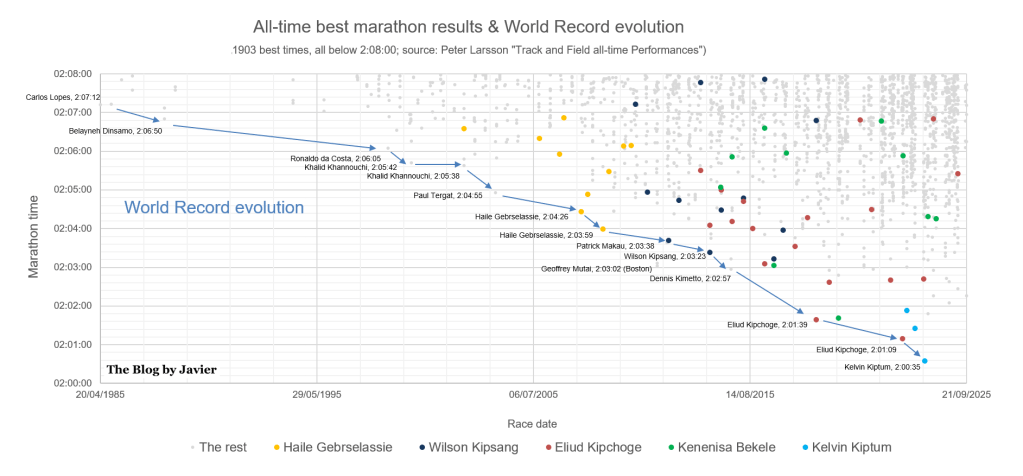
With the data of all-time best men’s marathon I plotted the chart below with the best 1,903 times, i.e., all those below 2h08′ and their dates, highlighting marathon times by Haile Gebrselassie, Wilson Kipsang, Eliud Kipchoge, Kenenisa Bekele and Kelvin Kiptum.

Some stats in relation to those 1,903 times under 2h08′:

  • Countries of which athletes achieved most such times: Kenya 853 times or 44.8%, Ethiopia 570 times or 30.0%, Japan 114 (6.0%), Morocco 44 (2.3%), Eritrea 41 (2.2%), Israel 20 (1.1%), France 20 (1.1%), Uganda 19 (1.0%). Those are the top 9 countries, there are another 34 from which athletes have run below 2h08′ (for a total of 43 countries).
  • There are 742 athletes that have run below 2h08′. The individuals who have done so more often: Eliud Kipchoge 18 times, Sisay Lemma 17, Tsegay Kebede 15, Tamirat Tola 13, Abel Kirui 13, Wilson Kipsang 12, Bernard Kiprop 12, Evans Chebet 12, Benson Kipruto 12, Laban Korir 11, Emmanuel Mutai 11, Amos Kipruto 11, Birhanu Legese 11, Kenenisa Bekele 10, Haile Gebrselassie 10, Leul Gebrselassie 10, Deso Gelmisa 10…

Now, if we raise the bar to see the times at or below 2h05′, we find 231 times:

  • Countries of which athletes achieved most such times: Kenya 108 times or 46.8%, Ethiopia 98 times or 42.4% (both combined 89.2%!), Tanzania 4 (1.7%), Belgium 4 (1.7%), Netherlands 3 (1.3%). Those are the top 5 countries, there are another 11 from which athletes have run at or below 2h05′ (for a total of 16 countries).
  • There are 124 athletes that have run at or below 2h05′. The individuals who have done so more often: Eliud Kipchoge 14 times, Tamirat Tola 8, Wilson Kipsang 8, Sisay Lemma 7, Amos Kipruto 6, Birhanu Legese 6, Leul Gebrselassie 5, three athletes with 4 times including Kenenisa Bekele, 14 athletes with 3 times including Kelvin Kiptum, Dennis Kimetto, Geoffrey Mutai and Haile Gebrselassie, 23 athletes with 2 times including Patrick Makau…
  • Which are the fastest marathons? The cities where most of those 231 times at or below 2h05′ have been achieved are: Berlin and Valencia with 35 each, London and Dubai with 27 each, Rotterdam 18, Amsterdam and Chicago with 15 each, Tokyo 14. Those are the top 8 cities (accounting for 81% of those 231 times), there are other 16 cities where such fast times have been achieved.

Now let’s look at the evolution of the World Record since 1985 in this other chart:

Some comments to the chart:

  • In the last 40 years, the record has been beaten 13 times.
  • The current world record was set by Kelvin Kiptum in Chicago in 2023 with 2h00’35” at the age of 23.9. He sadly passed away in a car crash a few months later. His career was very promising, having run only 3 marathons, all three in less than 12 months, all 3 below 2h02′. 3 of the best 7 times, 1 of the only 4 men having run below that mark.
  • The record that lasted the most was Dinsamo’s 2:06:50 in 1988, which took just over 10 years to be beaten by Ronaldo da Costa in 1998.
  • 3 athletes have set the world record twice: Khalid Khannouchi, Haile Gebrselassie and Eliud Kipchoge.
  • The biggest improvement of the record was made by Eliud Kipchoge who took 1’18” off Dennis Kimetto’s previous record.
  • Geoffrey Mutai ran in 2h03’02” before 3 world records set the bar below his time, however, as he achieved that in Boston 2011 (downhill and point to point race) it didn’t count for the record.

What is the best age to run marathons?

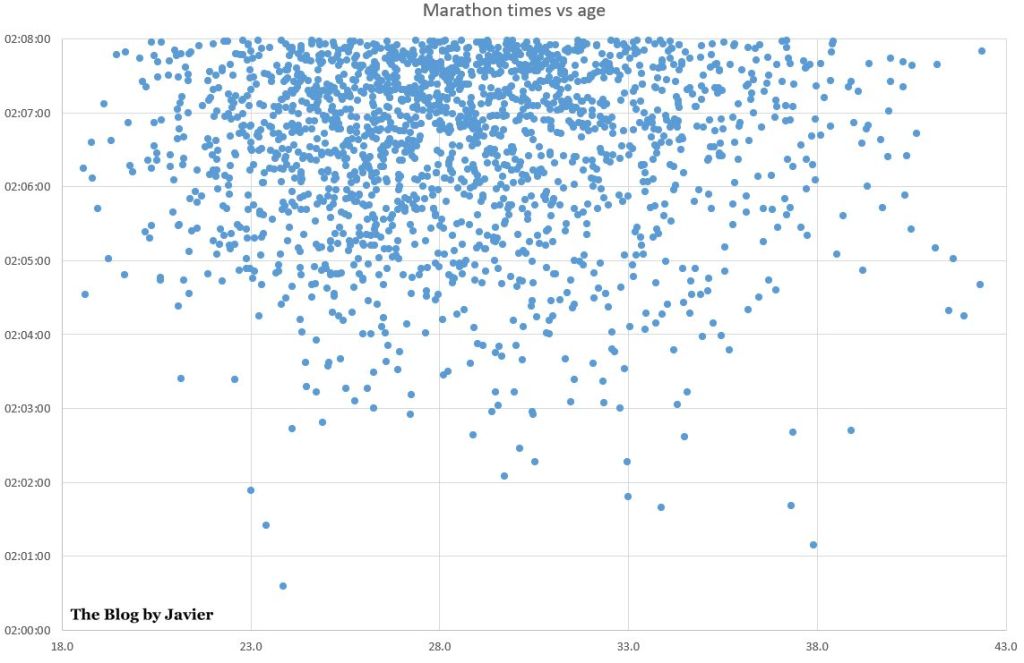
I plotted this other chart looking at the best 1,903 marathon times vs the age the runners had at the time of completing each of those races.

Most of the times below 2h08′ are achieved between 23 and 33 years old, but indeed most of the best ones are achieved between 28 and 39 years old, with the exception of the 3 marathons ran by Kelvin Kiptum, including his current world record.

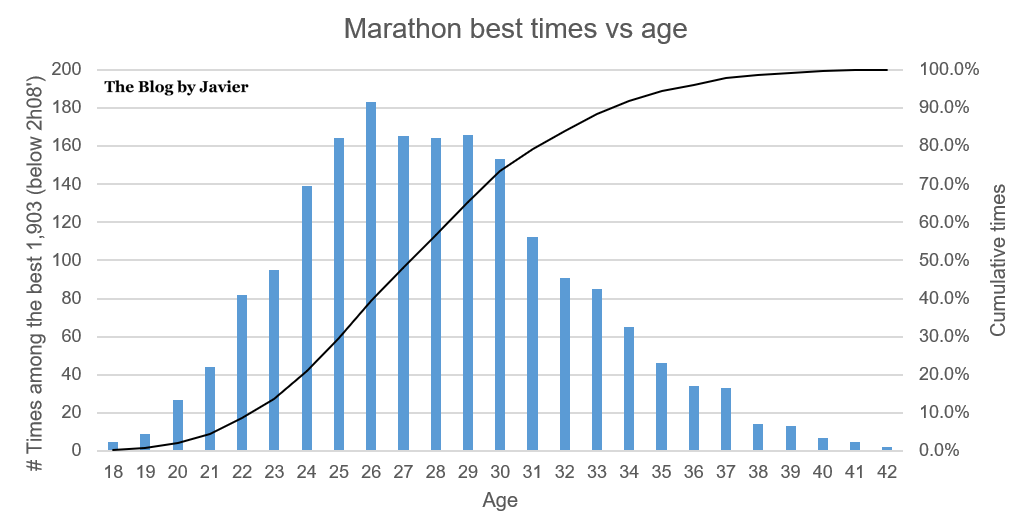
Another interesting chart to relate best times and age is the histogram below. In that one we can see that effectively most of the times below 2h08′ are achieved between 24 and 30 years old, and between 23 and 33 (both included) 80% of those times are achieved.

Leave a comment

Filed under Sports

All-time men’s best pole vault – Tokyo 2025 World Athletics Championships – Armand Duplantis

Last summer, after the Olympic Games Paris 2024 I wrote a post to review the best pole vault jumps after the world record set in that competition by Armand Duplantis with 6.25m. That post aged very quickly as just 3 weeks later Duplantis set another World record.

In this 2025 he had set another 3 records before going to the World Championship in Tokyo, where again he sat a new World record with 6.30m. This is a good time to update last year’s chart and recap the best ever performances.

For that purpose I used the website “Track and Field all-time Performances” (maintained since years ago by Peter Larsson).

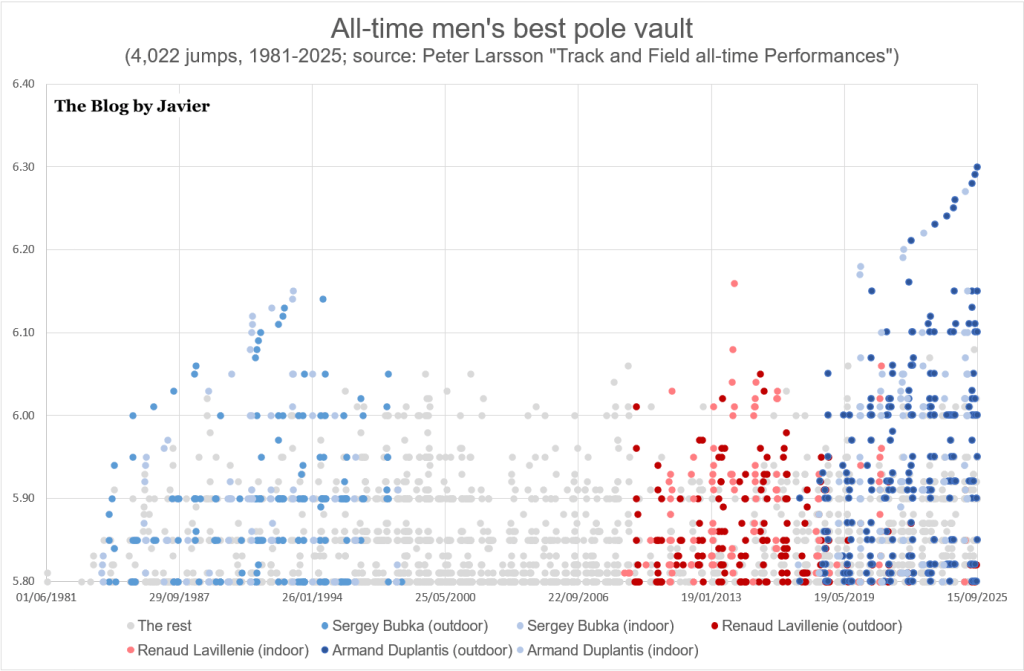
With the data of all-time men’s best pole vault I plotted the chart below with the best 4,022 jumps (jumps from 5.80m and above) and their dates, highlighting the jumps by Sergey Bubka, Renaud Lavillenie and Duplantis (dark colour for outdoor vaulting, light colour for indoor).

Bubka dominated the sport in the 1980’s and 90’s (first competing for the Soviet Union and later for Ukraine) when he set up to 35 world records (17 outdoor and 18 indoor), won 6 gold medals at the World Championships and 1 at the Olympic Games. Lavillenie also won a gold medal at the Olympics in London and won several World Indoor Championships (among other medals) and set an indoor world record (which was the absolute record for 6 years). Duplantis, competing for Sweden, at the young age of 25 has already won 2 gold medals at the Olympics (Tokyo and Paris) and 3 World Championships outdoors (among other medals) and has already set 14 world records (10 outdoors and 4 indoors).

Some comments after looking at the chart:

  • Bubka holds 249 of the 4,022 jumps (6.2%) at 5.80m and above
  • Lavillenie holds 271 of the 4,022 jumps (6.7%) at 5.80m and above
  • Duplantis holds 323 of the 4,022 jumps (8.0%) at 5.80m and above… he’s already the athlete with the highest proportion in that segment
  • Of those jumps of 6.00m and above (274 jumps… 52 such jumps in just the last year):
    • Bubka holds 46 of the 274 jumps (16.8%) at 6.00m and above
    • Lavillenie holds 21 of the 274 jumps (7.7%) at 6.00m and above
    • Duplantis holds 122 of the 274 jumps (44.5%) at 6.00m and above
  • If we focus at outdoor jumps of 6.00m and above (170 jumps):
    • Bubka holds 28 of the 170 jumps (16.5%) at 6.00m and above
    • Lavillenie holds 4 of the 170 jumps (2.4%) at 6.00m and above
    • Duplantis holds 82 of the 170 jumps (48.2%) at 6.00m and above
    • 25 men have vaulted outdoors at 6.00m or above, only Bubka and Duplantis jumped 6.09m or above: 6 and 28 times, respectively. Duplantis has performed 13 such jumps since the Olympics last year.
  • Until Duplantis came to the scene when the World record was at 6.16m held by Lavillenie, established indoors in 2014 (Donetsk). Since 2020 Duplantis has jumped above that world record 14 times.

Bubka achieved his best jumps when he was between 27 and 30 years old. Duplantis at his 25 years has already more than twice as many high jumps as Bubka in his entire career. If Duplantis continues his progression up to 27-30 years of age we can only imagine what I’d to come, something that might have been deemed unbelievable for those of us who witnessed Bubka in his prime, but we are now going through the same dominance yet with higher heights and more pronounced (Emmanouil Karális, silver at the World Championships in Tokyo, achieved 6.00m… 30cm less than Duplantis!).

Leave a comment

Filed under Sports

Flight excursion around the Lot and Dordogne

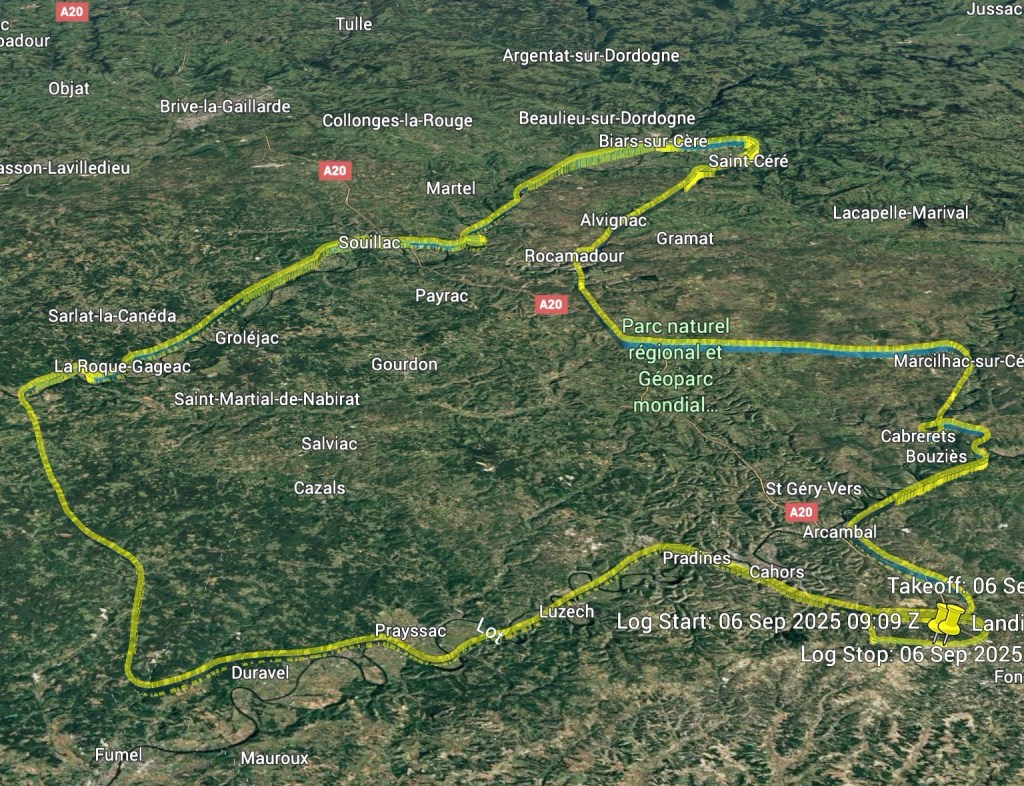
Yesterday, together with my family, we participated in a fly out excursion organized by Jean Claude and his aeroclub du Quercy for members of our Aviation Society. We came with different aircraft to meet at Cahors (LFCC) and from there, Jean Claude had prepared a closed loop circuit around the valleys of the rivers Lot and Dordogne, with several points to spot and some quizzes around the area.

Summary of the excursion

As our aeroclub is based in Toulouse Lasbordes (LFCL) we first had to fly to Cahors, a 40 minute flight.

Once at Cahors, we met different members of the local aeroclub and received a last briefing and some advice around the flight. The circuit was divided in 5 sectors.

Sector 1: in this sector we had to spot castles along the Lot, including the Château de Mercués (which belonged to Georges Héreil, former manager at Sud Aviation and father of the Caravelle), the Château de Caïx (acquired by Queen Marguerite II of Denmark, as her  husband, prince Henrik, came from the region), Puy l’évêque and the Château de Bonaguil.

Sector 1
Château de Mercués
Château de Caïx

Sector 2: it consisted of flying North to reach the Dordogne, by way of Villefranche du Périgord.

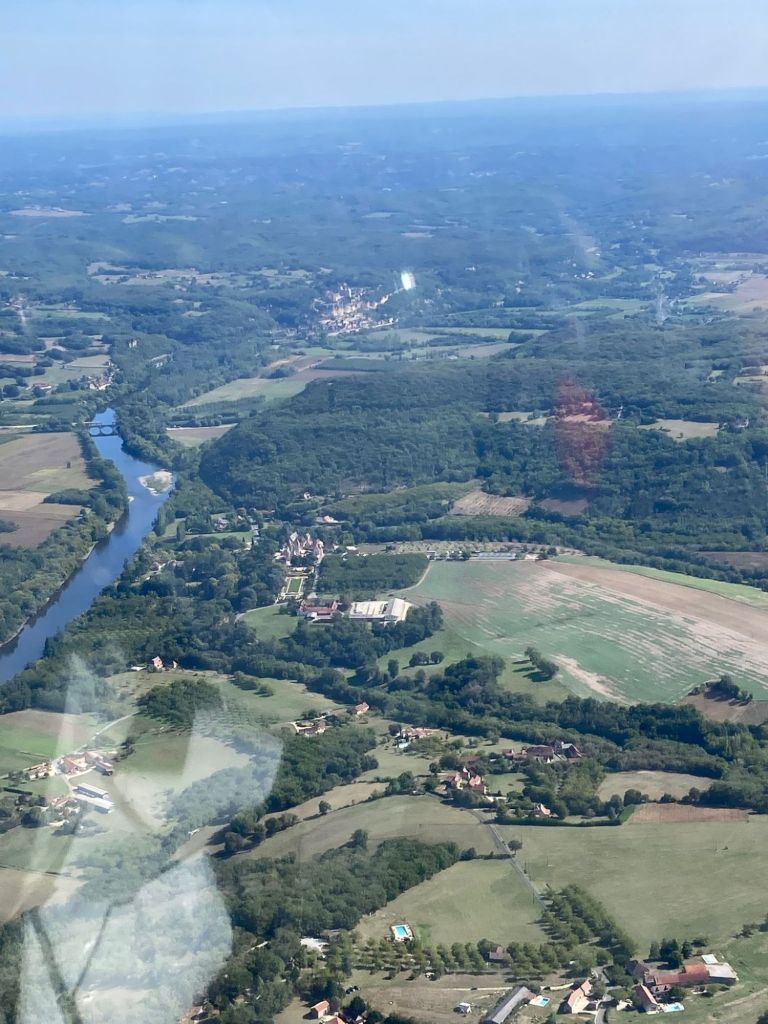
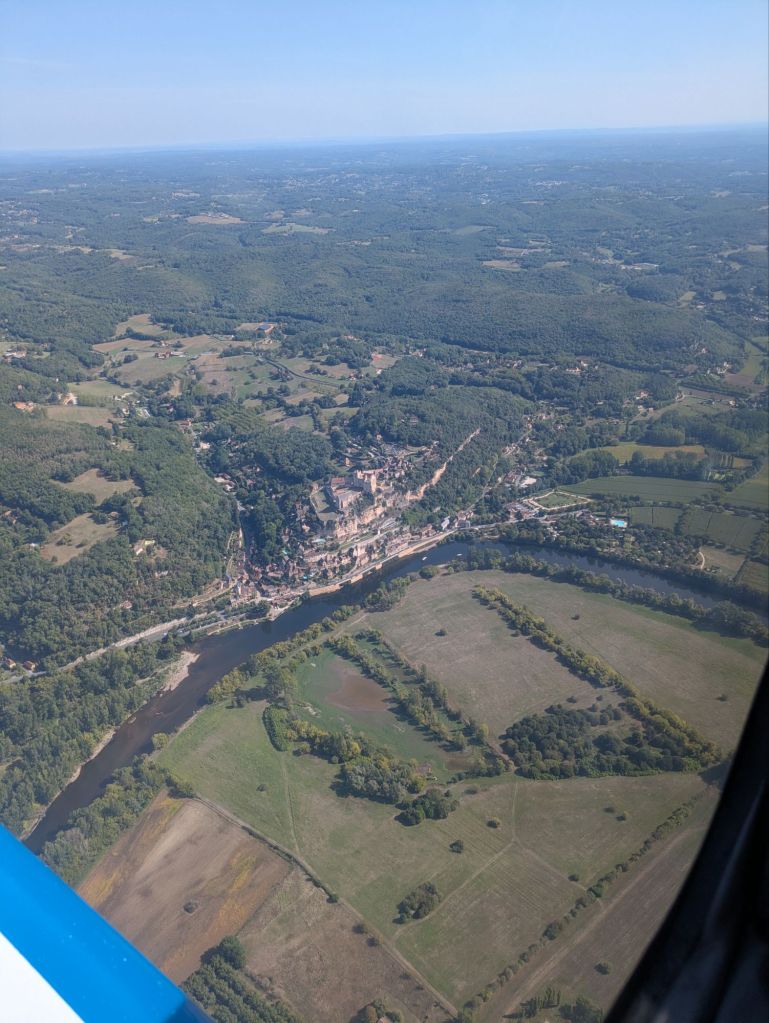
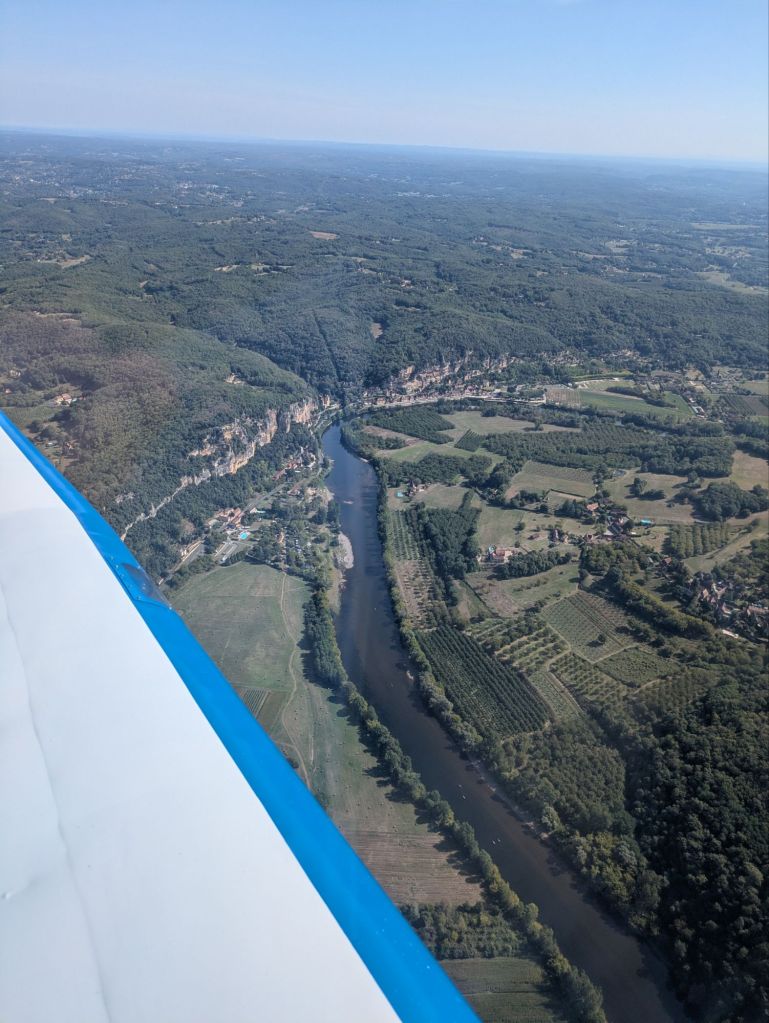
Sector 3: in this sector we had to spot castles along the Dordogne, including the Château des Milandes (which belonged to the American French singer, activist, resistance agent Joséphine Baker – whose remains rest at the Pantheon), Beynac-et-Cazenac, La Roque, Domme, Souillac.

Sector 3
Château des Milandes
Beynac-et-Cazenac
La Roque

Sector 4: in this sector we had to continue spotting castles along the Dordogne, including Château de la Treyne, Château de Belcastel and Château de Castelnau Bretenoux, we then turner South to fly over Saint Céré (home of the tapestry  artist Jean Lurçat), then West towards the fall of Autoire (seemed dry from the air), Rocamadour and Labastide Murat (origin of the Marshal Joachim Murat).

Sector 4
Château de la Treyne
Rocamadour

Sector 5: in this sector we went back to the valley of the Lot, by way of Marcilhac sur Célé, Cabrerets (where the Pech Merle cave is located, with its prehistoric cave paintings) and reaching Saint-Cirq-Lapopie. We then flew back to Cahors (birthplace of Leon Gambetta).

Sector 5
Saint-Cirq-Lapopie

When we completed the circuit, we landed again at Cahors and shared a delicious lunch with the participants and members of the local aeroclub (very welcoming). They showed us as well the flight simulator they have developed in house to help with the training of new pilots.

Flight simulator at Cahors aeroclub du Quercy

Once, finished we bid our farewell and flew back to Toulouse.

1 Comment

Filed under Aerospace & Defence

Summary of (my) 2024

Time to look back and reflect on how the year which is about to end developed. Brief recap of my 2024. (*).

The main experience that we enjoyed together in this 2024 was the road trip we did to Namibia during the summer holidays. We spent over two weeks driving up and down the country along solitary and unpaved roads, through deserts, mountains, canyons, along the coast… We did a bit of camping and enjoyed great hotels and resorts. We did some boat excursions and various game watching safaris at different parks. An unforgettable trip.

Namibia

Family. Andrea is now 11 years old and David, 8. Andrea just started secondary and is proving to be a responsible and good student. She loves drawing, researching for her school homework and clothes. She now has her own smartphone and starting playing volleyball in the village team. She is in her 3rd year of Spanish lessons, which now she also studies in the school. This year she is volunteering to take part in the school play at the end of the year. David continues to enjoy building Lego sets, playing video games but most of all he loves football, which he is now playing with the village team. He is also a very good student in his grade 3, where he enjoys Math and French. He is very helpful at home and he is now in his second year of Spanish lessons. They’re both taking piano lessons and this 2024 they have spent several weeks alone with parents in Madrid during school holidays, which they loved.

Running: After an end of 2023 marked by injuries, I just wanted to get again into the running habit and completing another marathon, which I did! In all, I run just 1,250km in 2024, more than in 2023 but less than I would have liked. I still had some injuries now and then but I could cope with them and I ran the marathon of Malaga in December, my 24th marathon.

Following a mantra I try keep to the letter (when in good health), “the running shoes, always in the suitcase”, the year 2024 caught me running in: Torrelodones, Miranda de Ebro, Brunei, Doha, Galapagar, Athens, London, Namibia (Sossusvlei, Swakopmund, Damaraland, Ethosa), Helsinki, Madrid, Málaga, the Netherlands (Wijchen), San Sebastián, plus the tens of times I trained in my village, in Blagnac and Toulouse.

Running around

Skiing. In 2024 we went again with the family for a week to our favourite resort at Vars, in the Southern Alps. This year again we could enjoy much time skiing with the kids out of their skiing lessons. They are more daring and at ease especially skiing off tracks, and sometimes it’s difficult to keep pace with them. This year Andrea got her 2ème étoile medal and David his 1ère one (levels from the French ESF).

Skiing in Vars (Alps)

Flying. This year I did not manage to fly as much as I wanted. I kept up with the recency requirements doing some training flights and some others with the kids. This year I also flew for the first time with Rodrigo and Harriet-Eve. I am sure that in 2025 I will have the chance to fly with more colleagues.

In all, this year I have flown just 5 flight hours, 7 flights and 15 landings. This takes my total experience to 215 flight hours and 339 landings since I started taking lessons back in 2011. In 2025 I will need to renew the SEP (single-engine piston) qualification, that will certainly require more flying in the coming months, hopefully with some excursions abroad.

Flying with friends and family

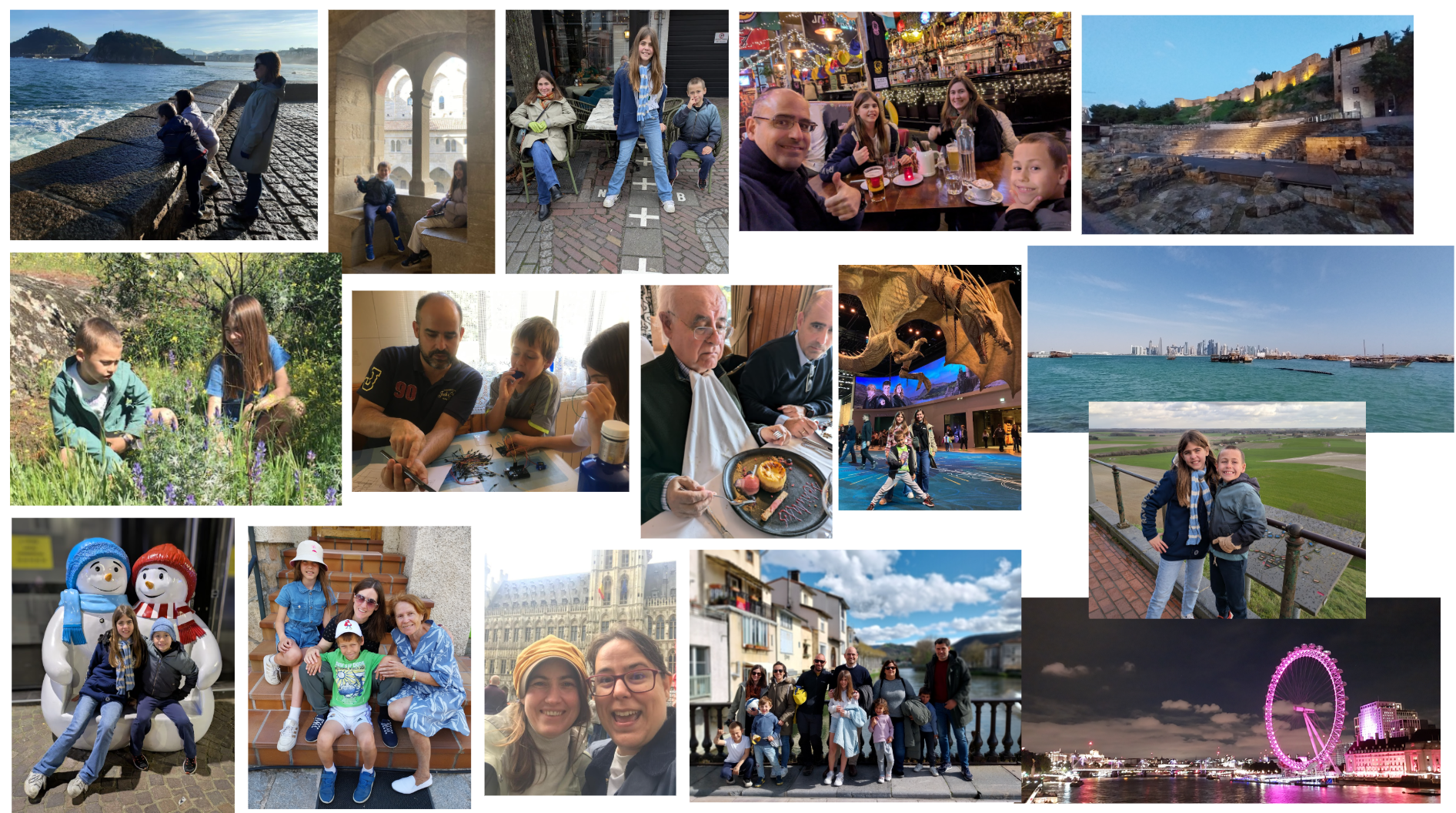
Travelling. Apart from the unforgettable trip to Namibia, in this 2024 either alone or with the family we continued to visit some new and old places: Brunei, Aix-en-Provence, Vars, Avignon, Doha, Paris (including another visit to the Parc Asterix which the kids loved), Madrid, Vic-Fezensac, Helsinki, London (including a great trip with the family to visit Harry Potter’s studios), San Sebastian, Málaga, Wijchen, Rijswijk, The Hague, Waterloo, Reims, Saint-Quentin, Poitiers, Bordeaux…

Traveling

Reading. In this 2024 I didn’t read as much as I would have liked to, but I managed to read 10 books with a good mix between reading in English, French and Spanish. I’m also happy for having read other 4 books of the Great Books curriculum for the bachelor in arts of Saint John’s College, I list I have been using as a reference for years. For the detailed list of books, see the post I wrote about my 2024 reading list with a brief description of each one.

Other cultural activities:

Bullfighting. This year again, together with Luismi, we went to Vic-Fezensac to attend its corrida concurso (same wording in French) with very strong bulls from different breedings. This year it was especially tough for the bullfighters as it was raining all the morning. Despite that, we saw a good show, with Sánchez Vara (that we had seen in previous occasions) and the Colombian Juan de Castilla who was awarded an ear, and left quickly after the 5th bull as he would be fighting in another corrida in the afternoon at Las Ventas (Madrid). I also renewed my membership to the foundation Toro de Lidia just a few days ago to keep supporting the art.

Bullfighting at Vic-Fezensac

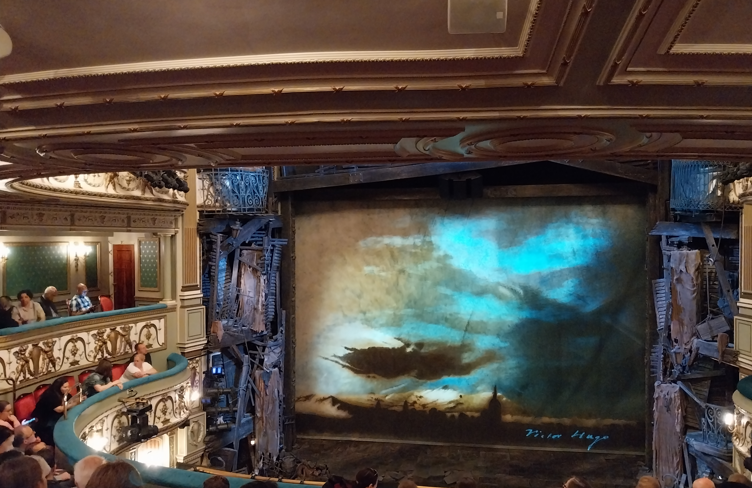
Theatre. We started the year with two musicals in Madrid: School of Rock (thanks to a wonderful invitation from my sister Beatriz!) and Fabiolo connection (which was hilarious). Luca and the kids then attended Aladdin by the Secret Pantomime Society in Pibrac. At the end of the school year we also attended the great show put up by the kids of the school with Shrek. I took the opportunity of a trip to London to attend Les Misérables (a great recommendation from by brother Jaime, and something I had been wanting to do since I read the book years ago).

Les Misérables in London

Cinema. After years of nearly not having gone to the cinema (small kids!) this year we have started to go more often, with or without the kids (5 or 6 times from memory?). My favorite movie this year was The Count of Monte-Cristo.

Museums. This year again we took benefit of every trip to visit as many museums and castles as we could, among them: Fondation (Victor) Vasarely (Aix-en-Provence), Palais des Papes and Pont d’Avignon, Kolmanskop ghost town (Namibia), Finish Aviation museum (Helsinki), Tower Bridge, British Museum, Tate Modern, Harry Potter Warner Bros studio London, Westminster Abbey, Casa natal Pablo Picasso, Museo Picasso, Roman theatre in Málaga, Alcazaba Palace and Castillo de Gibralfaro in Málaga, Centre Pompidou Málaga, Waterloo battlefield museum 1815, Kröller-Müller museum (NL), Escher in the Palace (The Hague).

Blogging. This is the 15th year since I started the blog in 2010. This year I wrote just 7 blog posts, in line with the past years since 2020. The blog received just over 20,700 visits, a bit more than in 2023 (in line with the past few years) and over 512,000 views since 2010.

Work. No changes in the scope of the work this year (A330neo product marketing since January 2023) but we have had quite a few changes higher up in the organization and more closely we bid our farewell to Anna and welcomed Andoni.

Since 2023 the markets have been very active. If in 2023 we at Airbus broke a new record of aircraft orders, this 2024 has also been very active and positive, with many sales and campaigns.

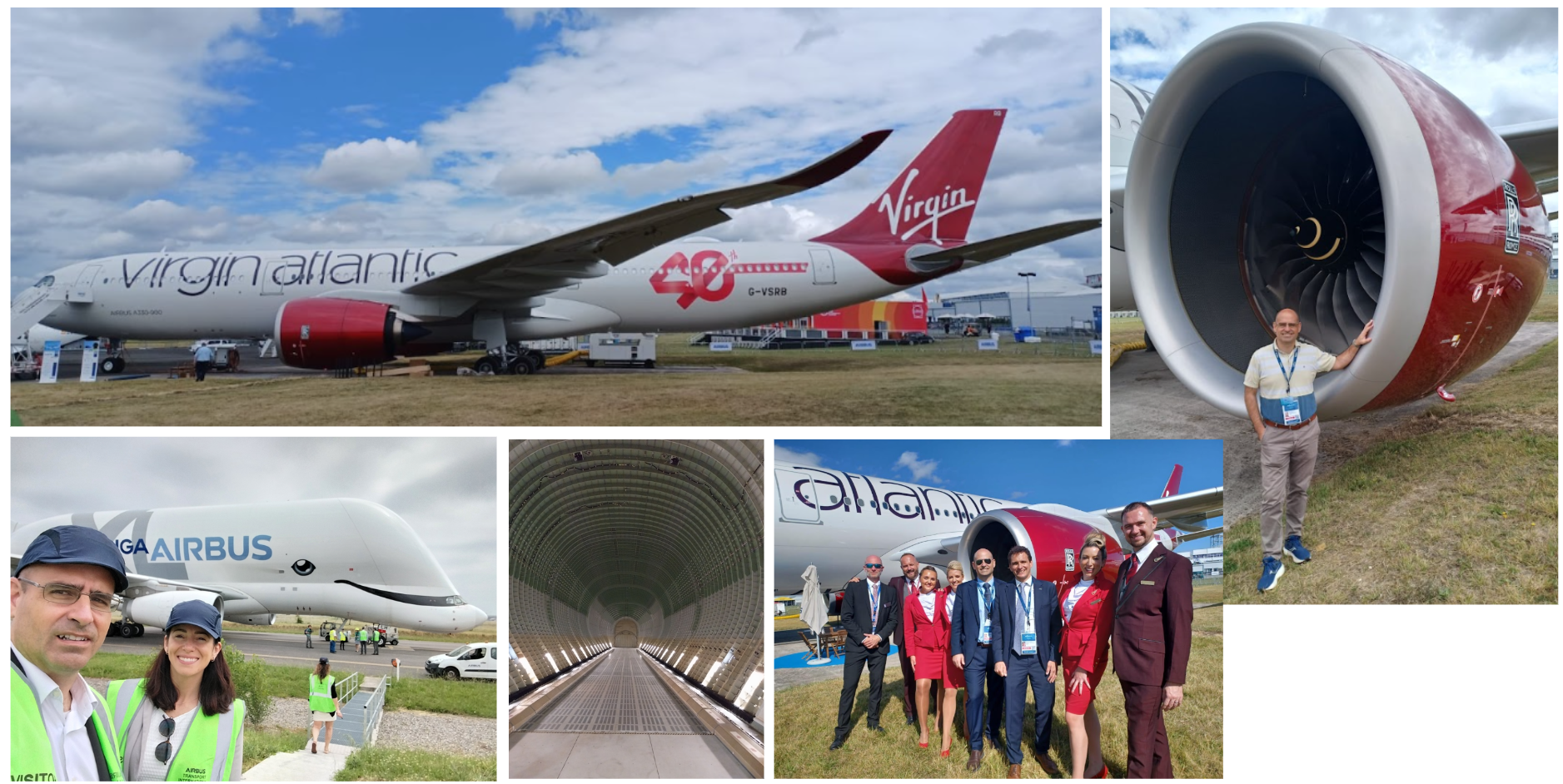
This year I had the opportunity to attend the Farnborough airshow, where I could showcase a Virgin Atlantic A330neo together with colleagues from Airbus and Rolls-Royce and the airline crews, at times showing the aircraft non-stop for hours to many different and varied groups of customers or institutional representatives.

Working in aviation means fun!

This year, on July 3rd I flew for the first time onboard an A330neo, with our flight test aircraft MSN 1795.

My first flight onboard the A330neo with Jose

In September came another highlight of the year with the organization of the Airbus Family Day, when we spent a whole day touring Airbus facilities in Toulouse with the kids.

2024 Family Day at Airbus in Toulouse

Not everything was positive in 2024: the father in law of one of my best friends passed away as did the father of my boss. The Russian invasion of Ukraine continues to create havoc in many families, in autumn we received a short visit from Lena and her family. Hopefully in 2025 that war comes to an end.

On the positive side, some family and friends had new babies and got married in this 2024!

Now it’s time to rest, celebrate with the family and hope for the best in 2025. For the moment we have just a few days in Madrid to enjoy with family and friends and a planned skiing week in Vars; hopefully that will be just the beginning of another memorable year.

I wish you the best for 2025, enjoy it!


(*) You can see here my 2010, 2011, 2012, 2013, 2014, 2015, 2016, 2017, 2018, 2019, 2020, 2021, 2022 and 2023 recaps.

1 Comment

Filed under Personal development, Travelling